
Finally a change of heart at the top
The release of International Assessment of Agricultural Science and Technology for Development (IAASTD) on 15 April 2008 took the world by surprise in more ways than one.
There has been remarkably little publicity for an exercise in which 400 scientists took 4 years to produce this 2 500-page report. It is a thorough appraisal of global agriculture, on a scale comparable to the Intergovernment Panel on Climate Change (IPCC). All the more startling and significant are its conclusions.
The IAASTD calls for a fundamental change in farming practice to counteract soaring food prices, hunger, social inequities and environmental disasters. It says genetically modified (GM) crops are highly controversial and will not play a substantial role in addressing climate change, loss of biodiversity, hunger and poverty. Instead, small-scale organic farms are the way forward; with indigenous and local knowledge playing as important a role as formal science. And the rush to grow crops for biofuels could exacerbate food shortages and price rises.
The director of IAASTD, Prof. Robert Watson, has been pressing home these messages in the mainstream media. Watson brought a great deal of experience to this role. He is chief scientist at the World Bank and independently, at the UK Department for the Environment, Food and Rural Affairs (DEFRA). He chaired the IPCC from 1997 until he was voted out of the chair in 2002, apparently because the US government hoped that his successor would not be as strong an advocate of a change in global energy policies.
The initiative for IAASTD came from the World Bank in partnership with international organisations that included the United Nations Food and Agriculture Organisation, United Nations Environment Programme, United Nations Development Programme, the World Health Organisation, and representatives of governments, civil society, private sector and scientific institutions worldwide.
In short, the IAASTD was a major undertaking by mainstream institutions, not known for radical ideas that would change the world. Even more remarkable, 60 countries have already signed up to the report; and while the UK Government is not among them, Watson indicated that it has the full support of the Prime Minister.
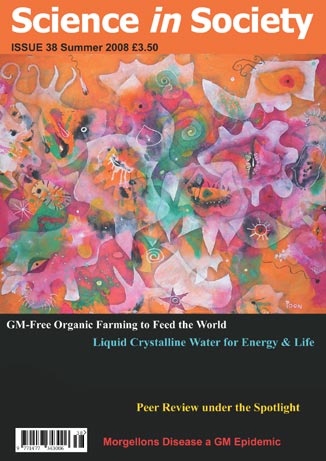
Regular readers will recognize the conclusions of the IAASTD in the pages of Science in Society, and will have been just as elated as we are because of that. (We are also very pleased because one of the co-authors of IAASTD is Lim Li Ching, who was deputy editor of SiS (2002-2004) before she moved to Malaysia and joined the Third World Network full time.)
The inescapable conclusions of the IAASTD, inescapable through sheer weight of evidence, are repeated, even more forcefully in our ISIS-TWN report, Food Futures Now *Organic *Sustainable *Fossil Fuel Free, launched in UK Parliament on Earth Day 22 April 2008. Everyone felt inspired and optimistic, as decades of corporate propaganda are swept away, and we can finally get down to the urgent task of implementing sustainable food systems for the world. As the London Daily Mail commented: For years, biotech companies have answered critics by insisting genetically modified crops are essential to bringing down food prices and feeding the world's hungry. Well, now we know theyre not.
Food Futures Now goes further. We argue that organic agriculture is the only way to feed the world, and the most effective way to mitigate climate change. Organic agriculture and localised food and energy systems can potentially compensate for all greenhouse gas emissions due to human activities and free us from fossil fuels.
The United Nations has declared 2008 the year of the food crisis, as grain shortages and sharply rising food prices led to a string of food riots around the world. The immediate cause of the food crisis is the huge divestments of corn and other food crops to producing biofuels as oil prices went through the roof. The outlook for food production is grim if we carry on business as usual, and considerably worse, if we were to adopt GM crops.
Climate change is hitting harder and quicker than expected. Temperature rise and change in rainfall patterns will reduce crop production by up to 16 percent. Glaciers are melting 20 times faster than predicted, and rising sea levels will put a third of the worlds farmlands in coastal regions under threat of flooding and salination while much of the rest will be starved of water as glaciers disappear because rivers fed by glacial melt will dry up. Weather extremes are increasingly frequent, and can cut crop harvests by a third or more. Global warming is also changing the ecology of pests and diseases to which industrial monoculture crops are especially susceptible. Above all, our industrial agriculture and food system is a major driver of global warming, heavily dependent on fossil fuels, and more seriously, on fossil water for irrigation. Aquifers have been pumped dry in most of the main food producing regions of the world, amid ever diminishing soil fertility and crop yields, and other chronic failures of the industrial Green Revolution.
The pro-GM lobby has been using the food crisis as to promote GM crops. A UK government Research Council was caught supporting a marketing exercise for the biotech industry disguised as scientific survey ("UK Farmers Upbeat about GM Crops" Debunked, SiS 38), even as irrefutable evidence against GM crops has been piling up.
Data compiled by the US Department of Agriculture and studies carried out in universities consistently show either no yield increases or yield drags in GM crops. The use of glyphosate herbicide on the major crops went up more than 15-fold between 1994 (when GM crops were first introduced) and 2005, and was not compensated by a decrease in other herbicides. Farmers have found it necessary to apply larger amounts of both glyphosate and other herbicides to kill weeds that have become resistant to glypohsate. GM crops have proven more harmful for biodiversity than conventional industrial agriculture in UK government-funded Farm Scale Evaluations, despite manipulations in favour of GM crops (Bogus Comparison in GM Maize Trial, SiS 22). Anecdotal evidence since 2005 from farmers around the world indicates that GM crops require more water than their conventional industrial counterpart. In short, GM crops have all the worst features of industrial Green Revolution varieties exaggerated, including susceptibility to diseases and climate extremes on account of genetic uniformity; plus outstanding safety concerns described in many issues of SiS including this one, and which the IAASTD has recognized.
The turning point is now or never. We have neither the time nor the resources to squander on GM crops, and they should be swept off the agenda once and for all.
On the other hand, we do have all the means at our disposal to overhaul our agriculture and food system to alleviate the food crisis and mitigate climate change.
Food Futures Now combines the latest scientific analyses, case studies on farmer-led research, and farmers own experiences and innovations that often confound academic scientists wedded to outmoded and obsolete theories. And you can get a hint of how the dominant knowledge system has to be transformed to support the radical overhaul of the agriculture and food system that the IAASTD calls for.
Most valuable are the practical know-how, the knowledge and innovations of local farmers who have succeeded in freeing themselves from the shackles of Green Revolution agriculture, or rehabilitated their degraded, arid land into fertile oases. These farmers demonstrate in concrete ways how, by placing themselves within the symbiotic, circular economy of nature, they can increase productivity while saving on inputs, and allowing nature to thrive, increasing the natural capital on which all life as much as industry depends. Particularly inspiring is the story of local farmers in sub-Saharan Sahel, who have greened the desert by saving and replanting trees, thereby creating more rain for the regions. It shows how human ingenuity and appropriate action could work effectively in times of climate change. Let us take heed and take heart.
Article first published 17/02/16
Comments are now closed for this article