|
ISIS Announcement 20/05/09
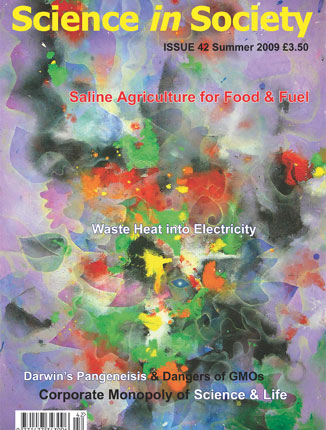
Announcing Science in Society #42 - Spring 2009
Science in Action, In and For Society Subscribe here
Electronic versions of all issues of Science in Society can be found in the ISIS members area. Membership details here
From the Editors - More than Banking Needs to Change
Banking for bankers and corporations
The events of the past year have led to many hard questions being asked about
our financial and system and ‘free market economy’.
Commentators are finally starting to challenge the assumption on which
so much has depended, that the market is always right - the invisible hand
will guide the economy to make the most effective use of resources – and if
there is ever a deviation from this optimal state, the market will correct
itself. That is why the bankers and their allies insist governments must
not interfere with the operation of the market. In practice, however, it means
that all important decisions are taken by the people who run the banks and
the big corporations. This is a very convenient theory for bankers, whose
telephone number salaries are one of the things we are not to interfere with.
But the theory is simply wrong.
To be sure, the market is generally able to correct small disturbances
from the optimum. If there are too few pizza restaurants to satisfy the demand,
more will open; if there are too many then some will go out of business. As
a result, we should end up with about the right number. For that sort of thing,
the market generally works a lot better than having some bureaucrat in charge.
Unfortunately, how a complex nonlinear system reacts to small
perturbations is not in general a good indicator of how it will react to large
ones, and that is certainly the case with economies. Markets frequently go
to extremes and show no signs of returning to normal on their own, in complete
contradiction of what the theory predicts. As George Soros points out in his
book The Crash of 2008 and What it Means, in recent years alone governments have had to intervene
in the international banking crisis in 1982, the bankruptcy of Continental
Illinois in 1984, the emerging markets crisis
of 1997, the failure of Long Term Capital Management in 1998, and more besides,
including of course the current credit crunch. The same bankers who demand
free rein when times are good are quick to run to the government for help
when their excesses get them into trouble.
The first priority of governments is clearly to get the economy
moving again and people back into work. Now that the myth of the market has
been so obviously demolished, however, they should ignore what Soros calls
the “market fundamentalists” and put in place measures
designed to stop it going wrong in the first place. To a large extent,
this would mean simply bringing back rules that were abolished in the 1980s
and 1990s, when the neo-liberals dominated economics both in theory and in
practice.
Light touch regulation failed to protect savings and pensions
It is now argued that there should be strict
regulations governing what banks can do. They would not be obliged by law
to comply, but those that did not could not expect to be bailed out by the
taxpayer if they ran into trouble. We would also include a rule that because
of the extra risk, pension funds and public bodies should not be permitted
to invest in banks that have not signed up to the code. If we cannot prevent
some people gambling, at least we can stop them doing it with our money.
As the advocates of laissez-faire keep reminding us, however,
our whole economy, not just the financial sector, is based on the market.
If there are lessons to be learned, they apply to other areas as well.
One of the chief causes of the crisis was the so-called light
touch regulation that was begun by Reagan and Thatcher and continued by their
successors. One by one, restrictions were lifted. Regulators have tended to
take the banks’ word that all was well. They were not given the resources
to do their job thoroughly, so that when a truckload of paper documents arrived,
there was no way they could find the toxic needles hidden in the haystack
of very ordinary material. The regulators were checking only the details of
what the banks were doing, not their overall strategies, which turned out
to be where the real dangers lay. The whole ethos of regulation was above
all, not to kill the goose that was laying the golden eggs nor tempt it to
fly away to a tax haven.
Light touch regulation fails to protect our health
Light touch regulation has also been the rule in other sectors, including
the pharmaceutical and biotech industries. Regulators depend on the companies
not only to carry out the tests but to analyse and interpret the results,
and then take their word for it.
A revolving door policy means that regulators often come from
industry and then go back once they have served their terms. Regulation is
largely about details rather than the strategic issues: when an application
is being discussed it is considered enough for the person with a connection
to that firm to leave the room, even though other corporations’ nominees may
be just as anxious as the applicant to see permission granted because of the
precedent it will set. The UK government has given its regulators a very strong
steer that they are to favour GM not because the farmers and consumers want
it – they don’t – but because they see it as one of our industrial golden
geese. Here, of course, they are blatantly ignoring
the market, which even the most committed neo-liberals seem willing to do
when it suits them.
The positive opinion given to Monsanto’s GM maize MON 863 by
the European Food Safety Authority (EFSA) was a case in point. The EFSA not
only allowed the company to claim commercial confidentiality for raw data;
but also agreed with the company that significant results suggesting kidney
and liver toxicities were not “biologically
meaningful”. No wonder the EU Council of Ministers have unanimously agreed
that the current legislation on GMOs requires a thorough revision with respect
to risk assessment.
What this means for the whole world
Now that the neo-liberal model has been thoroughly
discredited, the rich nations should stop imposing it on the rest of the world,
which many commentators have blamed for creating poverty and global warming
by encouraging over-exploitation of people and the planet (see Financing
Poverty, SiS 40).
At the same time, the recent multi-stakeholder
International Assessment of Agricultural Knowledge, Science and Technology
for Development (IAASTD) (see GM-Free Organic Agriculture to Feed the World, SiS
38) has also declared
industrial monoculture obsolete. Its major finding is that small farmers practicing
agroecology are the way forward to feed the world, eradicate poverty and save
the climate (see also Food Futures Now *Organic *Sustainable
*Fossil Fuel Free , ISIS/TWN Report).
The credit crunch occurred because
governments took the advice of the bankers on how a banking system should
be run. The result was a system specifically designed to make profits for
the bankers rather than to play a useful role in the real economy. They should
now learn from their mistake and pay heed to the words of Hans Herren, co-chair
of the IAASTD: speaking at the 5th European Conference of GMO Free
Regions in Lucerne, Switzerland:“It is for governments to implement the recommendations
of the IAASTD, not following what Monsanto is telling them.”
Contents
- Freeing the World from GM
- The Golden Rice Scandal Unfolds
- Who Owns Life, Not Monsanto?
- Corporate Monopoly of Science
- Death by Multiple Poisoning, Glyphosate and Roundup
- Acceptance of GM Crops Exaggerated
- Call for Direct Witness Evidence of GM Hazards & Failures
- Letters to the Editor
- Sustainable World
- Saline Agriculture to Feed and Fuel the World
- Harvesting Waste Heat to Save the Climate
- Reef to Replace Barrage to Tap the Tides?
- An Urban Dream Farm for London?
- Cooperative for Health, Food Security & Environment
Against the Credit Crunch
- Technology Watch
- ‘Biologicals’, Wonder Drugs with Problems
- Magnifection, Safe Pharming or Doomsday Device?
- Malaria Vaccine Trials Raise Concerns over Risks to Infants
- Epigenetics and Beyond
- Epigenetic Inheritance through Sperm Cells, the Lamarckian Dimension in Evolution
- Darwin’s Pangenesis, the Hidden History of Genetics, & the Dangers of GMOs
- Intercommunication via Circulating Nucleic Acids
- Health Watch
- Super-Toxic Cocktails
| |
|