
1 000 Kg per Mu in 10 Years Prof. Li Kangmin
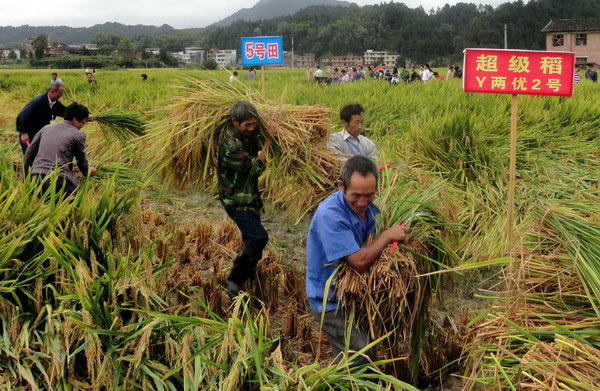
A ‘super rice’ yielding 926.6 kg/mu (1 mu = 1/15 ha) has been created in China by conventional breeding. Experts at the Ministry of Agriculture (MoA) announced the results of field trial in Leifeng Village, Longhui County of Hunan Province on 19 September 2011. China’s hybrid rice technology now leads the world [1].
The experts and professors nominated by the MoA had gathered in the village the previous day to examine and check the yield of the hybrid rice “Y Liangyou II” created by selective breeding at Hunan Hybrid Rice Research Centre, and cultivated in trial plots totalling108 mu. The expert team numbered all trial plots, and then randomly sampled three plots for determining yield: No. 2, 5, & 8.
Mr. Cheng Shihua of the MoA reported that 920.1 kg of grain were harvested from No 2 plot with an area of 501.2 m2; 1165.9 kg from No 5 plot with an area of 559.1 m2; and 1106.1 kg from No 8 plot with an area of 562 m2. After drying and removing impurity, and calculated on the water content of 13.5 %, the yields of 3 plots were 901.1 kg, 938.2 kg, & 940.5 kg per mu, respectively; the weighted average of 100 mu was 926.6 kg per mu.
Academician Professor Yuan Longping, previously featured in this magazine for his innovation in introducing system of rice intensification to China (see [2] Does SRI Work?, SiS 23) said that the target of super-rice in this third phase had been achieved by better variety, better method, excellent paddies that provided many advantage of climate and ecology, and good management.
In 1997, Yuan summed up the success of rice hybridization in China over 40 years as a combination of heterosis and improved morphology [3]. The yield of “Y Liangyou II” variety surpassing 900 kg per mu is the latest achievement of that approach. In the words of Yuan, improved morphology means a cultivar having a “tall physique” and is “energetic”.
He said it was the special fertilizer for super rice that helped them reach the target; another factor was the high quality soil in Longhui County. It is recommended for super-rice fields that well-composted organic fertilizer is applied at 1 000-1 200 kg/mu. In addition, N fertilizer should be added to hybrid xian rice Oryza saliva L. indica at 10-12 kg/mu and to hybrid jing rice O.s.L. japonica, (actually it should be O. s.L. ding [4]) at 12-15 kg/mu. It is also important to apply fertilizer at the appropriate time, for example, during the heading stage of rice growth. Actually, super-rice results from further development of dwarf- and heterosis-breeding, which was to create an ideal stalk length through heterosis by inter-specific hybridization [5].
Does the present breakthrough translate into a yield of 900 kg/mu at commercial scale? Yuan did not think so, but 80 % at more than 700 kg per mu is realizable according to past experience.
The highest rice yield in the world is in Australia, on average about 660 kg/mu, followed by 445 kg/mu in Japan. The yields of China’s super-rice have now reached 550 and 600 kg/ mu, respectively, at large scale, as the result of the first two phases of development.
As for the quality of super-rice Yuan said that during the 1970s and 1980s, quantity was mainly emphasized in order to solve the food problem, while quality was secondary. As the living standard improves, people are not content to fill their bellies, but also eat well, and therefore, the breeding of super-rice requires both high yield and high quality.
Four women correspondents from Hong Kong and Macao came to Hunan Hybrid Rice Research Centre to do interviews. They were invited to a meal of super-rice. Three of them ate three bowls of rice each, and the fourth ate two bowls; they all praised the taste of super-rice. A billionaire from Hong Kong dined at the Research Centre; and after eating a bowl of it, demanded a packet right away to take home for his wife to enjoy.
81-year-old Yuan has humorously proclaimed himself “born again in 1980”, He said, “When I became one of “born again after 90”, I could achieve a yield of super-rice over 1 000 kg, which is my dream.” This is the repost to Lester Brown’s question: Can United States feed China [6].
The super-rice research target of 1 000 kg/mu has not yet been approved by the MoA, but Yuan is actively going for it. He said it would be very difficult to achieve a yield of over 1 000 kg per mu. “We took 4 years each to achieve the target yields of 700 kg and 800 kg, 7 years to reach 900 kg, and we might take 10 years to reach 1 000 kg per mu (or 15 000 kg per ha).
Rice is the staple food for more than half of the world population. Rice production per hectare is now available to feed 27 people, and it needs to feed 43 people by 2050. Yuan told reporters that many countries in the world are suitable for planting China’s hybrid rice. If the area of its cultivation is increased by 75 million hectares globally, an increased yield of 2 000 kg per hectare will provide 150 million tonnes extra for feeding 400-500 million more people, and effectively guarantee food security [7]. China is ready to help people bid farewell to famine.
Prof. Li Kangmin is China’s representative on the International Organization of Biotechnology and Bio-engineering, and has researched extensively on ecological agriculture and local circular economy.
Article first published 05/12/11
Comments are now closed for this article
There are 3 comments on this article.
Anupam Paul Comment left 6th December 2011 03:03:49
No doubt its a great achievement.It mentioned only grain yield. It has achieved with heavy dose chemical fertilizers and pesticides.The farmers have to buy seeds every year.Seed sovereignty will be in jeopardy.Is it possible to increase yield? Everything has limitation and every action has its opposite action.The British in India recorded highest grain yield of rice( 13 t /ha) in 1880 in Salem and Thanjavur district of Tamilnadu.During that period there was no HYV or Hybrid rice, our indigenous had the capacity.And this amount is equal to Chinese yield.We have lost the varieties like our Muslin cloth.
Todd Millions Comment left 7th December 2011 09:09:59
Prof Li Kangmin-A Mu is what area?I seem too recall that the size varied by region.Impressive yeilds no doubt.Is the 'organic fertilizer'-traditional or composted?Have comparisions being done with vermiculture sludges for disease resistance and yeild?Any long term measurment of soil degration from the nitrogen applications?Tests of co planted 'weeds' too support the rice crop and provide edible greens?
Lastly-Where these tests done with the transplant and keep flooded feilds,or the flood and let sit,low water methods(nepalese testing I believe.)?
May professor Yuan have many more rebirths.Thanx
Mark Chan Comment left 28th January 2012 21:09:42
China has been producing rice for thousands of years, and according to China Ministry of Agriculture archives, there are over 10,000 variety of spices. I was fortunate to see a video recently showing a new super rice that can yield 1,500Kg/Mu (ref: 15mu/ha). A rice farming in Southern China have successfully grafting bamboo with rice plant (bamboo stem for strength holding 8-10 branches of panicales per plant). Bamboo can be grown in all terrans including hill sides and dry climates. Will this be the next breakthorugh to feed the world.