
Nuclear energy makes economic nonsense and ecological disaster and provides great opportunities for terrorists. Peter Bunyard
Human-induced global warming is already upon us. The trends in fossil fuel use and the release of greenhouse gases from all human activities, including agriculture, indicate that worldwide we will be hard pushed to achieve the 60 to 80 per cent reduction in greenhouse gases necessary to stabilise greenhouse gas levels in the atmosphere at 550 parts per million (ppm) before the century is out. That’s the upper limit before climate change events become extreme and devastating, according to climatologists [1].
The carbon dioxide level is currently close to 380 ppm in the atmosphere, more than 30 per cent up on the pre-industrial level of 280 ppm. Even at 400 parts per million, which will be reached within 10 years at the current rate of increase of 2 ppm per year, average global temperatures will rise by 2 deg.C [2].
In its scientific review, Climate Change 2001, the Intergovernmental Panel on Climate Change (IPCC) predicts that business-as-usual (BAU) activities across the planet could lead to an average temperature rise of as much as 5.8 deg. C within the century. But such predictions, disturbing as they are, do not take into account the impact of global warming on terrestrial vegetation, including the world’s tropical rainforests. Peter Cox and his colleagues at the Hadley Centre of UK Met Office have elaborated climate models that incorporate a dynamic carbon cycle. They predict that, within half a century, the BAU scenario will cause soils and vegetation to switch abruptly from a sink for atmospheric carbon to a source. That would mean not only the loss of the current capacity to withhold and remove carbon dioxide from the atmosphere, but in addition, the release of carbon from soils and vegetation that has accumulated over the past 150 years.
The net result could be a doubling of current concentrations of greenhouse gases within a matter of years. Adding in the fossil fuel emissions could take the levels of carbon dioxide to four times pre-industrial levels, i.e 1 000 ppm. The positive feedback from the loss of terrestrial carbon further heats up the earth’s surface, and the average surface terrestrial temperature could rise by as much as 9 deg. C instead of the predicted 5.8 deg. C; temperatures as high have not been experienced for more than 40 million years [3].
The soil/vegetation feedback on global warming is not the only one; we face other powerful positive feedbacks, including the change in albedo (the fraction of solar energy reflected back into space) as ice vanishes from the Arctic Circle and from parts of Antarctica where grass is establishing itself for the first time in millions of years [4]. In addition, the potential release of methane from the oceans overlying the vast sediments of the Amazon Fan, or in the permafrost regions of the Northern Hemisphere, could lead to the large changes in climate that were responsible for the mass extinctions of the Permian more than two hundred million years ago.
It has emerged that the Greenland ice sheet is less stable than previously thought. Its rapid melting would raise sea levels by several metres. Moreover, the Gulf Stream is diminishing in strength because of the influx of fresh water into the Arctic Circle [5].
In short, the climate system as we know it is poised on the edge of a profound transition. Once past a point of no return, terrestrial organisms including human beings will have little or no time to adjust and their future on this planet could well be jeopardized.
The UK government, spearheaded by the Prime Minister Tony Blair, has declared its intention to reduce greenhouse gas emissions from Britain by as much as 20 per cent of the baseline year of 1990 by the end of the First Commitment Period of the Kyoto Protocol. That 20 per cent will incorporate carbon trading, allowing industry to purchase carbon credits from elsewhere to offset its emissions, including reforestation projects in developing countries. It will also take on board ‘clean development mechanism’ projects (CDMs) in developing countries, whereby a donor industrialized country can share the equivalent of greenhouse gas emissions foregone through investing in a ‘cleaner’ project than would have been deployed had the additional investment and technical expertise not been available.
Despite a host of different projects, including wind-farms, it is becoming clear that the UK will have difficulty achieving that target. Energy demands in the UK are rising and emission cuts are stagnating. Indeed, over the past 40 years, the mean rate of energy demand has been increasing at 0.5 percent a year, mostly provided through burning fossil fuels. Moreover, recent figures supplied by the Department of Trade and Industry (DTI) show that carbon dioxide emissions from the UK, rather than falling as planned, are rising rapidly, by 2.2 per cent in 2003 and 1.5 per cent in 2004. And that despite the UK’s commitment to a legally binding 12.5 percent cut in greenhouse gas emissions compared to 1990, let alone the 20 per cent called for. Currently, the UK’s emissions are no more than 4 per cent below 1990 levels [6, 7].
The reality is that recent energy demand in the UK is growing at almost double the rate of the past half century; the DTI is predicting that the current per annum increase of 0.9 per cent will continue at least until 2010. Energy demand is up in all sectors of the UK economy, in transport, electricity and space-heating.
Blair’s government is now reviewing a number of options for reducing emissions [8], including wind power and the renewables; investment in tidal, wave and solar systems; a new nuclear power programme; subsidies for energy efficient household appliances; new building regulations that will incorporate energy efficient designs; carbon taxes including a rise in fuel duties; and a reduction in the prices of alternative fuels such as bio-diesel.
The International Energy Agency (IEA) projects that as much as 1400 GW (gigawatts = 109 watts) of coal-fired plants will be in operation by 2030 in the world, a considerable proportion in India and China. At a meeting of the IEA and World Coal Institute in Beijing (23 April, 2004), Wu Yin, Deputy Director-General of Energy Department, National Development & Reform Commission, China, stated that in 20 years’ time, China anticipated that coal would feature as the main fuel for a significantly enlarged electricity supply system. Vijay Sethu, Executive Director, Project & Structured Finance, Asia, ANZ Investment Bank, Singapore, confirmed that a similar situation would prevail for India. Both countries would also resort to nuclear power [9, 10]
During their lifetimes the coal-fired plants of China and Indian could emit some 500 Gt (gigatonnes) of carbon dioxide, equal to half of anthropogenic (human-source) emissions in the last 250 years.
In their 22nd report on Environmental Pollution of 2000, the Royal Commission set out four different scenarios for the UK to reduce its greenhouse gas emissions by mid century. How such reductions were to be achieved was markedly different in each case; however, all four scenarios anticipated that fossil fuels would continue to be used for transport, perhaps through fuel cells, but with the hydrogen originating from fossil fuels [11].
Scenario 1 is based on the notion that the UK would have a BAU economy, but with final energy demand kept down to 1998 levels. A 57 percent reduction in greenhouse gas emissions would be obtained through the deployment of at least 52 GW of nuclear power — four times today’s capacity— or as suggested, through using fossil fuel for electricity generation in which the carbon dioxide is recovered and buried in oil wells. Electricity would also be derived from renewable energy sources, including 200 offshore wind farms, each with 100 large turbines, as well as wave and tidal machines. The Severn Estuary barrage would be up and running and photovoltaic solar panels installed on the roofs of buildings. In recent years, efficient solar water heating systems have been developed that, even in the UK climate, make an effective contribution in reducing fossil fuel energy demands.
Scenarios 2 and 3 involve a reduction in energy use of more than a third while Scenario 4 requires an energy reduction of nearly one half compared to energy demands in 1998. Through reductions in transport, in electricity and in low- and high-grade heat, Scenarios 2 and 4 avoid the use both of nuclear power and fossil fuel stations with carbon dioxide recovery. Their demands for renewable energy resources are also reduced compared to Scenario 1. Meanwhile, Scenario 3 makes up for a reduced use of renewable energy sources by resorting to nuclear power although far less, at 19 GW, than the requirement for 56 GW in Scenario 1.
On the assumption that people and businesses are not going to pay silly prices for their energy, the Royal Commission has suggested a cut-off price of 7p/kWh for renewable energy supply, thereby imposing limits on the quantity of energy from such sources that could be available by 2025.
The nuclear industry has always seen itself as the saviour of industrialised society. The slogan of the 1960s, especially in the United States, was that nuclear power would deliver unlimited energy cheaply and safely, and that it would step into the breech when fossil fuel supplies became scarce. At the time, no one was thinking of the problem of greenhouse gases [12].
In its 1981 report on nuclear costs, the Committee for the Study of Nuclear Economics showed that a station such as Sizewell B would cost some £2 billion more (1980’s money) over its lifetime than a comparable-sized conventional thermal power station such as Drax B in Yorkshire [13], which would put nuclear power beyond the reach of privatization.
In 1996, for £1.5 billion, the newly created British Energy acquired seven Advanced Gas Reactor (AGR) stations and the country’s only commercial Pressurized Water Reactor (PWR). The actual cost of construction had amounted to over £50 billion, of which more than £3 billion had recently been spent on the Sizewell B PWR, newly commissioned in the mid 1990s.
The government sell-off in 1996 of what was to become the UK’s largest electricity producer might have seemed a give-away at the time, but in 2002, on account of having to compete for electricity sales against other non-nuclear generators, British Energy found its losses piling up with every unit of electricity sold. In less than a year, and in the biggest write-off of capital in the UK, the company’s market value plummeted to little more than £100 million. Basically, British Energy could not go on trading and had to call on the government to salvage it.
Despite complaints of favouritism from non-nuclear companies, the government agreed a loan of £410 million to British Energy, and a month later, upped it to £650 million. Meanwhile, as Energy Minister Brian Wilson reiterated in parliament on 27 January 2002, the government would provide the £200 million required to go into the fund for decommissioning.
Dale Vince, the managing director of Ecotricity, regards such support for the nuclear industry as economic nonsense. He said in an interview published in The Guardian [14], “If we were given £410 million instead of British Energy, we could have built enough onshore wind energy to power 10 per cent of the country’s electricity needs.”
Unfortunately, you cannot just shut down nuclear stations and walk away. You have to keep the safety systems, including core-cooling, up and running for as long as the fuel is in the core (see Box 1).
And then, when the spent fuel is extracted, you have to make multi-billion dollar decisions what to do with it [15] (see Box 2).
Box 1
How nuclear power is generated
Uranium-235, which comprises on average just 0.7 percent of natural uranium, is a fissile (capable of atomic fission) isotope that splits into more or less two radioactive halves when struck by a neutron. The bulk of natural uranium is made up of uranium-238, which, in contrast to the rarer isotope, does not split on being struck by a neutron but tends to absorb a neutron and, through a process of radioactive transformation (with the emission of an electron), jump up to the next element - plutonium. Plutonium is also fissile, and can be ‘bred’ from uranium fuel when a reactor is up and running.
A reactor, as distinct from the uncontrolled fission that makes an atomic bomb, needs the process of fission to be kept at a steady operating level. That is achieved through inserting or withdrawing control rods made of a material that will absorb neutrons and so prevent them from causing a runaway chain reaction (see Fig. 1).
With the exception of fast breeder reactors, which use plutonium to ‘enrich’ the fuel, the majority of reactor systems use a ‘moderator’ such as graphite or heavy water to slow down the neutrons so that they will be more effective in bringing about a chain reaction. The moderator therefore allows the use of uranium with a relatively low content of uranium-235. The majority of reactors in use today will use uranium fuel that has been enriched to around 4 percent.
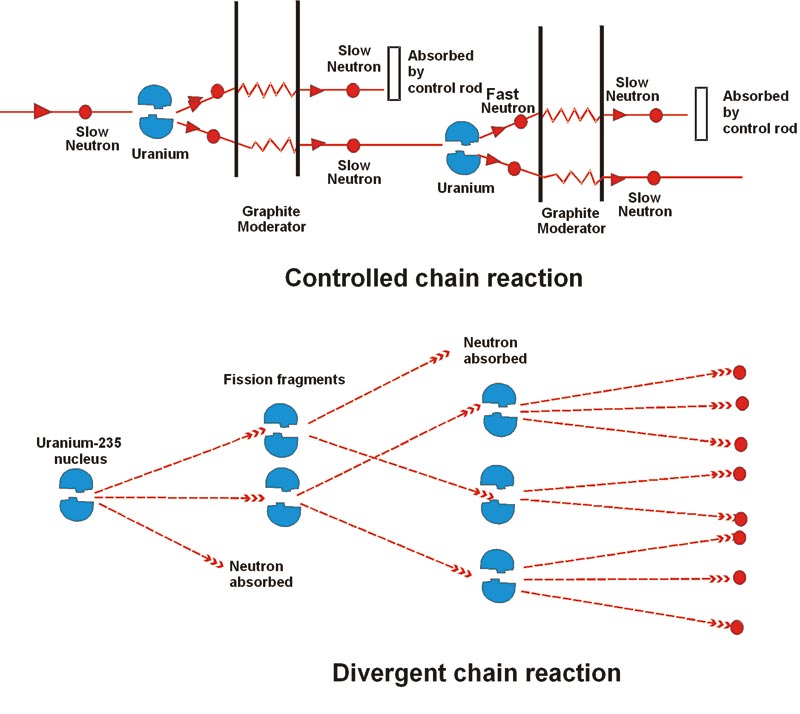
Figure 1. Controlled chain reaction in a nuclear plant as opposed to divergent chain reaction that makes an atom bomb
Box 2
The nuclear fuel cycle
The nuclear fuel cycle begins with the mining of uranium, followed by extracting it from the ore. The uranium is then enriched by centrifuging gaseous uranium hexafluoride, so that the heavier uranium-238 leaves behind an increasing concentration of uranium-235, the fissile material. The enriched uranium is then manufactured into ceramic fuel and encased in ‘cladding’, usually of zirconium alloy or stainless steel, as used in Britain’s Advanced Gas Reactors (graphite moderator and carbon dioxide gas for transporting heat to a steam generator).
Spent fuel from the power plant is highly radioactive and must be handled remotely. Initially, it is placed in cooling ponds to allow short-lived radioactive isotopes to decay. Then, there are two options: one to dispose of the intact, radioactive fuel, with its cladding, in long term repositories, where continual cooling can be provided; two to reprocess the fuel so as to extract any unused uranium as well as plutonium. Reprocessing leads to the production of various waste streams of virulently radioactive material. Various attempts have been made to vitrify (turning to glass) high level radioactive waste, so that it can deposited as a glass block. The UK still has to decide how and where to dispose of that waste.
Meanwhile, the extracted plutonium can be made into fresh fuel, such as Mixed Oxide Fuel, which also contains uranium. Reactors need to be adapted to take MOX fuel because its fission characteristics are different from using enriched uranium fuel.
Essentially, fossil fuels underpin the use of nuclear power, especially in the mining, extraction and manufacture of uranium fuel. To date fossil fuels have provided the energy and materials for the construction of nuclear installations, quite aside from providing electricity to maintain safety systems.
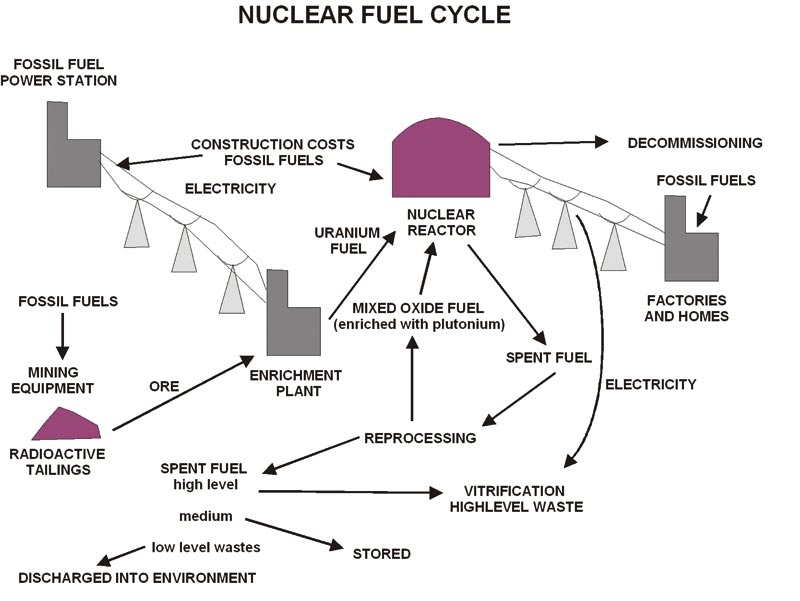
Figure 2. The nuclear fuel cycle including fossil fuels used in extracting uranium, constructing the nuclear plant, turning the power generated into electricity and decommissioning and reprocessing to get rid of hazardous nuclear wastes.
Do you send it to loss-making British Nuclear Fuels (BNF) for reprocessing, with all that entails in terms of discharges of radioactive waste into the Irish Sea and the atmosphere? That being the case, do you continue sanctioning the production of Mixed Oxide Fuel (MOX), which makes economic nonsense, as well as a dubious saving on uranium and is a security nightmare (see below)? Or do you reduce costs by storing the spent fuel intact?
As to the use of MOX, many critics within and outside the industry have repeatedly pointed out that the gains are far outweighed by economic and environmental problems. In France, reprocessing spent fuel to extract plutonium for MOX fuel manufacture will save no more than 5 to 8 per cent on the need for fresh uranium. Meanwhile, as experience in both France and Britain has shown, reprocessing spent reactor fuel leads to a hundredfold or more increase in the volume of radioactive wastes. In the end, all the materials used, including tools, equipment and even the buildings become radioactive and have to be treated as a radioactive hazard.
It is also highly questionable whether the use of MOX fuel will actually reduce the amount of plutonium that has been generated after half a century of operating reactors, both military and civil. Worldwide, more than 1 500 tonnes of plutonium have been generated, of which some 250 tonnes have been extracted for making bombs and another 250 tonnes extracted as a result of reprocessing the spent fuel from ‘civilian’ reactors. Apart from its military-grade plutonium - plutonium relatively pure in the 239 isotope - Britain now has some 50 tonnes of lower quality reactor-grade plutonium contaminated with other, less readily-fissionable isotopes such as 241 [16].
Because of the continued reprocessing of spent reactor fuel in commercial reprocessing plants in Britain, France, Russia and Japan, the world will have some 550 tonnes of separated civil plutonium by the year 2010, enough to produce 110 000 nuclear weapons.
Mixed oxide fuel, containing up to 5 per cent plutonium, is ideal material for terrorists, being no more than mildly radioactive compared with spent reactor fuel, and in a form from which the plutonium can be easily extracted. Just one MOX fuel assembly contains some 25 kilograms of plutonium, enough for two weapons. A reactor, modified to take the plutonium-enriched fuel for up to 30 per cent of the reactor core, has some 48 MOX fuel assemblies.
Currently, 23 light water (ordinary water) reactors - 5 in Germany, 3 in Switzerland, 13 in France and 2 in Belgium - have been converted to use MOX fuel. Five countries, Britain, Belgium, France, Japan and Russia, are manufacturing the fuel. With BNFL’s new MOX plant up and running, supply will exceed demand by a factor of two, at least until 2015.
BNFL claims that the use of MOX fuel will help burn up stocks of plutonium, including those from dismantled weapons. But the very operation of civilian reactors, with their load of the plutonium-generating uranium isotope, the 238 isotope, makes it inevitable that more plutonium is generated than is consumed. A 0.9GW pressurized water reactor which has been modified to take MOX fuel will burn a little less than one tonne of plutonium every ten years, whereas plutonium production will be about 1.17 tonnes, hence about 120 kilograms more.
The new myth is that nuclear power is the only source of energy that can replace fossil fuels in the quantities required to fuel the industrial society, whether in the developed or developing world, while eliminating the emissions of greenhouse gases.
Economies of scale demand that nuclear power stations are large, at least one GW (electrical) in size. Their sudden shutdown can put a considerable strain on the overall electricity supply system. And if their shutdown is the result of a generic problem, that will have major consequences, including the necessity of bringing on stream a large tranche of spare capacity. Furthermore, that capacity is likely to be fossil-fuel based and relatively inefficient.
As reported recently in New Scientist [17], the UK’s advanced gas-cooled reactors (AGRs) are showing signs of unexpected deterioration in the graphite blocks. These blocks serve the double function of moderating the nuclear fission process and of providing structural channels for nuclear fuel and control rods. The potential failure of the graphite compromises safety and in all likelihood the UK’s 14 AGRs, currently supplying nearly one-fifth of the UK’s electricity, will have to be shutdown prematurely, rather than lasting through to 2020 and beyond. Bringing reserve capacity to replace the AGRs will inevitably lead to a surge in greenhouse gas emissions. But that’s not the only problem the UK nuclear industry faces.
On Sunday 12 June, 2005, the BBC reported that a leak of highly radioactive waste containing enough uranium and plutonium to make several atomic weapons had gone unnoticed for more than 8 months [18]. It appears that a pipe in British Nuclear Fuels’ thermal oxide reprocessing plant at Sellafield in Cumbria had fractured as long ago as last August, spewing nitric acid with its deadly load of radionuclides onto the floor. The leak, containing as much as 20 tonnes of uranium and 160kg of plutonium, was discovered only in April of this year.
British Nuclear Fuels has justified the use of the reprocessing plant as being essential for the production of mixed oxide fuel from the spent fuel taken from the UK’s Advanced Gas Reactors. As a result of the leak, the nuclear inspectorate has ordered British Nuclear Fuels to shut down THORP, the thermal oxide reprocessing plant. Just how the spilt waste can be removed remains to be seen, but once again the accident reinforces concerns that the nuclear industry, quite aside from its poor economic showing, can never be made safe enough.
In addition, the Environment Agency inspectors told BNF that it had to improve the way it discharged low level radioactive waste into the Irish Sea, now probably one of the most contaminated waters in the world. Some commentators estimate it will take considerably more than a century to clean up the radioactive waste that the industry has already discharged into the environment, at a cost of well over £50 000 million.
Article first published 08/07/05
Comments are now closed for this article