
ISP News
Invest Instead in Sustainable Agriculture
Independent scientists, politicians and farmers have joined up to call for a GM-free Europe, and for urgent support for non-GM sustainable agriculture. Lim Li Ching reports
The scientists were among a contingent of 30-strong from all over the United Kingdom who crossed the English Channel to Brussels. Many more would converge from the rest of Europe, making up a total of 120 who had registered for the ISP Briefing at the European Parliament on 20th October 2004. The event, hosted and co-chaired by Jill Evans, MEP from Plaid Cymru and the Greens/European Free Alliance, was without precedent in more ways than one. Scientists, politicians and farmers have joined up to call for the European Commission to abandon its drive for GM crops and to focus instead on supporting non-GM sustainable agriculture. Representatives from numerous civil society organisations – organic farmers, gardeners, producers, chefs, lawyers, doctors – and MEPs turned out to add supporting voices.
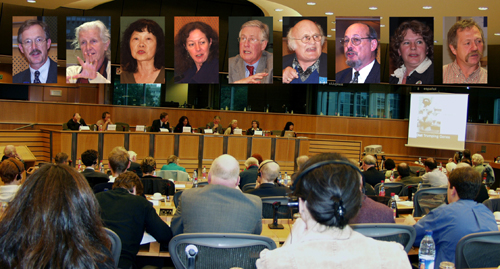
Introducing the briefing, co-chair Prinz Felix of Löwenstein, President of the federation of organic food producers in Germany, stressed that European agriculture is at a crossroads and that, "a major challenge for politicians in Europe is to guarantee there will be GM-free agriculture in the long-term".
Mae-Wan Ho, director of I-SIS and member of the ISP, outlined how scientific evidence has turned decisively against GM crops and in favour of non-GM sustainable agriculture. The Central Dogma underpinning genetic engineering - whereby one gene is supposedly responsible for one protein and hence one trait - has long been superseded by the ‘fluid genome’ in which the expression and structure of genes are constantly changing under the influence of the environment.
She painted a beautiful picture of the living organism regulating itself and its fluid genome as a whole, in contrast to artificial genetic engineering that is crude, imprecise and invasive. The organism is a good model of sustainable systems. It captures and stores coherent energy and mobilises that energy efficiently over a wide range of activities. This is paralleled by sustainable ecosystems that depend on diversity to capture and store as much living energy as possible. Hence biodiversity and productivity go together, a fact exploited in traditional ecological farming. That is why GM crop and other monocultures are unsustainable and incapable of providing the solutions to hunger.
Highlighting major uncertainties over the safety of the GM process, she argued that "GM is a scientific and financial dead-end, and it is now time to draw a curtain over it!" Based on the evidence, Ho said, the rational course of action is to go for a GM-free Europe and a comprehensive shift to non-GM sustainable agriculture.
Bringing home the message that sustainable agriculture works, Sue Edwards, director of the Institute for Sustainable Development (ISD), Ethiopia, presented compelling evidence from a project started in 1996 with local farmers and the Ethiopian Bureau of Agriculture and Natural Resources (BoANR). In Tigray, Northern Ethiopia, as in much of the country, land degradation is a huge problem, leading to low agricultural production and poverty. Edwards described how various organic and land management techniques selected and implemented by farmers there have increased yields and rehabilitated degraded environments.
In particular, composting has increased crop yields by two to three-fold, outperforming chemical fertilizers, and without the debts incurred in buying chemical fertilizers. This has led to more income for farmers. Other indicators of sustainability are apparent, such as increased agricultural biodiversity, reduced weeds, better moisture retention in soil and increased resistance to pests and disease.
The success of the project has been such that, from its humble beginnings at four sites, it has now expanded to more than 90 communities working with BoANR in Tigray. Furthermore, the Federal Environmental Protection Authority has now adopted the approach as its main strategy for combating land degradation and poverty throughout the country, and has started to implement the strategy in 69 pilot communities all over Ethiopia.
Peter Saunders, Professor of Applied Mathematics from King’s College, London placed the urgency for adopting sustainable agriculture squarely in the wider context of climate change. Oil is a finite resource, and climate change a reality. But as he pointed out, industrial agriculture is energy and resource consuming, with research showing it uses six to ten times more energy than sustainable agriculture to produce one tonne of cereal. GM crops will only intensify that dependence, and carry unknown risks on top of that.
Saunders stressed the need to base farming on farmers’ knowledge, which is "not the same as doing it the old way, as we have the benefit of modern science." Such knowledge cannot be patented, whereas GM crops allow companies to own and control plant varieties, giving them the incentive to promote GM heavily. "There is an urgent need to move to low-input agriculture," he said, "The proper role of science is to improve sustainable agriculture, not to make a fast buck for biotech companies".
Bob Orskov from the Macaulay Institute, Scotland continued on the theme of how sustainable agriculture is a better option than conventional monoculture with examples from Asian countries, where multiple cropping, including agroforestry, has increased crop yield, soil fertility and biodiversity.
In Sri Lanka, Indonesia and Malaysia, where animals are customarily grazed under trees such as coconut and oil palm, he documented that the practice increased both the yield of the trees and the productivity of the animals. "A real win-win situation!" he said. Similarly, integrating animals like ducks and fish into rice production gives much better yields than with just using herbicides. Such multi-cultures are also possible in Europe. Research carried out in Scotland showed that when sheep are grazed under trees, sheep productivity is higher than if grazed in open spaces. This is especially so in dry years. He concluded, "If we really want to support rural poverty alleviation, we would pay more attention to multi-cropping, including agroforestry."
Former UK environment minister Michael Meacher sketched out the changes needed in science policies and research, to shift away from GM to sustainable agriculture. He launched an outspoken attack on the commercialisation of GM science. "If science is to be fully trusted, it has to be pursued with total independence and freedom from commercial bias", he said. The policy implications are threefold: if we want independent research we must pay for it; no member of a regulatory committee or advisory body should have, in the current or recent past, links to the industry concerned; and contributors to scientific journals should fully disclose their funding sources. This is crucial in light of his estimate that 40% of the members of scientific advisory bodies in the UK have links to the biotech industry, with 20% linked to Monsanto, Zeneca and Novartis.
Meacher also lamented how the European Commission seems to be buckling under the pressure of the US-Canada-Argentina complaints at the World Trade Organisation (WTO), against its de facto moratorium on GMO approvals. He said it was absurd to suggest that Europe has hindered the development of GM technology or that it has led to hunger in developing countries, as the time it took for Europe to revise its laws is reasonable, and hunger has nothing to do with the absence of GMOs.
While admitting that it was probably unrealistic to expect an outright ban on GM crops in Europe, he called for a systematic programme of research into the environmental and health impacts of the technology before further approval, an extension of the criteria for non-approval of GMOs to include cases that would undermine the sustainability of agriculture, and a prohibition on the patenting of lifeforms.
Citizens are certainly not taking GM crops lying down. The growth of GM-free zones on the continent has been phenomenal. Beatrix Tappeser from the German Federal Agency for Nature Conservation described GM-free zones as a self-organising process between farmers. Since November 2003, fifty GM-free regions have been established in Germany, involving 11 600 farmers, and covering 430 000 ha of arable land and more than one million ha of total land, including riverbanks and forests. The Agency actively supports some of these initiatives and is funding an information campaign on the issue. As it is responsible for protected areas in the country, the Agency has also established large-scale conservation areas where no GM varieties can be planted.
French farmer José Bové, representing Confédération Paysanne and the European Farmers Coordination, described the current peaceful campaign of civil disobedience in France that has destroyed experimental fields of GM crops. This has come about because the government isn’t listening. Most of the population and many farmers reject GM crops. Around 2 000 mayors have declared their municipalities GM-free, but the French central government has taken them to court, arguing that the municipalities do not have such a right. Despite this, 17 French regions (out of a total of 22) have now declared themselves GM-free.
While stressing that work has to be done to improve democracy, Bové argued that other means must be found to make citizen voices’ heard. Hundreds of people have joined them in pulling up GM crops, including an MEP. He vowed to continue the fight against GMOs, "even if we have to go back to prison".
ISP member Eva Novotny summed up the mood when she outlined the economic, social and environmental measures that should be taken to promote sustainability and to support small-scale farmers. This means moving away from large-scale, high-input, industrial-monoculture techniques, to local non-GM agricultural production that supports family farms, fair prices, and biodiversity.
The ISP used the occasion to launch the French and Spanish versions of its report, The Case for a GM Free Sustainable World, a complete dossier of evidence on the known problems and hazards of GM crops and the proven successes and benefits of sustainable agriculture (see www.indsp.org).
We gratefully acknowledge financial support for the briefing from Fondation de Terre Humaine, Fondation de Sauve, Green Cuisine, Josephine Sikabonyi for Farmers Helpline, Caroline Clarke, Brian Baxter and Roger Taylor.
Article first published 26/10/04
Comments are now closed for this article