
I-SIS Special Miniseries - Life of Gaia
This miniseries is dedicated to our planet earth, so we may better appreciate how she lives and sustains all creatures large and small, that we may learn to dance to the complex rhythms of her life music without stopping her in her tracks.
Space scientist and inventor Jim Lovelock first proposed in the 1970s that the entire earth is a self-organizing, self-regulating entity, rather like an organism. He named the earth Gaia, after the Greek earth goddess.
The idea that Gaia is alive and has a life of her own immediately caught fire. It inspired many earth scientists to look for the dynamic processes that organize and regulate the currents of the earth, to make a congenial home for all her inhabitants. These scientists are richly rewarded.
Records from ice and deep sea cores show detailed globally correlated changes going back at least 800 000 years, leaving us in no doubt that the earth behaves from moment to moment as one coherent whole, just like an organism.
Not only can we can read Gaia’s life-history from her deep memory stores, we can also tune in to her life-force pulsing as she is living today.
Gaia spinning in her perpetual dance around the sun, her mighty breath tumbling from hot belly to the poles, swirling across the continents, bringing welcome rain to forests, grasslands and crops, or torrential downpours, floods and hurricanes. Vast slow vortices of water connect her oceans from the furthest northern reaches to the southernmost haunts, from the shimmering sea surfaces to the dark deep beds, distributing warmth and nutrients, sustaining life with life.
Gaia’s breath is our breath, her water our water. Let Gaia live that we may live.
The projected increase in carbon dioxide level in the atmosphere is without precedent over the past 12 million years or more. Peter Bunyard reports.
One way to see the future is to look at the distant past, even 100 million years ago. For if we continue to burn fossil fuels and deforest at the current rate, then within a century we might find ourselves with greenhouse gas concentrations in the atmosphere and surface temperatures similar to those of that ancient past.
Fifty million years ago, the planet had little ice, yet global temperatures were on average no more than 5 C warmer than today. Equally relevant, CO2 levels in the atmosphere were probably no higher then than has been projected for the more extreme scenarios projected by the IPCC (see box)
IPCC
The Intergovernmental Panel on Climate Change has been established by United Nations agencies, World Meteorological Organization and the United Nations Environment Program to assess the risks of global warming from scientific, technical and socio-economic information, and to consider the options for adaptation and mitigation. The IPCC consists of more than 300 leading international scientists.
Before we blithely brush off concerns about a warmer planet, it is worth noting that 50 million years ago, sea levels were several hundred feet higher than they are today. Most of that water is now locked away in Antarctica and Greenland. If these ice sheets were to melt, Denmark and large parts of eastern Britain and Holland would vanish in their entirety, as would many other places. We would have considerable difficulty surviving, not least because of extreme weather conditions, and the loss of vast areas of cropland to produce food.
Given that we have records of surface temperatures and precipitation patterns going back a few centuries at best, how can we possibly lay claim to knowing what the earth’s climate was like, hundreds of thousands if not millions of years ago?
That is where the Antarctic comes in, not only because of its 2,400 metre thick cap of ice, which covers 14 million square kilometres, but also because of sediments off the land mass at Cape Roberts in the Ross Sea. The ice, like that drilled at the Russian Base, Vostok, yields information going back 400,000 years on temperature, CO2 content, sea-level. The sediments, overlying Beacon sandstone of the Devonian, are 1500 metres thick, dating from 34 to 17 million years ago until the present. Meanwhile, drilling 100 metres into the underlying sandstone takes one back still further, even beyond 100 million years ago.
Peter Barrett, from New Zealand’s Antarctic Research Centre at Victoria University, has been member of a team of some 55 scientists from Australia, Britain, Germany, Italy, Netherlands, New Zealand and the USA, who investigated the sediments. He points out that "Global climate, even in 50 years’ time, may be warmer than the earth has experienced in the past 12 million years."
From tree stumps, fossils, leaves and coal seams, we know that 200 million years ago Antarctica was covered in forests and swamps. Antarctic temperatures then were at least 15 C warmer than today and, consistent with that, global temperatures some 7 or 8 C warmer than now.
Two distinct factors may have been responsible then for a warmer, vegetation-covered Antarctica. During the Cretaceous and Early Cenozoic, between 136 and 54 million years ago, we know that atmospheric CO2 was high and certainly responsible for part of the warming. The other factor relates to Antarctica still being part of Gondwanaland, a gigantic joined up super-continent landmass that included Australasia and the Indian Sub-continent. Once that super-continent began to break up, Antarctica became increasingly cut-off by a strong polar air circulation system and consequently a cold circum-polar ocean current.
Whichever was more decisive - a falling concentration of greenhouse gases or the increased isolation in the polar extremity - the first ice-sheets formed over Antarctica 34 million years ago. And then, as the earth cooled still more some 2.5 million years ago, the ice-sheet formed for the first time over Greenland in the Northern Hemisphere. From then on, we have had ice ages affecting both poles.
In all probability, the cold circum-polar current contributed most to the chilling of Antarctica, in which case it might take more than elevated CO2 levels to bring about a complete melting of the ice-sheet.
Yet, as the ice-core data shows, the expansion and retreat of the ice-sheet during the glacial and inter-glacial periods have always been associated with swings in temperature that themselves correlate closely with levels of CO2 in the atmosphere. Some 18,000 years ago, when the last ice age was at its most intense, CO2 levels were 30 per cent below 1900 levels and sea-level was 120 metres below present sea-level.
That should warn us that whatever regulates greenhouse gas concentrations in the atmosphere could have profound effects on climate. In fact, we do not know which triggers which: whether CO2 concentrations in the atmosphere trigger climate change or whether climate change triggers CO2 concentrations. In all likelihood one affects the other, which then feeds back in a mutual dynamic process.
Until 800,000 years ago, the glacial cycle lasted some 40,000 years, but then lengthened into the current 100,000 cycle. The two periodicities, 40,000 years and then 100,000 years happen to conform respectively to the changing obliquity and eccentricity of the earth’s orbit, both of which determine changes in the pattern of solar energy reaching the earth.
The orbital changes, including the swinging of the earth from side to side in its axial precession, comprise what has been called the Malenkovitch Wobble. Few scientists question that it influences the seasons and global climate. Moreover, the Antarctica data are the best record we have showing correspondence between the retreat and then re-establishment of the ice sheet with where the earth is at regarding its orbit around the sun.
But one factor has been largely overlooked: the role of the biosphere in modulating climate through its impact on the atmosphere and the concentration of the prime greenhouse gases such as carbon dioxide, methane and even water vapour. And when life is doing well, as James Lovelock realized in formulating his Gaia hypothesis, then CO2 levels tend to be low, thereby reflecting a greater intensity of primary photosynthetic productivity by green plants. Hence his famous remark: "life prefers it cold."
Lovelock was referring in particular to the cloud-forming characteristics of certain algae - namely the coccolithophores - which contribute significantly to the cooling of the earth’s surface, especially over the oceans. Simultaneously, they are responsible for drawing down CO2 in photosynthesis and depositing it as calcium carbonate on the ocean floor. The White Cliffs of Dover are none other than CO2 made solid, mostly by life and hence taken out of the atmosphere for geological periods of time. This is a very important carbon sink.
Plankton activity of the past leaves its mark in the ice-core record. When plankton are thriving, the concentrations of CO2 in the atmosphere, as found in bubbles of air entrapped in the ice, go down; on the other hand, when phytoplankton activity is depressed, which appears to be correlated with inter-glacial periods, then CO2 levels rise (Fig. 1 & Fig. 2). If it were not for phytoplankton activity, then atmospheric levels of CO2 in the pre-industrial era would likely have been 450 parts per million rather than the actual level of 280 ppm.
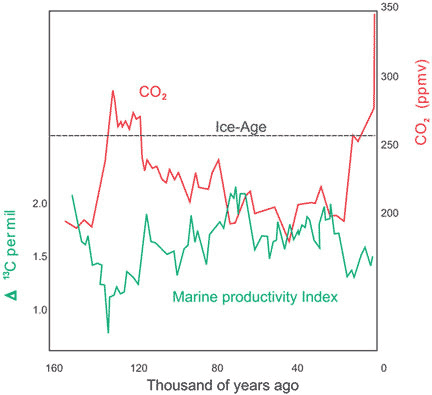
Figure 1. Atmospheric carbon dioxide mirrors plankton growth in inverse relationship.
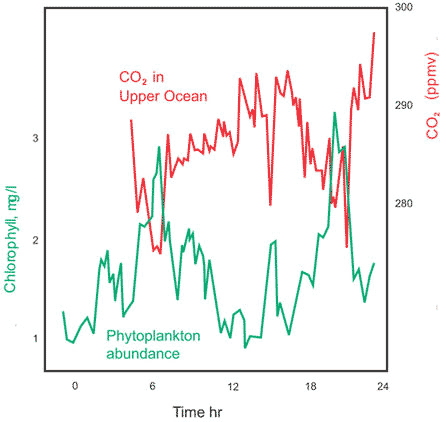
Figure 2. Atmospheric carbon dioxide mirrors plankton abundance over much shorter timescale of hours in the Atlantic.
In a theory of climate that embraces the role of life, could it be pure coincidence that ice-ages show plankton activity at a peak and that northern peat bogs show peak storages of carbon when the climate is colder? Could it be that as the earth wobbles, drifts and swings its way around the sun, life takes advantage of the changing conditions, either embarking on a spate of photosynthetic activity, which deposits organic carbon or, on the contrary, suddenly embarking on a feverish burning up of the surplus store of carbon? Both activities, photosynthesis and respiration, would take off as conditions suited them, until running out of ‘steam’, when orbital changes would initiate a new cycle of change. Could it be that the change 800,000 years ago from a 40,000 glacial cycle to one of 100,000 years came about because life extended the time during which greenhouse gases were kept down in the atmosphere?
The evidence from polar ice is of sudden spurts in the emissions of greenhouse gases from purely natural sources, with temperature increasing in tandem. Positive feedback mechanisms are clearly at work yet, because of our ignorance, they are nowhere to be seen in the current general climate models that the IPCC uses to predict future climate change. If we are to learn anything from the distant past it is that we should take all precautions not to perturb a system, which at some unknown critical point, jumps violently into a very different state. That vast polar continent, sheared off from the rest of the living world, has issued its warning.
Article first published 07/10/03
Comments are now closed for this article