
I-SIS Special Miniseries - Life of Gaia
This miniseries is dedicated to our planet earth, so we may better appreciate how she lives and sustains all creatures large and small, that we may learn to dance to the complex rhythms of her life music without stopping her in her tracks.
Space scientist and inventor Jim Lovelock first proposed in the 1970s that the entire earth is a self-organizing, self-regulating entity, rather like an organism. He named the earth Gaia, after the Greek earth goddess.
The idea that Gaia is alive and has a life of her own immediately caught fire. It inspired many earth scientists to look for the dynamic processes that organize and regulate the currents of the earth, to make a congenial home for all her inhabitants. These scientists are richly rewarded.
Records from ice and deep sea cores show detailed globally correlated changes going back at least 800 000 years, leaving us in no doubt that the earth behaves from moment to moment as one coherent whole, just like an organism.
Not only can we can read Gaia’s life-history from her deep memory stores, we can also tune in to her life-force pulsing as she is living today.
Gaia spinning in her perpetual dance around the sun, her mighty breath tumbling from hot belly to the poles, swirling across the continents, bringing welcome rain to forests, grasslands and crops, or torrential downpours, floods and hurricanes. Vast slow vortices of water connect her oceans from the furthest northern reaches to the southernmost haunts, from the shimmering sea surfaces to the dark deep beds, distributing warmth and nutrients, sustaining life with life.
Gaia’s breath is our breath, her water our water. Let Gaia live that we may live.
A global circulation of water between the surfaces and the depths of oceans plays a major role in keeping the earth’s climate congenial to life. But this circulation is unstable to global warming, with catastrophic consequences. Dr. Mae-Wan Ho reports.
Those of us who live in northern Europe have a special interest in the Gulf Stream Drift – a surface current of warm water that flows from tropical to northern Atlantic - which ensures that our mean annual temperature is about 5 to 7 C warmer than would otherwise be the case. The Gulf Stream Drift is linked to a large thermohaline circulation (THC) in the Atlantic Ocean that redistributes heat across the globe, and depends both on heating (thermal) and on the salt content (haline) of ocean water.
Warm water from the tropics flows to the North Atlantic and gives off heat to the atmosphere. This cools the water, increasing its density, causing it to overturn and sink near Greenland and the Norwegian Seas. This down-welling of cold water is what drives the thermohaline circulations. The cold water make its way back to the south in a deep current that ultimately involves all the oceans on earth (see Fig. 1). There is no such actively driven current in the North Pacific because the water is too fresh and therefore not dense enough to sink even when cooled.
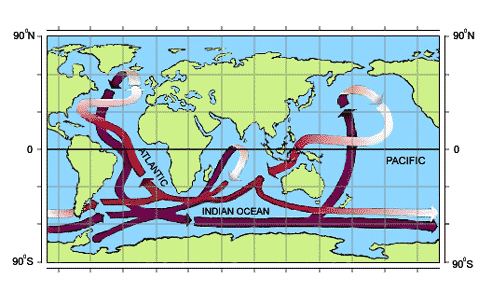
Figure 1. The thermohaline circulation system.
The North Atlantic thermohaline circulation is responsible for much of the total oceanic heat transport towards the north pole, peaking at about 1.2 + 0.3 Peta Watts (1015 Watts) at 24oN latitude.
The effect of the THC is much more extensive than just the Gulf Stream Drift. The shifts in temperature and salinity of the oceans affect marine ecology. Colder waters are rich in nutrients and contain a great deal of dissolved carbon dioxide, whereas warmer waters are oxygenated and stripped of nutrients. The THC is also a major forcing of hurricanes, which feed off warm surface sea temperatures. The stronger the thermohaline circulation, the more tropical cyclones occur, as larger areas have warm sea surface temperatures.
How fast is the THC? It depends. The idea that it may have many speeds is more than a century old, but only since the 1960s have quantitative models been proposed to support the existence of multiple equilibrium states corresponding to the different speeds of the THC. These models have further shown that transitions between the different states are often abrupt, and can be brought about through small perturbations to the water cycle. ‘Abrupt’ in this context means decades, even years, which is indeed very abrupt in terms of geological timescales.
Analyse and models of the abrupt climate change during the last glaciation 11 000 to 12 000 years ago also suggest that the event may have been triggered by changes THC in response to small perturbations in the hydrological cycle.
Most, but not all models show a reduction in the strength of the THC with increasing concentrations of greenhouse gases, and if warming is strong enough and sustained long enough, a complete collapse cannot be excluded.
According to the model produced by the research group in the Hadley Centre for Climate Prediction and Research, Met Office, a shutdown of THC could occur from a sudden freshening of the North Atlantic, say, due to the influx of water from melting ice, reducing the mean density of the water and inhibiting the water column from sinking and feeding the convective circulation. The strength of the North Atlantic overturning reduces to near zero very quickly, then recovers to its original strength over a period of about 120 years.
The atmosphere responds promptly to the cessation of the THC, and a cooling of the Northern Hemisphere is rapidly established, which is most severe over and adjacent to the North Atlantic. Over the first three decades after the cessation of the THC, the southern hemisphere warms due to the loss of northward heat transport normally carried by the THC. By the third decade, the maximum cooling over Western Europe will have reduced somewhat.
But surface temperature is not the only response to the cessation of THC. As the result of general cooling in the Northern Hemisphere, there is a widespread reduction in both surface evaporation and precipitation there, with increases elsewhere. The combined temperature and water-cycle changes would be expected to have a significant impact on vegetation and agriculture. It is estimated that primary productivity will be reduced by 12% in the northern hemisphere as a whole, with larger regional changes: reduction of 16% in Europe, 36% in the Indian subcontinent and 109% in Central America.
A wide range of theoretical models has been proposed for the THC, and a feature common to many of the models is a non-linear behaviour, involving multiple equilibrium states, delayed sudden transitions between the states (known as hysteresis) and threshold effects (sudden change at critical values). In its simplest form, the model, first proposed by Stommel in 1961, consists of two boxes representing the high-latitude and low-latitude North Atlantic, with water exchanged between the two through an overturning circulation. The strength of the overturning is proportional to the density difference between the two boxes. The atmosphere is assumed to be able to dampen large-scale sea-surface temperature fluctuations relatively quickly through radiation, whereas there is no such feedback regulation on the salinity of the surface water.
A theoretical model based on Stommel’s gives a starkly simple solution of overturning T as a function of the rate of freshening F. For F less than a critical value Fc, three solutions exist (Fig. 2). The middle solution (the dotted line) is unstable, so in practice there are only two realizable solutions, the upper branch with strong overturning, and the lower branch with weak to reversed overturning. For F > Fc, only the lower branch solution is possible. In this case, the freshening of the surface water is so strong that it will fail to sink. On the contrary, salt water from the deep will flow towards the North Atlantic, driving a reverse overturning.
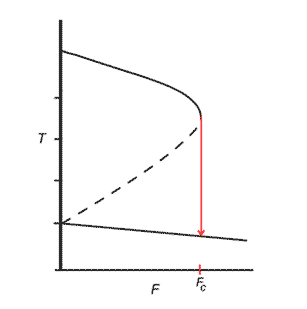
Figure 2. Multiple states and abrupt transitions at critical points
The present THC is assumed to be in the upper, strong overturning branch. But what would happen when carbon dioxide increases further?
A robust feature of climate models is a strengthening of the water cycle – between earth surface and atmosphere - when carbon dioxide increases, due to the increased amount of water vapour that warmer air can carry and return as rainfall. This would lead to increase in freshening, F, in the model, and hence a gradual weakening of the overturning. If F increases to and beyond Fc, the upper equilibrium becomes untenable and the system jumps to the lower branch. Such a jump would be quite difficult to reverse, and that’s the characteristic of hysteresis. Even if F is brought back below the critical value, the system will stay on the lower branch, unless factors not included in the model can come into play.
This simple model is not likely to be the whole story. The prediction of abrupt change is fairly robust. But whether the THC shuts down, reverses or recovers after that appears to depend on the precise model.
As pointed out by Andrey Ganopolski of the Potsdam Institute for Climate Impact Research in Germany, successful modelling of abrupt climate change in the earth’s history needs to take into account all the major components of the earth’s system. Apart from changes in atmospheric composition and the thermohaline circulation, the dynamics of ice sheets formation and vegetation cover also played important roles in the evolution of palaeoclimate.
Article first published 07/10/03
Comments are now closed for this article