
Industrialised countries are heavily dependent on fossil fuels, especially oil and gas. Gas and oil together provide 70% of the energy used in both the US and UK. But the world’s reserves are rapidly diminishing, and they don’t have to actually run out before precipitating a crisis. Dr. Mae-Wan Ho explains
In 1956, a geologist with Shell Oil, M. King Hubbert, used a bell-shaped curve to correctly predict that oil from the lower 48 states in the US would peak around 1969, to be followed by irreversible decline. The term ‘peak oil’ has since been used to identify the point at which roughly half of all the oil in the region has been extracted, and production would decline, driving up the price of oil and eventually failing to meet demand.
Dr. Colin J. Campbell, who spent decades working as an international exploration geologist for major oil companies, assembled what has become widely recognized as the world’s leading hydrocarbon database. He is now a trustee of the Oil Depletion Analysis Center (ODAC), a London-based charitable organization. In his book, The Coming Oil Crisis published in 1999 and later writings, Campbell used the same ‘Hubbert’ curve to predict that worldwide oil production would peak between 2005-10 (Fig. 1).
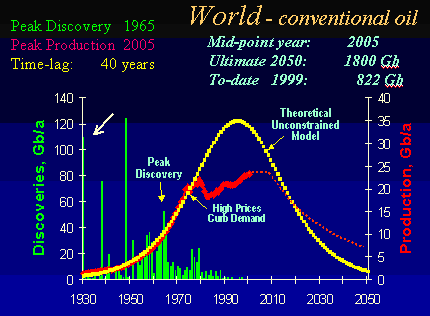
Figure 1. The green graph indicates the amount of oil (in Giga-barrels per annum) discovered in the world each year. Except for two isolated spikes in earlier years, the maximum was reached in 1965. The red curve shows the actual amount of oil extracted each year, given the constraints of the oil crisis in the early 1970s. This contrasts with the yellow curve, a theoretical prediction of oil extraction if no constraints were imposed. The lag between peak discovery and peak extraction is 40 years. The total amount of world oil that either has been or can be extracted is 1800 Gb, of which 822 Gb of oil have already been produced in 1999.
(From Campbell 2000)
Campbell pointed out that peak production generally lags 40 years behind peak discovery. In the US, peak discovery was in1930 and peak production, 1972. North Sea (UK, Norway and Denmark) oil production peaked prematurely in 2001 (from peak discovery in 1974), because advances in extraction technology reduced the time lag to 27 years. The peak discovery of the world as a whole was 1965, so the theoretical peak production year ought to have been 2005, but because of the oil shocks of the 1970s, production was artificially restricted by the OPEC quota system, so actual production has been below capacity. He predicted therefore, that world production is on a plateau from around 1970 to 2010 and will thereafter turn downwards.
Campbell said that oil reserves have been grossly overstated by the Organization of Petroleum Exporting Countries (OPEC, see box 1), since it was set up, probably by countries which want to increase their extraction quota accordingly. Oil discovery peaked in the 1960s, and since 2000, one barrel is discovered for every four we consume. The rest of the world - apart from the Middle East - peaked in 1997, and is therefore in terminal decline. Non-conventional oil delays peak only a few years, but will ameliorate the subsequent decline. Gas, which is less depleted than oil, would likely peak around 2020.
Box 1
OPEC – Organisation of Petroleum Exporting Countries – is a collective founded in 1960 to collaborate in managing the export of their crude oil to the rest of the world. Because of their ability to adjust production level, they possess a great deal of influence on the price of oil. Current members are Algeria, Ecuador, Gabon, Indonesia, Iran, Iraq, Kuwait, Libya, Nigeria, Qatar, Saudi Arabia, United Arab Emirates and Venezuela.
OPEC member countries produce about 41 percent of the world’s crude oil and 15 percent of its natural gas. However, OPEC’s oil exports represent about 55% of oil traded internationally. After crude oil price rose to more than $50 per barrel in October 2004. OPEC production ceiling was increased by 1 mb/d (million barrels a day) to 27mb/d effective from 1 November 2004.
The signs are that Campbell may not be far off the mark. People like Ali Bakhtiari, head of strategic planning at Iran’s National Oil Company (NOIC), and Matthew Simmons, an energy investment banker and adviser to the controversial Bush-Cheney energy plan, are united with Campbell in thinking that global oil production is about to peak, which in turn will signal the permanent end of cheap oil. When crude oil price rose above $50 per barrel in October 2004, people are suddenly jolted into thinking that oil production may be peaking. Worse yet, Campbell’s charge that the oil reserves have been overstated also turns out to be correct.
At the beginning of 2004, oil giant Royal Dutch Shell shook the world in a series of revelations indicating that about a fourth of its oil and gas reserves does not exist. The faked oil and gas reserves amount to some 4.5 billion barrels. At $35 per barrel as the basis for calculating Shell’s "accounting errors", this yields a sum of $150 billion, compared with the total market value of Shell shares 7 May 2004, which is 140b euros (more than $150 billion at the time)..
Shell is not alone. El Paso of Houston Texas revised its reserves down by 43% on 31 December 2003. The company Forest Corps announced a new field of 49 million barrels, which was revised down to just 8 million a year later by Redout Shoal in Alaska; and according to Lothar Komp, writing in the Executive Intelligence Review, "there are many others."
He quoted energy investment banker Matthew Simmons, "We still do not have any reliable data on (Iraq’s) two great fields. The most famous one is Kirkuk and we have no new data on that at all. It is a very old field and the idea that suddenly Iraq can produce five or six million barrels per day is just a joke. It’s goofy."
At an international briefing in February 2004, Simmons also said, "The US and Canadian natural gas market peaked in 2003. Russia’s recent oil turn-around was totally out of the blue."
Simmons strongly questioned the amount of reserves that actually exists in the Gulf after reviewing more than 200 technical papers written by scientists in the Society of Petroleum Engineers. The world’s major reserves are in a handful of oil fields within a region "slightly more than half the size of Virginia", and "all five of these great fields have a litany of challenges today." The evidence is that "the easy oil era in Saudi Arabia is either nearly over or over." For example, "the ability to drill vertical wells in Saudi Arabia has now become obsolete, and that even extended reach horizontal wells are now being described as second generation wells… and ... replacing those are maximum reservoir contact wells which sometimes the papers call bottle brush wells."
Technology just like this, said Simmons, led to a stunning production collapse in Oman’s Yibal field. By 1990, vertical wells had become obsolete. So for the first time ever horizontal drilling was introduced to the Middle East. Production hit a brand new record of 250 000 barrels a day, but began to decline rapidly in 1997. By 2001, Yibal’s production dropped below 90 000 barrels a day, and is now somewhere between 40 000 and 50 000 barrels a day. "It caught everyone by surprise," Simmons remarked.
While Saudi Arabia’s national oil company Saudi Aramco claims to have 257.5 billion barrels, its recently retired executive vice president Sadad Al Husseini said there is in fact "130 billion barrels of proven reserves".
Since the collapse of the Soviet Union, the Russian reserve estimate has fallen by around 30%. And as long ago as 1993, a Russian oil minister described his country's reserves as "strongly exaggerated due to inclusion of reserves and resources that are neither reliable nor technologically or economically viable".
So, even though the five big Middle Eastern countries do hold around half the world’s remaining oil, there is a great deal of uncertainty as to how much there really is, and how long it is going to last.
Another bombshell was dropped in November 2004 by BP exploration consultant Francis Harper, who estimated the amount of total usable oil reserves in the world at 2.4 trillion barrels, considerably less than the 3 trillion assumed by bullish commentators such as the US government’s geological survey. He said production would peak between 2010 and 2020; and demand will outstrip supply much earlier than other forecasts by ExxonMobil Corp. (XOM) or Royal Dutch/Shell Group (RD SC.
A major contribution to the rise in demand for oil is from rapidly growing economies like China. China forecasts the country’s crude oil output will peak at 200 million tonnes in 2015; it reached 17m tonnes last year, from 120 000 tonnes at the start of the communist era in 1949. But crude oil consumption is forecast to hit 350 to 380 million tonnes as early as 2010 from a little more than 250 m tonnes last year. China is the second-largest oil consumer after the US, and has been a net importer of oil for the past 10 years.
More pessimistic news came from a study released in November 2004 from ODAC. It found all major new oil-recovery projects scheduled to come on stream over the next six years unlikely to boost supplies enough to meet world’s growing demands.
ODAC analysed 68 mega projects with start-up dates from 2004 through 2010, and concluded they would add 12.5 million barrels a day to world oil supplies by the turn of the decade.
"This new production would almost certainly not be sufficient to offset diminishing supplies from existing sources and still meet growing global demand," ODAC Board member Chris Skrebowski said.
More than half of the estimated new supply would simply replace production declines elsewhere due to natural depletion. A modest one percent annual rise in demand over the six-year period would leave little or no surplus capacity to cushion against unforeseen disruptions in supply. If demand were to increase by two percent annually, available supplies could fall short of the total needed in 2010 by more than two million barrels a day – roughly equivalent to losing all of Kuwait’s current daily production.
"With most producers operating flat out to meet runaway demand increases this year, the world’s immediately available spare production capacity has virtually disappeared," Mr Skrebowski said. "This means that significant additional supplies in the near-to-medium term must come from new projects already in the development pipeline."
According to data from the latest BP Statistical Review of World Energy, 18 major oil-producing countries are now past their peak production, and their combined annual output dropped by over a million barrels a day in 2003. This group of countries now accounts for almost 29 percent of total world production
The ODAC study did not attempt to forecast when other countries would peak and tip into decline, but experts agree that several more are likely to do so within the next few years. Mexico and China (see above), the world’s fifth- and sixth-largest producers respectively, appear to be among the likely candidates.
Mexico’s national oil company, Pemex, has already announced that production from Cantarell, the world’s largest offshore oil field, is expected to peak in 2006 and then decline by 14 percent a year. China, too, has confirmed that its two largest producing regions are now in decline. It achieved only modest overall production growth last year of 1.5 percent.
Of the 68 confirmed projects that ODAC analysed, 56 are due to come on stream in the next three years. Seven are scheduled to start pumping oil in 2008, three in 2009 and just two in 2010. Since it takes, on average, six years from first discovery for a major project to start producing oil, any other new projects approved now would be unlikely to add further supplies until after 2010.
"It is disturbing to see such a dramatic fall-off of new project commitments after 2007, and not more than a handful of tentative projects into the next decade," Skrebowski said.
"This could very well be a signal that world oil production is rapidly approaching its peak, as a growing number of analysts now forecast, especially in view of the diminishing prospects for major new oil discoveries," he said.
Article first published 18/01/05
Comments are now closed for this article