
I-SIS Lecture
Have you ever wondered what being alive is like? What actually happens inside when we go about our business of living? What happens in our tissues, cells and molecules? When we dance, do our tissues, cells and molecules dance too? Do they dance when we sit still?
We can show you what happens inside small organisms under a microscope, a special microscope that enables us to see right through to their tissues and cells, and especially their molecules as they are busy being alive. The short video I am about to show you [1] (Quantum Jazz Part 1, order your copy right now!) has been put together by Andy Watton at ISIS, who is here today, editing from real time digital recordings and setting the clips to music made by Julian Haffegee, also at ISIS, who runs our website and produces our magazine Science in Society. Julian is a regular contributor to Jazz Guitar Online and Vintage Guitar websites.
The title of my talk is “Quantum Jazz”, subtitled: “The meaning of life, universe and everything”, borrowing from Douglas Adams’ Hitchhiker’s Guide to the Galaxies. I hope you will see why.
In the video, you saw little creatures from our local garden ponds and from the soil, darting about, beating their legs, exercising, flexing their muscles or just flashing brilliant colours at you, literally all the colours of the rainbow.
These creatures are thick with spontaneous activities at every level, right down to the molecules inside their cells.
What enables us to see them like that is the polarising microscope geologists use to look at rock crystals, slightly modified, but the principle is the same. Rock crystals appear in wonderful colours under the microscope because the molecules have a static orderly arrangement. The molecules of organisms, though ordered, are anything but static, they are moving around all the time. The only reason they appear colourful, and you may have noticed that the most active parts of the organism are always the most brightly coloured, is because the molecules are moving in concert as a whole, so the light passing through them still see perfect order. These images offer the most direct evidence of the remarkable coherence, or oneness, of living organisms.
Exclusive to the SiS archive; Download | Buy the Book from Amazon
Quantum jazz is the music of the organism dancing life into being, from the top of her head to her toes and fingertips, every single cell, molecule and atom taking part in a remarkable ensemble that spins and sways to rhythms from pico (10-12) seconds to minutes, hours, a day, a month, a year and longer, emitting light and sound waves from atomic dimensions of nanometres up to metres, spanning a musical range of 70 octaves (for that is the range of living activities). And each and every player, the tinniest molecule not withstanding, is improvising spontaneously and freely, yet keeping in tune and in step with the whole.
There is no conductor, no choreographer, the organism is creating and recreating herself afresh with each passing moment.
That’s why ordinary folks like us can walk and chew gum at the same time, why top athletes can run a mile in under four minutes, and kung fu experts can move with lightning speed and perhaps even fly effortlessly through the air, like in the movie Crouching Tiger and Hidden Dragon. This perfect coordination of multiple tasks carried out simultaneously depends on a special state of wholeness or coherence best described as “quantum coherence”, hence quantum jazz.
Quantum coherent action is effortless action, effortless creation, the Taoist ideal of art and poetry, of life itself.
Quantum coherence is a state of maximum local freedom and maximum global coordination. There is no equivalent for that in the mechanistic paradigm that dominates mainstream biology and mainstream discourse, in which the local and the global, the individual and the collective are inevitably in conflict. But quantum jazz says it all. It shows just how mistaken the dominant paradigm is.
It is all explained in my book The Rainbow And The Worm [2]; hope you’ll all read it.
It’s about the physics of organisms in place of the physics of dead matter in mainstream biology and the world at large. It is why we are stuck in debates about the hazards of mobile phones and genetic engineering, or the benefits of complimentary medicine. There is nothing in mainstream biology that deals with wholeness or coherence, nothing that tells you how, because the whole body is interconnected, even very weak electromagnetic fields could be harmful or, if appropriately applied, beneficial. And because we fail to see nature as an interconnected whole, life appears entirely as a struggle for survival of the fittest, one against all and all against nature. We wage wars and exploit our planet to death.
Let me concentrate on basic biology for now, on what happens inside the body.
Prof. William Stewart, now Chair of the Health Protection Agency, told the BBC and The Guardian last year that children under eight should not use mobile phones, and those between 8 and 14 should use them only when absolutely necessary [3] (Mobile Phones & Brain Damage). He issued the same warning five years ago when he chaired an independent enquiry that resulted in the report, Mobile Phones and Health, which was ignored. A new report was published last year, which said there are possible health implications from new research but still no hard evidence.
The new research was a large Europe-wide study, lasting four years and costing more than 3 million euros that once again eschewed any suggestion that electromagnetic fields from mobile phones and other sources are health risks even though they confirmed some disturbing findings that mobile phones do terrible things to the genetic material of cells [4] (Confirmed: Mobile Phones Break DNA & Scramble Genomes).
The biggest barrier to progress in understanding the biological effects of weak electromagnetic fields is simply that there is nothing in conventional mechanistic biology and physics, the physics of dead matter, which could make sense of them [5, 6] (Fields of Influence pt. 4 - The Excluded Biology; Non-Thermal Electromagnetic Field Effects).
Contrary to the picture perpetrated in biology textbooks, which is largely a projection from our dysfunctional hierarchical social organisations, there is no controller versus the controlled within the organism. No instructions emanating from some central controlling agency to the line managers and onto the workers. Furthermore, the organism is not a machine made of replaceable molecular nuts and bolts controlled by the genes working in linear causal chains, as genetic engineers would have us believe.
Biochemist Henry Kacser at Edinburgh University was among the few who really understood biochemistry and genetics ahead of most of his peers [7]. He coined the phrase in the 1970s - “molecular democracy of distributed control” - to describe how all the molecules actually work together, with lots of feedback and feed-forward loops.
Indeed, since the early 1980s, molecular geneticists have already discovered the fluid genome, a molecular dance of life in which messages fly back and forth between the genes, the organism and the environment, not infrequently changing the genes themselves.
The reality is that each and every part of the organism is intercommunicating from moment to moment. Each player, down to an individual molecule, is as much in control as it is sensitive and responsive. And that’s what the organic whole is about, as opposed to a mechanistic whole.
You can read about that in my book, Living with the Fluid Genome [8]. And get further updated on these important issues, on life, the universe and everything in successive issues of our must-read magazine, Science in Society.
I’d like to tell you about some of the scientists who have inspired my work. First among them, quantum physicist Erwin Schrödinger, who dared to ask the big question, What is Life in his book first published in 1944 [9]. And he devoted the last chapter of that book to the meaning of life.
Schrödinger began with the statement: “..present-day physics and chemistry could not possibly account for what happens in space and time within a living organism”, and proceeded to explore what kind of physics and chemistry was necessary.
He is usually credited with having predicted DNA as the genetic material, but that’s only half of the story. The other half of his book dealt with the problem of coherence, how organisms could function as a perfectly coordinated whole, and that half is still missing in present day mainstream biology. My book The Rainbow Worm is an update on the big question What is Life, on coherence, and also, the meaning of life.
Here are some other pioneers. Ludwig von Bertalanffy of general systems theory [10], Ilya Prigogine of the theory of dissipative structures [11], and Kenneth Denbigh [12], the thermodynamics of the steady state. In different ways, they, too, grappled with the major problem that life could not be understood in terms of the physics of dead matter. I was especially inspired by Kenneth Denbigh, whom I came to know personally, and with whom I corresponded on his thermodynamics of the steady state, which I extended, with his approval, to derive the “zero-entropy” model of the organism and sustainable systems.
Yes, I soon noticed that sustainable systems are just like organisms. Based on that, we plan to set up a zero-waste, zero-emission food and energy farm to tackle climate change and the energy crisis [13] (Dream Farm 2 - Story So Far). So answering the big questions can often lead to useful applications.
Now, back to why organisms could be sensitive to electromagnetic fields. Researchers such as Harold Saxon Burr starting in the 1930s [14] and Robert Becker in the 1960s to 1990s [15] had detected electric fields in developing embryos and adult organisms, and provided evidence that electric currents and fields are what the body uses for intercommunication, to function as a coordinated whole, to heal itself, and in some cases, even regenerate lost parts. But this line of research has been almost completely ignored by mainstream biologists to this very day [5].
There is no excuse for that, as electric currents flowing throughout the body, even from single cells, can be detected with the highly sensitive SQUID (superconducting quantum interference device) magnetometer, which has been used in imaging the electrical activities of the brain starting in the 1990s [6].
Another scientist who greatly influenced me, and whom I came to know, was solid-state physicist Herbert Fröhlich [16, 17]. He pointed out that the organism is densely packed with dielectric molecules (as in a solid-state device), which both react to and generate EMFs, and hence the laws of solid-state physics would apply to the organism as first approximation. He proposed that the energy the organism gets by metabolising food could ‘pump’ the living system into a state of “coherent excitations”, the way that pumping energy into a solid-state device could make its light-emitting atoms vibrate in concert to produce coherent light or laser.
The term “coherent excitation” is wonderfully evocative. Think of a motley collection of dancers responding to the seductive rhythm of good music, and working themselves up to a frenzy of excitement when they end up moving in coordinated fashion without being choreographed to do so.
Unlike an ordinary laser light that’s coherent in a single frequency of EMF, the living organism is coherent over a multitude of frequencies spanning many orders of magnitude, 10 or more. As a result, the organism is sensitive to the entire range of EMFs, from the extremely low frequency radio waves to the microwave region and beyond, because it is effectively tuned by its coherent activities to all those frequencies.
The usual denial that very weak electromagnetic fields cannot have any effect is based on the argument that the energies in these fields are “below the thermal threshold” of random motions of molecules, which will certainly swamp out the signals. But coherently vibrating molecules, far from swamping out the weak signals, will sum up their response to the weak signal, and hence result in a substantial effect. To use another analogy that engineers understand, the organism is like an exquisitely tuned receiver (and emitter) for EMFs over the widest possible range of frequencies. That’s why the quantum jazz of the organism is so fantastic; its antennae are tuned to signals from many frequencies, even those from faraway galaxies, and will respond to them with new music. But its music could also be sabotaged by malignant interference.
While I was coming to grips with all those ideas, we made a remarkable discovery in my laboratory that gave concrete evidence to Fröhlich’s hypothesis.
By half-accident, we found that all living organisms – especially those that are most actively moving around – look like a dynamic liquid crystal display in all the colours of the rainbow [2, 18, 19] (what you saw in the video just now), hence the “rainbow worm”. The first rainbow worm I set eyes on was the fruit fly larva, and I had been working with the fruit fly for 15 years by then, and never suspected I would see it in that light.
When the first wave of excitement had subsided, the enormous implication of what we saw began to hit home. Previously, only materials with static orderly arrangement of atoms or alignment of molecules could appear crystalline. The fact that living mobile organisms with all their molecules churning around transforming energy could look like a dynamic liquid crystal display is evidence that living organisms are indeed coherent to a high degree – even quantum coherent.
The colour images mean only one thing (Figure 1): the molecules inside, including especially the 70 percent by weight of water, are all aligned with their positive and negative charges pointing in the same directions, and moving in a coordinated way. That’s why even a signal with energy below the thermal threshold can have significant biological effects. The response is summed over astronomical numbers of molecules moving in concert. An organism the size of a tiny fruit fly larva would have about 1015 molecules, which would make the response very substantial indeed: some 1015 times greater than the noise generated by randomly moving molecules.
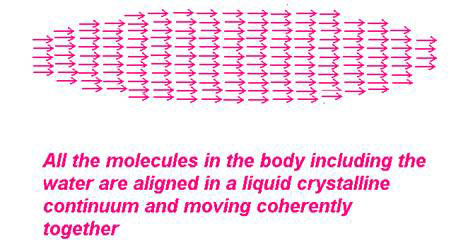
Figure 1.
All organisms look like the rainbow worm archetype of the fruit fly larva. Daphnia and the brineshrimp that you feed to your goldfish are not so different. You too, would look like that if we had a macroscope big enough to put you under.
The liquid crystalline organism is crucial for coordinating activities all over the body, which is why its extreme sensitive to weak EMFs; the two are intimately related, because the body also happens to use electric currents and electromagnetic fields for intercommunication.
The liquid crystalline matrix extends throughout the body into the interior of every single cell, thereby providing intercommunication between each cell and every other.
The liquid crystalline matrix is not only sensitive to EMFs, but also to subtle changes in pressure and temperature, which it converts into electrical signals. The water aligned with the liquid crystalline matrix provide important channels for intercommunication, in the form of jump conduction of protons (positive electricity) much faster than nerve conduction. It may be the basis of the acupuncture meridian system of traditional Chinese medicine, as a colleague and I suggested some years ago, and corroborated by accumulating evidence since [20] (Acupuncture, Coherent Energy and Liquid Crystalline Meridians) (see Collagen Water Structure Revealed, this issue).
Proton-conduction throughout the body can provide a ‘proton-neural network’ that regulates and coordinates the metabolism of every cell [21] to provide energy to the body as required.
Now, let me way something about the importance of water. Water is the simplest molecule with the strangest, most complex behaviour as a liquid, all down to the fact that the molecules are linked by hydrogen bonds into large dynamic networks. Recent evidence indicates that liquid water already possesses a high degree of structure and has the uncanny ability to organise molecules and particles dissolved or suspended in it (Two State Water Explains All? This issue)
But water molecules aligned along surfaces – interfacial water - is much more ordered, and there is evidence that the aligned water molecules on surfaces of proteins support ‘jump conduction’ of protons. Recent findings suggests that a high degree of order exists in the water associated with collagen in the connective tissues, making them ideal for intercommunication by jump conduction of protons (see above).
The importance of water in the cell has been argued most cogently by Gilbert Ling [22] over a period of more than 30 years, with only a handful of scientists with both the imagination and technical proficiency required to understand and appreciate his work [23] (Strong Medicine for Cell Biology). He was among the first to point out that water inside the cell is very different from ordinary water – though that’s already mysterious enough – that the molecules are aligned in ordered layers over a matrix of extended proteins.
Another researcher who has studied water for nearly as long, Philippa Wiggins [24], has convincingly shown that water plays the leading role in living processes, and is largely responsible for what I have referred to as Water’s Effortless Action at a Distance (this issue).
It is very difficult to imagine what the cell is really like, and a lot of effort has gone into ‘fixing’ living tissues to preserve some semblance of life, and sectioning the tissues to look inside the cell.
The typical electron microscope picture of a cell with internal structures that you can find in many cell biology text books has been killed by fixing in strong solvents, then harshly treated to strip the water away, and then stained.
Thankfully, there is a scientist who wanted to know what the living cell really looks like, and went to considerable lengths to capture its live image.
Ludwig Edelmann at Saarlandes University in Germany showed that when great care is taken over fixation procedures that do not strip the cell water from the proteins, a very different and much more aesthetically appealing picture of the cell is obtained [25] (What's the Cell Really Like?). It is so beautiful it took my breath away when he first showed it to me (Fig. 2).
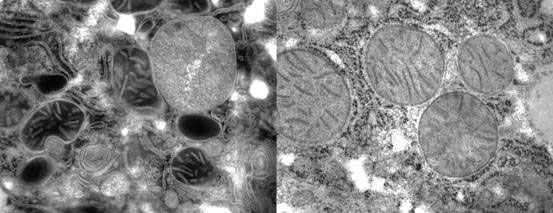
Figure 2. Two faces of a cell under the electron microscope, left, when water is not harshly stripped away, right, best standard fixing and dehydration procedure (courtesy of Dr. Ludwig Edelmann, Saarlandes University)
Just compare what Edelmann has accomplished with the best that standard procedure has to offer. There are so many more structures you can see in Edelmann’s life-preserving snapshot, the structures are fluid and dynamic as if they are changing shapes as they converse with one another. In the snapshot of the fixed and dehydrated cell, most structures are reduced to grainy debris, and the remaining structures are swollen rigid. Find out more in Science in Society 24.
I would have liked to tell you more about quantum coherence and quantum physics that really excites me. If you read Science in Society 22, you will find that, not just the organism, but the entire universe may be quantum coherent. We put out a call for quantum jazz artworks in a competition. Sadly, we did not get any entries. But now that you know what quantum jazz is, perhaps you can contribute in whatever way you feel inspired to. Please inspire us!
Based on lecture delivered at Artists Review Meeting, 20 September 2006, Goldsmith College, London University.
Article first published 16/10/06
Comments are now closed for this article