
To follow up on your articles, Organic Cotton Beats Bt Cotton in India (SiS 27) and Message from Andra Predesh:Return to organic cotton & avoid the Bt cotton trap (SiS 29), I enclose photographs of mealy bugs infested cotton plants in the demonstration plots of different seed companies in Vidarbha: Ganga Kavari, Paras Bbhrahma, and Banny. All of the plots have the Bollgard label. These mealy bugs have never been in our region on any plants before Bt cotton was introduced. I learned about the devastation of cotton in China two years ago. This alerted me to photograph and video the demonstration plots regularly. So, anybody can say with confidence now that the mealy bug has entered Vidarbha cotton fields through the Bt cottonseed.
Now when the cotton plants have died, the mealy bug is shifting to nearby plants. By mid June, farmers will go for the new cotton crop or plant another crop. But before that, the bug will have multiplied like any thing. It has shifted to Congress weed nearby, and many other weeds and plants in gardens.
At the same time I am studying the sudden death of plants. The new generation cotton seeds, called ‘Research Hybrid seeds’; are all male sterile. In short, they are terminator seeds; and proven by the high-level government committee in1993. I have the report of it. The breeder then published an article advising farmers that they should not use the F2 seeds of such hybrids, as the plants coming out of them are 100 percent sterile. Your article, Killing Fields Near You (ISIS News7/8) confirmed this for me.
I am an organic farmer residing at Yavatmal in the state of Maharashtra. Our organisation, Vidarbha Organic Farmers Association, has been propagating organic farming since 1994. We have been helped a lot by Dr Vandana Shiva. She was the first person to tell us about about terminators. Right now, we are working for her organisation Navdanya.
Ram Kalaspurkar, organic farmer, Vidarbha Organic Farmers Association, Yavatmal, Maharashtra, India
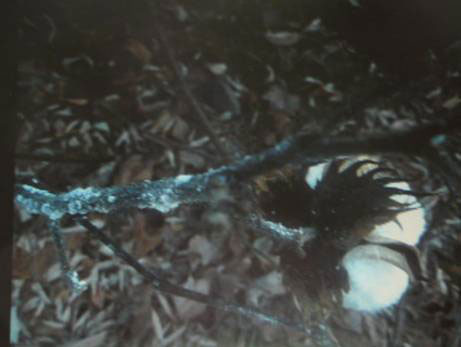
Bt cotton plant infested with mealy bugs
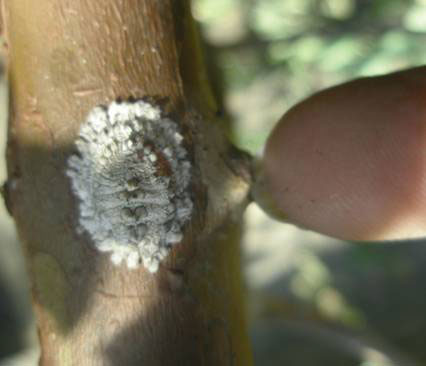
Close-up of big mealy bug on Bt cotton plant
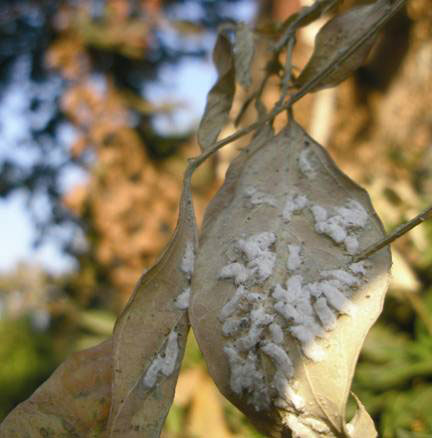
Other plant infested with mealy bug
Regarding your article, Mystery of Disappearing Honeybees (SiS 34), I am a Dutch beekeeper in the east of the Netherlands near Germany, and we see the same problem with bees, as in Belgium, Germany, France and the whole of Europe. In the Netherlands the government is set to give permission for growing GMOs, even in such a very small country. It will cause a lot of damage: bad for biodiversity, the earth, water, air, drinking water and food.
I just lost 68 percent of my bees, and I blame the city workers who sprayed glyphosate twice at the end of October last year. My beehives were 4 metres from the spray, whereas the legal distance is 200 metres. By the beginning of January 2008, the bees started to die. The municipal authorities in villages and small cities spray glyphosate on weeds in public places, gardens and footpaths. In big cities, they would use steam instead of weed killers.
I did a ‘test’ in September 2007 with a bit of glyphosate, and within three or five minutes, the bees were dead. It is very important for the city workers to give people warning when they spray, but they never do.
We must study the toxic effects of GMOs and glyphosate, for the sake of the next generation, our children, as well as the sick and old people.
Hans van den Broek, Stalen Enk, BR Velp, The Netherlands
I just read your article, Mobile Phones and Vanishing Bees (SiS 34). I am concerned, because I work at a 3G company in Sydney, and have started to notice large numbers of dead bees in the stairwell, about 60 of them last time I looked….
It may be a random coincidence, but maybe they are being mis-directed by the signals from our building? Is there anything I can do?
Name and address supplied, Sydney, Australia
Dr. Mae-Wan Ho replies
If there is a mast on top of your building, I suggest the company engineers measure the intensity of microwave radiation inside your building. Although the main beam is directed away from the building, substantial radiation could be coming from the 'side lobes' of the transmitted microwaves. If it is killing bees, certainly not good for people either. Perhaps your engineers can suggest some effective shielding for the building.
Please watch out for further signs of dead bees. To protect the bees you will have to re-site your transmitter(s) away from the paths of bees.
I am working at a property developer at Jakarta (the Capital of Indonesia) and came across your article, Biogas Bonanza for Third World Development (SiS27).The company I am working for (and its affiliates) is developing several low-end apartment towers. My Directors are very keen on the idea of using biological (human) waste as an additional source to generate electricity power. I am trying to prepare a simple study on this issue. Could you advise me where I should start?
Felix, Jakarta, Indonesia
Dr. Mae-Wan Ho replies
Most countries that have used human wastes to generate biogas have done so on a family scale, mixed in with livestock and other wastes. You can find the most up-to-date details in the final chapters of our Food Futures Now *Organic *Sustainable *Fossil Fuel Free (ISIS publication, 2008). But one reader has drawn our attention to a newspaper report “Tiruneermalai can now use biogas for streetlights” (The Hindu, online, 9 July 2007), describing a project of the Tiruneermalai town council that involved collecting human waste from 240 dwelling units in for anaerobic digestion. The resulting biogas operates a generator to provide power for streetlights. The company A. Mohan of Sundarm Fabricators that made the biogas digester said the model would be ideal for multi-story apartments. It has installed similar systems at three villages in Namakkal and seven villages in Salem.
I certainly think this is a very good idea that should be implemented worldwide. We have suggested including human wastes for anaerobic digestion in our zero-emissions, zero-waste, food and energy Dream Farm 2 described in the ISIS publication mentioned above.
Article first published 30/05/08
Comments are now closed for this article