
How cold fusion and antigravity experiments led engineer/physicist Frank Znidarsic to a new causal theory that relates all natural forces and might well have interested Einstein; but is he right? Dr. Mae-Wan Ho
Electrical engineer and physicist Frank Znidarsic has been investigating new sources of energy for twenty years following the trail of cold fusion and antigravity research. He finally came up with a startling new theory of quantum reality that relates all the natural forces including gravity [1-3], but has yet to publish in a mainstream journal, though there is a peer reviewed paper accepted for publication [3], co-authored with Glen Robertson of NASA Marshall Laboratory. At Znidarsic’s request [4], I looked into his theory and became sufficiently convinced to write about it.
The unification of all forces – ‘a theory of everything’ or ToE - a project started by Albert Einstein and taken up by many after him, has become the holy grail of theoretical physics. Although the unification of weak electromagnetic and strong nuclear forces has been achieved, gravity remains beyond the pale of existing physical laws. If Znidarsic is right, his theory (which I shall call the Z Theory) may well lead to an understanding of the range and the strength of the force fields and can also provide an explanation for Planck’s constant, the fine structure constant, the Bohr atom, the quantum jump, and the intensity of atomic emission spectra, etc., a long list of unsolved mysteries, or mysteries accepted to have no explanations by the scientific community. No other candidate ToE has come close to accomplishing all that, and especially not the standard theory of the universe that’s in danger of going down in history as the most spectacular failure of big science (see Box1).
Box 1
Higgs boson is a boojum
At a conference in August 2011 scheduled to announce the discovery of the Higgs boson that would confirm the standard theory of the universe, scientists at CERN have had to admit the “god particle” might not exist at all [5]. Earlier in July, scientists in US Fermilab near Chicago, who have been searching for the Higgs boson for nearly 30 years said they hoped to establish if the Higgs exists by the end of September when the Tevatron closes down.
If the Higgs boson does not exist, it would have been the most spectacular failure of big science, as well as the most phenomenal waste of taxpayer’s money. Physicist Shahriar Afshar already warned of “chaos and infighting” among scientists, and a complete loss of confidence among the general public and taxpayer [6], should the Higgs boson fail to turn up
The Large Hadron Collider, purpose-built to hunt for the Higgs boson, is housed in a 27 km circular tunnel buried 175 m beneath the Swiss-French border at CERN (European Organization for Nuclear Research) in the suburbs of Geneva [7]. It took 16 years and a consortium of 20 nations spending a total of US$10 billion to complete [8], plus a yearly operating cost of $1 billion [9].
It began operating in September 2008, but a “spectacular failure” due the an explosion between two of the collider’s powerful superconducting electromagnets shut it down for more than a year. When it reopened, it operated at only half power at 3.5 trillion electron volts (TeV) per proton instead of the 7 TeV for which it was designed [10]. At the end of 2011, all CERN accelerators will shut down for 15 months for repairs, including an unknown number of magnets that have mysteriously lost the ability to handle the high currents and produce the high fields necessary to run the Collider at full strength. The Collider is scheduled to start up again in 2013 with proton energies of 6.5 TeV.
CERN plans an upgrade to a total proton energy of 33 TeV over the next 20 years, almost as much as the US superconducting super collider cancelled by Congress in 1993. Meanwhile, the ‘good news’ is “Higgs particle could be found by Christmas” [11], or most likely not.
The Z Theory is simple and intuitive once the basic physics and engineering concepts are explained, thanks to enthusiastic fellow physicist Lane Davis [12], who has created an excellent series of more than 20 videos posted on YouTube [13]. Davis takes you from high school electromagnetism and practical everyday engineering through highly controversial cold fusion and anti-gravity research to the elementary algebra that encapsulates the Z theory, proving how all the fundamental constants are reduced to just one, the velocity of sound in the atomic nucleus of about 1 million metres per second, 1.093846 x 10⁶ m/s, to be more precise [12].
The series is narrated by Davis himself, illustrated throughout with examples from games and sports, and peppered with irrelevant, irreverent, and sometimes comic relief from the maths. And for a grand finale, the ‘master’ equation is presented in rap. Wish I had a physics teacher like that when I was young.
Znidarsic’s strength is his ability to translate effortlessly between abstruse theoretical/ mathematical concepts and physical intuitions of mechanical and electrical interactions; a rare talent in danger of being snuffed out altogether by an education system that separates scientists from engineers, the theoretical and academic from the practical and technical.
Znidarsic’s journey began by visiting laboratories engaged in unusual research shunned and denigrated by the mainstream academic community: cold (nuclear) fusion in electrolytic cells and gravity modification with spinning magnetic fields. The velocity of about 1 million metres per second kept turning up in both types of experiments. The common ingredients are electromagnetic interactions in condensed matter, leading to nuclear fusion in one setting, and in the other, antigravity effects. Znidarsic decided that the velocity of 1 million metres per second is that of ‘sound’ within the nucleus, and from then on, it was plain sailing as he homed in on the Z theory.
The velocity of 1.094 million metres per second is the lynchpin of the Z theory. The quantum transition (quantum jump), which so mystified and frustrated Einstein and many great quantum physicists, is the result of a classical impedance match – a match that allows energy to flow directly without resistance within the atomic structure - when the velocity of light in the outer electronic orbitals of the atom equals the velocity of sound within its nucleus, i.e., 1.094 million metres per second, and energy transfer can take place with 100 percent efficiency. The 100 efficient process emits one photon, not a series of progressively smaller photons that would be emitted by less efficient non-impedance matched system.
At the same time, momentum – the quantity of motion, or impetus - is carried by the magnetic components of the electronic and nuclear force fields. This requires us to accept that magnetism is not a conserved property, but can be greatly amplified locally, in the same way that inserting an iron core inside a coil of wire carrying an electric current greatly amplifies the magnetic field passing through the core. Crucially, the magnitude of the electromagnetic, gravitomagnetic, and nuclear forces converge during the quantum transition, enabling the separate fields to exchange energy in one single step.
It is this increase in the magnetic component of the strong nuclear force that makes nuclear fusion possible – without the need for thermonuclear temperatures – and sometimes results in the appearance of local gravitational anomaly.
That is the gist of the theory, which I shall explain in more detail, starting with a brief look backwards at conventional quantum mechanics.
Physicist Max Planck in Germany initiated the present era of quantum physics by introducing the idea at the beginning of the past century that light (and the entire electromagnetic spectrum) comes in tiny packets or quanta, the energy E of each quantum being proportional to the frequency of light f, as in Equation (1) for Einstein’s photoelectric effect.
E = hf (1)
The proportionality constant h is Planck’s constant – the smallest unit of action - named after its discoverer. Planck’s constant is derived from experiments, and accounted for the discrete spectral lines of sunlight and light emitted from elements excited by X-rays, but Planck had no explanation as to where that constant comes from.
Danish physicist Niels Bohr applied Planck’s constant to the structure of the atom in a model with electrons orbiting the nucleus rather like planets orbiting around the sun in our solar system. Bohr’s model of the atom is quantized, i.e., it has electrons orbiting the nucleus at different energy levels in multiples of Planck’s constant. It explained the emission spectrum of the atoms in terms of quantum transitions from higher to lower energy orbits, and accounted for the chemical properties of the elements. However, according to classical electromagnetic theory due to Scottish physicist and mathematician James Clerk Maxwell, orbiting electrons are accelerating all the time and should continuously emit electromagnetic energy, and hence soon fall into the nucleus. Bohr’s model could not explain the stability of the atom, nor can it produce the probability of quantum transitions from one energy level to another, among other things.
French physicist Louis deBroglie offered the solution. He proposed that the electron has wave-like properties. The electron does not circulate in orbits around the nucleus. Instead, it encircles the nucleus in the form of a standing wave, and a particle-like photon is emitted as these standing waves instantaneously collapse during a quantum transition. This wave-particle duality of light and matter is a paradox in quantum physics, for which there is no explanation.
The widely accepted ‘Copenhagen interpretation’ proposed by German-born physicist and mathematician Max Born tries to get around those difficulties by saying that deBroglie’s matter waves are just a mathematical construct and not real. Einstein rejected the Copenhagen interpretation and believed to his dying day that the theory of quantum mechanics is not complete.
It is against such a backdrop that Znidarsic’s theory emerged, thanks to new observations rejected by the establishment on ground that they cannot be explained within conventional physics, quantum or classical. Instead of questioning conventional physics, the establishment closed its collective mind and locked out the true scientists who welcome new challenges, and would sacrifice almost anything in pursuit of beauty and truth (see [14] Beauty and Truth in Science and Art, I-SIS publication).
We have reviewed cold fusion experiments extensively beginning four years ago, and most recently in connection with its possible commercialisation [15] (Cold Fusion Ready for Commercial Production? SiS 51). ‘Cold fusion’ refers to nuclear fusion reactions that happen in desk top devices, such as electrolytic cells, at well below thermonuclear temperatures of millions of degrees Centigrade. These reactions - first demonstrated in 1989 by electrochemists Martin Fleishman at University of Southampton in the UK and Stanley Pons at Utah University in the US – aroused a storm of controversy that has yet to subside, with detractors calling cold fusion research ‘quackery’ and worse.
I am convinced that cold fusion works, and in many different forms, all dependent on the collective quantum properties of condensed matter that conventional quantum mechanics has yet to take into proper account. There are already several theories that explains cold fusion in terms of collective quantum properties (or quantum coherence) [16] (How Cold Fusion Works, SiS 36); Znidarsic’s theory is one of them, but at a much more general and fundamental level.
Znidarsic noticed that cold fusion reactions proceed in a (coherent) domain of 50-100 nanometres on being excited with energy input in the range of about 1013-1014 Hz. The product of the domain size –taking it to be equal to the grain structure in the cathode metal - and the frequency of excitation energy gives one million metres per second, a velocity that Znidarsic calls the quantum transitional velocity, Vt.
The gravity experiments of Russian-born Eugene Podkletnov, which inspired Znidarsic, were originally carried out at Tempere University of Technology in Finland, until Podkletnov was dismissed from the University when a journalist reported his work as ‘antigravity’, a term Podkletnov himself never used [17-19]. The best results were obtained when a 3 megahertz AC magnetic field was used to stimulate the 0.3 meter diameter superconducting toroidal disk spinning in a levitated state over the magnetic field [1]. (This levitation of the superconducting disc itself has nothing to do with gravity. It is relatively well understood as the effect of the repulsive force generated by the superconducting disc against the magnetic field [20]). A gravity anomaly appeared above the disc, in the form of reduced atmospheric pressure and reduced weight of up to 2 percent or more [17-19], that cannot be explained by the usual diamagnetic interaction, as it depends solely on mass, and not on the nature of the material itself. The product of the disc size (the coherent domain as wavelength of the electromagnetic field) and the stimulation frequency once again, as in the case of cold fusion, gives a velocity of about 1 million metres per second, the same quantum transition velocity, Vt, which Znidarsic identified as the velocity of ‘sound’ or optical phonons within the superconducting disc.
Cold fusion and antigravity appear totally unrelated to the casual observer. But Znidarsic noted the connection via the velocity of ‘sound’ or phonons within the coherent domain of 50 nm in the cold fusion experiments and the much larger 0.3 m superconducting disc in the gravity modification experiments. The clue lies in the correlated electronic vibrations of the atoms within the coherence domain, which physicists call a ‘Bose Einstein condensate’ (BSC): all the atoms in that state act as one, and can be considered a single entity.
With a combination of intuitive imagination and analogies to mechanical vibrating system within the atom, Znidarsic showed that the velocity Vt, is very likely to be equal to the speed of sound in the nucleus (see Box 2). (For those who get intimidated by equations, please skip over the box, as it just adds corroborative details in subatomic vibrations to make the transitional velocity Vt credible.)
Box2
Identifying the speed of ‘sound’ in the nucleus
Picture the electrons as force fields vibrating back and forth towards the nucleus, or better yet, as particles attached to an elastic band and engaged in harmonic motion. The strength of the restoring force is directly proportional to the square of the displacement of the particle from its rest position, i.e., the greater the displacement, the stronger the restoring force, up to a maximum, Fmax of 29.05 Newtons at the radius of the electron re (which is half the classical radius of the electron). The elastic constant, K-e, which determines the magnitude of the restoring force, is an inverse function of the displacement rx multiplied by Fmax.
K-e = Fmax / rx (1B)
The expansive electromagnetic force of the electron is counteracted by the compressive, strong nuclear force acting in the opposite direction. At points where the forces balance, the elastic constant of the electron field equals the elastic constant of the nuclear field and the harmonic motion of a nucleon (proton) is produced. The frequency of this harmonic motion fn, is given by Equation (2B) (the division by 2p converts angular frequency to frequency in Hertz, and Mn is the mass of the nucleon).
fn = 1/2p √( K-e /Mn) (2B)
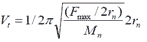
The velocity Vt emerges as the product of the frequency at a displacement equal to twice the momentum spacing of the nucleons, rn of 1.36 x10⁻¹⁵ m (larger than the radius of a proton because of movement of adjacent nucleons; this comes from standard nuclear physics when calculating the velocity of nucleons).
 (3B)
(3B)
Vt is therefore the speed of ‘sound’ or phonons generated by vibrations of nucleons within the nucleus.
Vt, the speed of sound within the nucleus, is also exhibited across atomic distances within the coherent domains of cold fusion experiments and across the macroscopic distance of the superconducting disc in gravity modification experiments.
When the speed of light in the electronic structure of the atom equals the speed of sound in the nucleus, energy transfer can occur without loss at 100 percent efficiency. This is a condition similar to that of a billiard ball hitting directly another pool ball. All of the energy is transferred at once without bounce. A similar condition results in the emission of a single photon. Conversely, a ball bouncing off of the earth is an example of a non-impedance matched system. The earth does not move at the speed of the bouncing ball and the ball gives up energy in a series of progressivity smaller bounces. A series of progressively smaller photons are not emitted during a quantum jump and Znidarsic concluded that the process of quantum jumping is one of impedance matching.
Light or electromagnetic radiation in vacuum has a much higher velocity, c = 299,792,458 metres per second, nearly 300 times as large as the velocity of sound in the nucleus of atoms identified by Znidarsic. In order for light in the electronic structure to match the velocity sound in the nucleus, it must be slowed down nearly 300-fold. Light does indeed propagate at reduced velocity through dense media; the refraction of light in water is an everyday example. In the laboratory, scientists have managed to slow light down even to a standstill in a BSC of atoms [21, 22] (see [23] Trapping Light, SiS 22).
In a similar way, the external stimulating electromagnetic fields are trapped and slowed down within the coherent domains in cold fusion and superconducting disc in the gravity modification experiments. And when the slowed electromagnetic velocity matches the velocity of sound within the nucleus, there is no longer any barrier to energy transfer, and cold fusion can proceed [16].
The gravity modification experiments show that gravity is indeed tied up with electromagnetic forces in some mysterious ways, as has already been suggested by the work of other physicists, notably Robert Dicke, Bernard Haisch, and Harold Puthoff in the United States [24-29]. Dicke and Puthoff proposed that mass alters the electric permittivity and the magnetic permeability of spacetime [28]. Haisch and coworker Alfonso Rueda proposed that [29] “a background sea of quantum light” fills the universe and generates a force that opposes acceleration, which is why matter seems to be solid. So “maybe matter resists acceleration not because it possesses some innate thing called mass…but because the zero-point field exerts a force whenever acceleration takes place.”
Znidaric suggests that the BEC in the superconducting disc somehow locally amplifies the magnetic components of the forces. An increased magnetic field is required to carry the same amount of energy at a lower velocity. The process is similar to that of a tsunami, as the tidal wave slows, its height piles up in an amount necessary to carry its energy.
This increased gravitomagnteic field gives apparent antigravity effects. In other words, the weak and strong forces and gravity balance out via their amplified magnetic components. Znidarsic emphasizes that this does not violate any law of conservation, as it is known that magnetic, as well as electric permittivity can be modified locally. The BEC therefore, acts like a soft iron core, only much more so, as the magnetic component of mass (gravitomagnetic force) is only 10-39 that of the ordinary electromagnetic field
When asked how that amplification could be achieved, Znidarsic says he does not exactly know, but suspects it involves an increase in the magnetic component of the fields that compensates for the reduced velocity of the fields; “just as water flows in a river bed through a valley electrons transit between states through channels of matching impedance.” Could this be the “zero-point energy” that has been the holy grail of Haisch and Puthoff and their followers, including Podkletnov and Znidaric , who see space-propulsion systems that can travel at 6 times the speed of light, as Podkeltnov claims for his latest, as yet unpublished experiments on gravity pulses [19]? I leave these tantalizing questions hanging, while I go on to more immediate important things.
Vt, the velocity of quantum transition, is that at which the velocity of light within the electronic structure of the atoms equals the velocity of sound within its nuclear structure and the impedance of the interacting states are matched, so energy is exchanged “without bounce” (i.e. with no barrier and at 100 percent efficiency). That is what accounts for the quantization of energy levels in the atom. Electrons attempt to flow along all possible paths but they can only move between orbits through channels of matching impedance. Znidarsic shows that Planck’s constant is based on Vt , which also determines the energy levels of the Bohr hydrogen atom and the intensity and probability of its spectral emissions.
In essence, the energy of the photon is given by Equation (2) where Q is the elementary charge, and eo is the electric permittivity of free space.
 (2)
(2)
The terms within the brackets [ ] equals Planck’s constant, and Equation (2) thereby reproduces Einstein’s famous photoelectric relation in Equation (1). Planck’s constant is shown to be a simple function of the elementary charge and the quantum transition velocity Vt.
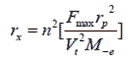
Similarly, the principle radii of the hydrogen atom rx is derived in Equation (3) where n is an integer, Fmax is the maximum restoring force of 29.05 Newtons for harmonic motion of the electron at the radius of the electron, rp is 1.309 x 10⁻¹⁵ metres, the radius of energetic accessibility (also half the classical radius of the electron, and comes from an analysis where the electrical force is viewed as a spring), and M-e is the mass of the electron, 9.109 x 10⁻³¹ kg.
 (3)
(3)
The expression within the brackets [ ] equals the ground state radius of the hydrogen atom, and the equation also determines the principle energy levels of the hydrogen atom.
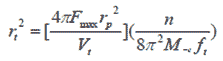
Finally, the probability of quantum transition is shown to be the square of the intensity of the spectral line, which is just the amplitude of electronic harmonic motion at transition, rt given in Equation (4), where the terms between the brackets [ ] is again Planck’s constant.
 (4)
(4)
The fine-structure constant, a, is a fundamental physical constant or coupling constant characterizing the strength of the electromagnetic interaction introduced by theoretical German physicist Arnold Sommerfeld in 1916, who found that it determined the splitting or fine-structure of the hydrogen spectral lines. Its current value is 7.2973525698 x 10⁻³ or approximately 1/137 [30]. It is defined in terms of other fundamental constants, and the simplest formula is Equation (5), where e is the elementary charge, ћ = h/2p is the reduced Planck’s constant, c is the speed of light in vacuum, and ke is the Coulomb constant. Its origin remains obscure, however.
a = kee2/ћc (5)
Znidarsic found a simple expression for the fine structure constant given in Equation (6).
a = 2Vt/c (6)
As the ratio of two velocities, a is naturally dimensionless.
Znidarsic has derived quantum mechanics from classical Newtonian mechanics, thereby showing that “quantum mechanics is a special case of Newtonian mechanics”, rather than the other way round. This is an enormous claim, and not likely to be easily accepted by the physics establishment. The ball is now in their court, to show how and if Znidarsic is mistaken.
Article first published 12/09/11
Comments are now closed for this article
There are 12 comments on this article.
Dr. Michael Clarjen-Arconada Comment left 13th September 2011 06:06:55
Fascinating and thrilling are the implications of Znidarsic genial contribution: a new theory of quantum reality that relates all the natural forces including gravity.
Thank you Mae-Wan-Ho for the brilliant and thorough exposition integrating all the factors in the global equation: "Znidarsic has derived quantum mechanics from classical Newtonian mechanics, thereby showing that quantum mechanics is a special case of Newtonian mechanics, rather than the other way round." It is delightful to read through, savoring every word including the specific equations. It makes you salivate for more to come.
Appreciating the principle radii of the hydrogen atom (rx, equation 3)in understanding its principle energy levels, will enable human beings to harness better the over-abundant energy present on Earth, the Planet of water (H20)and light (sun).
As we dwell in the harmony of these equations, we discover intuitively that the solutions to our food an energy systems on Planet Earth have to come primordially from water-hydrogen and sun-light sources. At this point in time, it is fair to say: we hold this truth to be self-evident.
Let us put our best minds to design simple methods of clean (complete cycle) energy systems(renewable, distributed) around the simple Code: Return to the Ecological-Organic Garden. In this way we can produce abundant clean food and energy in order to regenerate human beings and Planet Earth, and achieve optimal sustainable development genuinely for humans and other species
in this Planet.
robert garrison Comment left 13th September 2011 17:05:10
brilliant.are there any opposing arguments at this time?simple and ellegant.
kyle manjaro Comment left 17th September 2011 06:06:31
An essential view in quantum mechanics (QM) is expressed in its tenets of non-separability upon which entanglement, for one, is founded.
QM is a non-local theory. NM (Newtonian Mechanics) is a "local" theory - and "local," to remind ourselves about the matter, doesn't refer to 'neighbourhood,' it refers to non-separability.
In this view, both points of view are true: NM is a special case of QM and QM is a special case of NM.
The "special case" is determined by the restriction or not (from one point of view) to "local" or "non-local", or, from the other 'classical' or recent historical point of view, an expansion from a "local" to a "non-local" point of view, which, in part, is the route we've already taken to QM.
Everything a part of the whole versus everything as the whole in parts. Seeing the 'thing' whole versus seeing the whole 'thing.' Wisdom versus analysis-synthesis as two distinct and differently inclusive ends of the same "telescope."
A key relationship is that the non-local is necessarily always to be found in and as an inherent part of the local, and the local is inherently always a restricted potential in the non-local.
IMHO! Just saying!
KM
F.Monti Comment left 18th September 2011 02:02:50
For something similar look up Harold Aspden's work. His published papers and books on unified theory are freely available online.
David Llewellyn Foster Comment left 17th November 2011 21:09:52
When I searched for Z theory I could only find this paper by Pietro Giorgio Zerbo
http://arxiv.org/ftp/physics/papers/0602/0602047.pdf
Might not this alternative attribution of authorship prove to be a potential source of misidentification and therefore a cause of possible confusion about generic "Z Theory" - especially for those of us who are not theoretical physicists, and who may be struggling to comprehend the special significance of these arcane formulations? Guess I had better watch the Lane Davis video series!
icarus Comment left 22nd November 2011 21:09:43
Cute, compelling result that with fine structure constant being ratio of two velocities.
But I don't see where gravity comes into it ... what am I missing here. Is it a theory of everything or just a better description of the atomic interactions? (Formidable in itself of course.)
Ted Kepple Comment left 23rd November 2011 03:03:04
Very Impressive, but way over my head...
Frank Znidarsic Comment left 27th November 2011 02:02:16
My papers on Microsoft Academic
http://academic.research.microsoft.com/Author/7519801.aspx
enjoy
Frank Znidarsic
Emanuel Comment left 1st February 2012 00:12:30
wonderfull stuff !!! If this is correct the implications in science and tech are huge !!! The simplicity of the equations have a great impact on me
Ryan Schroder Comment left 16th May 2012 18:06:41
I find this theory quite insightful in that it offers an approach that I have not yet seen in conventional particle physics derivation. It is clear that the transition velocity is directly related to the energy level transition and does reflect the idea of the 100% efficiency photon frequency emission along with solving the Doppler problem that is ignored in the debroglie Model. However, this all being true, does not make it correct to say that quantum theory is not true in any way. Quantum theory allows us to look at particle systems from many different approaches and hold very general relationship truths and patterns that can not be denied. The essence of location does not exist in the particle world they way it does in the classical world so it is obvious that derivations such as the ones above can not be always applied. Throwing away quantum mechanics due to a special case observation under the condition of super conductivity does not at all seem to be a constructive approach for a scientist, and this is coming from a scientist who agrees with your theorem! That would be me. Yes this relation does hold true, but it can not replace quantum mechanics, it can only add a small piece to it, a piece that happens to be solved via unconventional methods with respect to quantum standard. Lastly, the part I do disagree with is that there is even the existence (in our universe at this time) of a gravitomagnetic force-field. Gravity does NOT depend on ferromagnetic properties nor the magnitude of any magnetic field anywhere in the universe. String theory hits the closest to the mark in that gravity gauge bosons are closed strings not bound to a membrane as the other bosons are.
Renko Comment left 10th August 2013 19:07:49
Ryan Schroder said: "Throwing away quantum mechanics due to a special case observation under the condition of super conductivity does not at all seem to be a constructive approach for a scientist, and this is coming from a scientist who agrees with your theorem!"
Who said it's a good idea to throw away quantum mechanics? It's like blaming Einstein for throwing away Newtons laws, no?
Hatt Philippe Comment left 12th February 2016 23:11:58
This represents a great step in the comprehension of natural forces and their interrelations .
There is still one thing lacking .What about the initial force driving the whole process within the nucleon .I try to give an answer to that question ,considering that a force creating the mass is at the origin of the process .Actually without mass none of the four fundamental interactions are working .Mass is generally considered as a given ,for me this is not the case as a force is driving the creation of mass .Having determined that force ,I could deduct the other forces from that primordial one .
Please see my site if interested :philippehatt.com