
Non-GM varieties more drought resistant, yet agritech giants ensure farmers are unable to access them Dr Eva Sirinathsinghji
The United States is suffering the worst drought in 50 years. But crop damage may well have been avoided if high quality non-GM varieties were available to farmers. Further evidence is emerging that glyphosate-tolerant crops are ill-equipped to deal with drought, while high quality non-GM varieties are flourishing. Monopoly of the seed industry has left farmers unable to get non-GM varieties, despite the drought having global repercussions including steep rises of cereal prices and reduced meat production in many countries.
In a commentary circulated by GM Watch (UK), Howard Vlieger, a co-founder and agroecological farming advisor of Verity Farms in drought-stricken South Dakota the US, provides evidence from a farmer who has grown both GM and Verity Farms’ non-GM varieties of soybean and corn side by side [1]. Non-GM corn, grown in agroecological conditions to promote soil biodiversity and nutritional content is shown next to Monsanto’s GM triple-stack GM corn, which is glyphosate-tolerant and additionally expresses two Bt insecticidal toxins, grown using conventional chemical industrial methods that include the use of Monsanto’s glyphosate-based herbicide, Roundup (Figure 1). As captured in the photograph, non-GM varieties appear greener, fuller, and healthier. These impressions are backed up by the far superior yield reported of non-GM corn, which averaged 100-120 bushels per acre (BPA) compared to the 8-12 BPA to 30-50 BPA of GM corn.
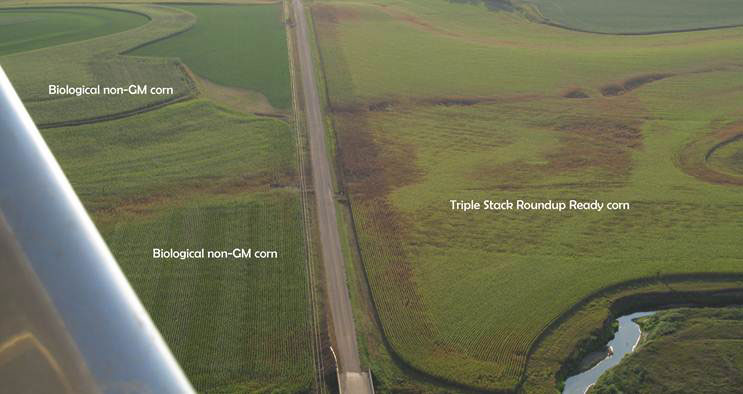
Figure 1 Aerial photo of adjacent fields with non-GM corn (left) and triple stack roundup ready GM corn (right)
The large yield differential was confirmed in a new set of harvest data provided by Vlieger (with accompanying photographic identification) for three fields surrounding Verity Farm, all growing Smart Stack RR corn [2]. All were harvested for corn silage as the yields were too poor to harvest the grain. The federal crop insurance adjuster appraised yields were respectively 12 bushels per acre (BPA), 27 BPA, and 28 BPA. The Non-GMO corn on Verity Farm across the road yielded 108 BPA.
The findings were replicated with soybean crops (see Figure 2).
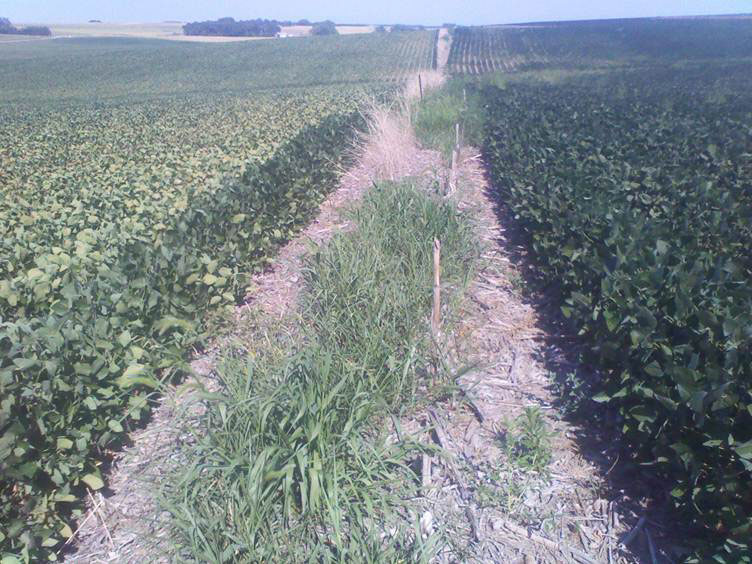
Figure 2 GM (left) and non-GM (right) soybean crops
Triple Stack RR corn may be especially drought intolerant, but the new evidence from the farm is consistent with previous laboratory findings that glyphosate-treated crops are less water efficient than untreated crops. One such study was performed in Brazil when farmers reported “injured-looking” glyphosate-tolerant soybean crops. The team, led by Luis Zobiole from State University of Maringá found that GM glyphosate-tolerant (GT) soybeans absorbed less water, which resulted in reduced water efficiency [3]. The volume of water that non-treated GT soybean plants required to produce 1 g of dry biomass was 204 % and 152 % less than required when the plant is exposed to 2 400 grams acid equivalent (a.e) of glyphosate per hectare, in single or sequential applications respectively. GT soybean plants receiving a single application of the currently recommended rates of glyphosate (600–1200 grams a.e per hectare) needed 13–20% more water to produce the same amount of dry biomass than non-glyphosate treated plants.
A previous publication by the same lab showed GT soybeans to have reduced lignin content and photosynthesis rates, both possible mechanisms for the reduced water efficiency [4]. Lignin is an essential component of plant cell walls, and contributes to the compression strength of stems and to the efficient transport of water and solutes over long distances within the vascular system. Water deficiency is not the only physiological effect that glyphosate imposes on crops. It has been shown to reduce nutrient availability and immune responses and thus defence against plant diseases (see [5] Glyphosate Tolerant Crops Bring Death and Disease, SiS 47). At least 40 diseases are known to be increased in weed control programmes with glyphosate and the list is growing, affecting a wide range of species: apples, bananas, barley, bean, canola, citrus, cotton, grape, melon, soybean, sugar beet, sugarcane, tomato and wheat [6].
Many farmers are fully aware of the control of the seed industry by multinational corporations like Monsanto. Prior to the mid-20th century, the majority of seeds were in the hands of farmers or public-sector plant breeders. Now, agritech giants have used intellectual property laws to commodify the worlds’ seed supply and turn seeds into private property to be bought and sold for profit. As a result, not only are they flooding the market with patented GM seeds and preventing farmers from saving them each year, they are also diminishing the supply of non-GM seeds. Monsanto is now the largest seed company in the world followed by DuPont and Syngenta; they have all acquired or created “partnerships” with independent seed companies that sell both GM and non-GM seeds. As highlighted recently by Pierre Patriat, director of APROSMAT, the association of seed producers of the Brazilian soy-producing state of Mato Grosso in Brazil, farmers are faced with little choice but to grow GM varieties, which is posing a serious threat to the country’s food security and sovereignty [7]. An estimated 23 % of the propriety seed market is owned by Monsanto who, in addition has used licencing agreements to spread its technology - giving some 200 smaller companies the right to insert Monsanto's genes in their separate strains of corn and soybean plants [8, 9].
According to Vlieger, the demand for their non-GM seeds is on the rise, offering an alternative to the current monopoly. While the non-GM seeds are bought out, their GM seeds are sitting in the warehouse. He is hopeful that the demand will be met with increasing supplies of non-GM varieties by small and larger companies as they awaken to the needs of farmers.
In a decisive move, Peru passed a ten year ban on GM ingredients in March 2012 in response to farmers who are worried that the introduction of GMOs will compromise the native species of Peru such as the giant white corn and the numerous species of famous potatoes [10]. It is about time that the rest of the world follow suit (see [11, 12] The Case for A GM-Free Sustainable World and Food Futures Now *Organic *Sustainable *Fossil Fuel Free , ISIS publications).
Glyphosate-tolerant crops have been repeatedly shown to be less healthy than conventional varieties. Their increased water demands make them entirely unsuitable in times of unpredictable weather conditions and increasingly limited supply globally (see [13] World Water Supply in Jeopardy, SiS 56). Monopolisation of the seed market means conventional varieties are unavailable, therefore reducing the farmers’ ability to effectively deal with changing conditions and most worryingly, it threatens global food security and sovereignty. A global shift to non-GM agroecological farming is the real way forward.
Article first published 09/10/12
Comments are now closed for this article
There are 7 comments on this article.
Cindy Comment left 9th October 2012 22:10:22
A farmer who has land next to a lake in southern Michigan dug a deep well 2 years ago about 600 feet from the lake shore. He did it in the dead of winter, going through snow and frozen ground, right after the summer crowd closed up and left for the season. When they returned they found that their water pipes often sucked air. This farmer used immense irrigation systems this whole summer on his GM crops. Another GM farmer near a pond that a friend of ours owns a few miles away also drilled a well to irrigate his fields-- and the pond went dry.
Dylan Comment left 10th October 2012 02:02:33
So, Monsanto and friends flood the market with toxic products which they know beforehand will fail (whilst hoarding their own supply of non-GM seeds in a vault in the Arctic). Along with the ability to cause floods and droughts where and when required, they then make billions on weather derivatives and commodities futures (betting on weather events and crop failure without actually owning the underlying assets), knock out competition and buy up land on the cheap from distressed farmers.
Hmmm -where have we seen this Modus Operandi before?
Doomsday Seed Vault: Bill Gates, Rockefeller and the GMO giants know something we don’t
http://urlbam.com/ha/M004r
Why in the World are They Spraying? (Full Length Documentary)
http://youtu.be/j0fBcH0iuX0
Texas Wildfires: Scalar Squares Intentionally Prevent Drought Relief - HAARP
http://www.youtube.com/watch?v=FILkoBgWZ9w&feature=share&list=UU7ktpNzvxJo8PHD0bLl5K-Q
Rory Short Comment left 10th October 2012 04:04:41
The pursuit of monetary profit by companies such as Monsanto is relentlessly destroying the eco-sphere.Consulting the Genius of the Place by Wes Jackson offers a way out of the agricultural hole that we have dug for ourselves over millennia assisted in this century by Monsanto and the like.
rich Comment left 12th October 2012 05:05:45
Let that be a lesson to farmers who choose to grow GMO crops.
Todd Millions Comment left 14th October 2012 16:04:39
Adding insult to this injury-The drought resistant dwarf corn 'developed' by the big M,was ripped off from indigenous strains developed too survive drought in the SW states hundreds of years ago-yet with the insert of herb and bt toxin 'cassetes'-become in whole the massposioneers -property.Shades of green revolution!Add to this-Earl'the butt head',ordering the ripping up of the shelter belt shrubs planted at public expence in the 30's-Too prevent droughts and the severity of them,by capturing snow in drifts,when he was ag sec under Nixon,to-'bring 100,000acres of idle land into production',and we have an unbroken 40year lineage of -stunningly mage desisions.Still being copied in canaduh!
Ruth Lanton Comment left 17th October 2012 00:12:41
It's not a matter of "farmers choosing to grow GM crops." In many cases, alternative seeds aren't available in sufficient quantities, and farmers have to choose between growing GM crops or not growing crops at all.
Put the blame where it belongs: on Monsanto and other "biotech seed giants" not on the farmers struggling to make a living.
John Fryer Comment left 5th November 2012 04:04:06
The supply of seeds is a problem. Monsanto have bought up the seed companies so that there is no choice left. Where were the monopolies commissions?
But anyone with business sense couldstart up a seed business with a few acres of land and supply NON GMO seed for sale.
If you cant beat the seed compnaies why not join them and market the seeds now not easily available.