
Will farmers get justice at last from years of victimisation from big agribusiness peddling genetically engineered crops? Dr. Eva Novotny
After years of suffering what amounts to “corporate feudalism” at the hands of agbiotech giants like Monsanto, farmers are now fighting back as the US government launches an unprecedented anti-trust enquiry. A major grievance is that the required seed licence forces farmers to relinquish their right to plant, harvest and sell their own seeds (see [1] Monsanto versus Farmers, SiS 26).
The US government is concerned about the lack of competition against large corporations. So, for the first time in history, the US Department of Agriculture (USDA) and the Department of Justice have joined forces to organise a series of workshops from March to December 2010, to be held in different parts of the country, that aims to [2] “explore competition issues affecting the agricultural sector in the 21st century and the appropriate role for antitrust and regulatory enforcement in that industry.”
The first all-day hearing, held in Ankeny, Iowa, 12 March, was attended by about 500 people, including farmers from several states, ranchers, company representatives, local people and, notably, representatives from Monsanto, the company with near monopoly on seeds of maize and soybean. In the US, these seeds are mostly genetically engineered (GE) (see [3] GM Crops Increase Herbicide Use in the United States, SiS 45).
Monsanto’s dominance in the seed industry (Figure 1) illustrates the breakneck speed of corporate concentration in the sector. Monsanto now controls 60 percent of the corn seed market, 62 percent of the soybean market, 95 percent of the transgenic cotton seed market and is rapidly consolidating control of the vegetable, sugar beet and wheat markets [4]. Monsanto’s GE soybean and corn cover 92 percent and 85 percent respectively of total US acreage for those two crops.
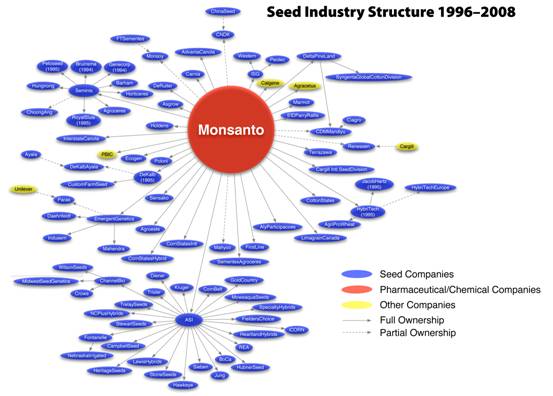
Figure 1 Anatomy of seed monopoly
At the hearing, Attorney General Eric H. Holder Jr. conceded that [5] “reckless deregulation has restricted competition in agriculture.” Agriculture Secretary Tom Vilsack, whose record [6] of promoting GE crops and corporate control does not augur well for the outcome of the workshops, nevertheless expressed concern over the present situation. “This is not just about farmers and ranchers. It’s really about the survival of rural America.” He said, “We’ve seen a significant decline in the number of farmers and ranchers and that translates into a significant decline in the number of people living in rural America.”
Commenting on the joint involvement of the two governmental departments, Mr. Holder told reporters [7]: “You will see an historic era of enforcement that will almost inevitably grow from the partnership that we have established.”
Over the years, as large multinational corporations began selling GE seeds and buying up seed companies, life has become increasingly more difficult for farmers [1]. This was starkly portrayed in the documentary Food inc [8] (The Food, Inc. Horror Movie, SiS 46), especially for those who hold out against growing GE crops.
A handful of large corporations, especially Monsanto, DuPont/Pioneer and Syngenta, dominate and control the seed market. Farmers who produce milk and raise livestock are also in distress on account of their dependence on grains for feed. Farmers are already squeezed on low prices they receive from supermarkets. In addition, they have to cope with rising seed prices, despite the recession. In the past year, prices for maize seeds have risen 32 percent; and for soybean seeds, 24 percent [9]. Since 2001, prices have increased 135 percent and 108 percent respectively, while the Consumer Price Index rose by only 20 percent. The price of Monsanto’s herbicide Roundup, used with most GE crops, doubled in 2007-2008. Further price increases for GE crops are on the way, as varieties with multiply-stacked genes are introduced [3, 10, 11] (Glyphosate Resistance in Weeds - The Transgenic Treadmill, SmartStax Corn: Corporate War on Bees, SiS 46).
Saving seeds from one year to the next is prohibited under the licence agreement. And woe to any farmer who finds GE plants growing on his property if he does not have a current licence for them: he can be sued for heavy fines by the seed company, even if the plants came from stray seeds that fell to the ground after the previous harvest, or if GE pollen blew in on the wind to fertilise the errant plants. Some farmers had spent years developing their own unique strain of seeds only to have the harvest contaminated with GE plants and confiscated by the GE company. If a farmer prefers to buy non-GE seeds, he may find it very difficult to obtain them, as Food inc. documents [9]; the dominance of the large corporations over the seed market makes them unavailable in many areas. Farmers are in a mood to fight back.
At a rally held the preceding evening, farmers voiced their grievances and opposition to the excessive control that ‘Big Ag’ has gained [12]. “The crops that we grow are the basis of our civilization from when it started; so if anything belongs in the public domain, if anything belongs to the people of the world, it’s the crops we grow for food,” said one farmer to general applause. “In 2000 Monsanto Corporation tried to patent wheat; and after a five-year-long battle, we stopped them.” He pointed out that Monsanto claims to own corn, soybean, canola [oilseed rape] and cotton, yet “these crops go back as far as wheat. They are the basis of civilization. How can they claim to own them?” Monsanto did this from a legal standpoint through a patent office, he continued. “That’s not right. We’ve got to turn that back.”
A dairy farmer from Wisconsin said: “Monsanto does not have the right to dictate the value of my life, my work, and the food I produce.” (Applause)
One farmer came all the way from Arkansas to warn the Iowans against ‘Big Ag’, only to find that the problem is already universal. Another from a family of farmers extending back to his great-great-grandfather declared: “the corporation has no conscience and is singularly driven for profit.” Paraphrasing President Abraham Lincoln’s famous Gettysburg Address, he added that the government agencies have a responsibility to protect democracy and prevent “government of the corporation, by the corporation, and for the corporation.”
Also present at the rally was the Senior Scientist of Pesticide Action Network, Dr Marcia Ishii-Eiteman. She had been a member of the Steering Committee for the International Assessment of Agricultural Knowledge, Science and Technology for Development (IAASTD), a major and comprehensive report released in April 2008 by about 400 scientists and other experts from some 60 countries [13, 14] (“GM-Free Organic Agriculture to Feed the World”, SiS 38). The report arose from concern that modern advances in agricultural science and technology, with their increased productivity, had nevertheless led to unintended and undesirable social and environmental effects. It addresses the policies needed to ensure security of food and livelihoods while maintaining environmental integrity. One of the most important findings is that GE crops are not needed to feed the world, contrary to the claims of the GE industry. GE crops are described in the report as ‘highly contentious’ and as having variable yield, which may be lower than that of conventional varieties. A remarkable feature of the report is the importance attached to traditional knowledge. Contrary to the modern Western trend for huge farms practising intensive chemical monoculture, small-scale farming according to ecological principles has a major role to play.
In other words, local farmers have experience and wisdom needed even in this modern, technologically-based world. Above all, corporations driven by self-profit must not be allowed to control farmers and agriculture. The US government must surely be getting the message.
Article first published 07/04/10
Comments are now closed for this article
There are 7 comments on this article.
Jerold Hubbard Comment left 22nd June 2010 02:02:34
I am a grass roots farmer from the USA. The BIG push for the international Bankers is to control food production and what's in it! If you care about your health, your children's health, and what mood alterations will be inserted into your food......you need to voice your opinion now!!!
Why? They are working 24/7 to enslave me...and to take away your choices and chances to voice your opinons! This is for real!!
Cindy Blum Comment left 8th April 2010 23:11:25
Any time one corporation or person is allowed to exert complete control over others there is a huge problem. Our government is not exempt from this grievance. This is especially egregious when we are talking about something so basic to life as food. The people must use their power to fight back both in the political arena and in the market. Buy organic, support organic, talk to the produce managers at your local stores, join a CSA and deal directly with the producer of your food, etc. If your bottom line is cheap, abundant food don't be lulled into a false sense of security promoted as the status quo. If there are no alternatives to the corporate feudal lords, do you think prices will be lowered if production rises? Guess again. This is one example of power begetting greed.
Senor Pescado Comment left 8th April 2010 23:11:00
Monsanto and CEO's are on THE LIST M. La Raza. they will be gotten
they are worst scumbags in the world and when the sneaked in GM corn to Oaxaca the narcos are upset
they will go away with the revolution
read T. Jefferson, blood needs to be spilled in the revolution
Iain Dunlop Comment left 8th April 2010 15:03:02
From the moment the court legalized the ownership of genetic material this was all so predictable. A centralised food industry based on high tech monocultures and petroleum inputs exists at the mercy of climate change and any energy constraint. I wish the farmers well as right now we're sitting ducks!
tony villar Comment left 1st June 2010 23:11:20
monsanto is an evil corporation.
Dean Mindock Comment left 23rd June 2010 02:02:38
Monsanto is all image, a deadly image. Not one independent study has verified the safety of GM crops. Yet, because of corrupt politicians and agencies, we are living in a nightmare world where the food is being forever contaminated and those in power that could stop it, are allowing it. If this is the New World Order, I do not want it nor wish it for anyone. It is institutionalized evil.
George Hewitt Comment left 8th April 2010 01:01:29
Great news!
Assuming a positive outcome to restrict BigAg, will this extend to Europe and, in particular, India where there are high levels of crop failures reported due to BigAg activity?
Is there an International Law expert out there who could venture an opinion?