
Cordless phones similar to mobile phones for increased risks to brain tumours, especially for the young, where the risks are five times for users compared with controls Dr. Mae-Wan Ho
Lennart Hardell’s group at University hospital, Orebro, Sweden, have been investigating the brain cancer risks of mobile phones since the late 1990s, and conducted several case-control studies in which cancer cases were compared with matched controls in terms of exposure to microwaves from mobile phones and more recently, also cordless phones. The group has consistently found that wireless phones increase the risks of brain tumours, both malignant and benign, especially on the side of the head where the mobile phone is used.
The most persuasive results came from two large case-control studies on brain tumours assessing the use of mobile phones and cordless phones. These were done by a standardized questionnaire mailed out to people, and answered in total by 905 (90 percent) of cases with malignant brain tumours, 1 254 (88 percent) cases with benign tumours and 2 162 (89 percent) population-based matched controls. A pooled analysis of the data from these two studies confirmed the association of mobile and cordless phone use with brain tumours.
The highest risk for both malignant and benign brain tumours was found for the same side of the head of those who have used wireless phones for more than 10 years. Significantly, the risks are several times greater for the youngest group: people who started to use mobile phones when they are less than 20 years old.
Sweden was one of the first countries in the world to adopt mobile phones, starting with the analogue phones in the early 1980s. From 1981 to the end of 2007, NMT (Norway Mobile Telephone) 450 MHz phones were used; and NMT 900CMHz operated during 1986-2000. The digital GSM (Global System for Mobile Communication) from 1991 operated with a dual band of 900 and 1 800 MHz. The third generation of mobile phones, 3G or UMTS (Universal Mobile Telecommunication System) using 1 900 MHz was introduced worldwide a few years ago, in Sweden in 2003. The fourth generation (4G) system is now in the planning stage.
The desktop cordless phones DECT (Digital Enhanced Cordless Telecommunication) have been used in Sweden since 1988, at first operating on analogue 800-900 MHz, but since the early 1990s, the digital 1 900 MHz system is used.
Most studies on the association between the use of wireless phones and brain tumours are hampered by insufficient years of use, as the latency period of cancer is long in comparison. As Sweden was one of the first countries to adopt the technology, it offers the best opportunity for finding an early association. So far, the main results are from the Hardell group and from the Interphone study group. Interphone is a research programme set up in 2000 involving 13 countries to investigate the association between mobile phone use and cancer risk, particularly brain, head or neck, and coordinated by the international Agency for Research on Cancer (IARC), part of the World Health Organisation [2].
The Hardell group carried out 3 case control studies, all by mailed questionnaires. The first study covered the period 1994-1996, and included 209 cases (90 percent) and 425 controls (91 percent) that answered the questionnaire. This was followed by two larger studies using the same methods, over the time period 1997-2003. These studies included cordless phones and more questions on, for example, occupational exposures. The information was supplemented over the phone when necessary. The side of the head that had been most used during phone calls was assessed by separate questions: >50 percent of the time for one side, or equally both sides. This information was checked during the supplementary phone calls. Tumour localisation was based on information in medical records and all tumour types were defined using histopathology reports. The use of the wireless phone was defined as ipsilateral (tumour on the same side as phone use >50 percent of the time) and contralateral (<50 percent). From information on the time period of use and average number of minutes per day during that period, the latency time (to tumour development), and cumulative use in hours over the years were calculated. Use in a car with external antenna was disregarded as well as use of a hands free set. The minimum latency period for tumours was set at one year. Only living subjects were included in the studies.
Earlier, I reported the results of the second case-control studies from the Hardell group, which covered the period 1 January 1997 to 10 June 2000, in [3] (Cordless Phones and Malignant Brain Tumours, SiS 37); and pointed out then that the base stations of cordless phones, being in the house, typically expose residents to much higher intensities of microwaves than any mobile phone transmitters nearby.
A third case-control study was carried out using an identical questionnaire to the second, and covered the period 1 July 2000 to 31 December 2003. In total 729 cases (89 percent) and 692 controls (91 percent) participated.
Analysis of the pooled case studies (2 and 3) clearly showed increased risks of both malignant astrocytomas as well as benign brain tumours, especially on the same side of the head the phone is used more than 50 percent of the time. Table 1 summarises the results on malignant tumours.
Table 1 Odds ratio (OR) and 95% confidence intervals (CI) for malignant tumours in pooled case control studies 1997-2003
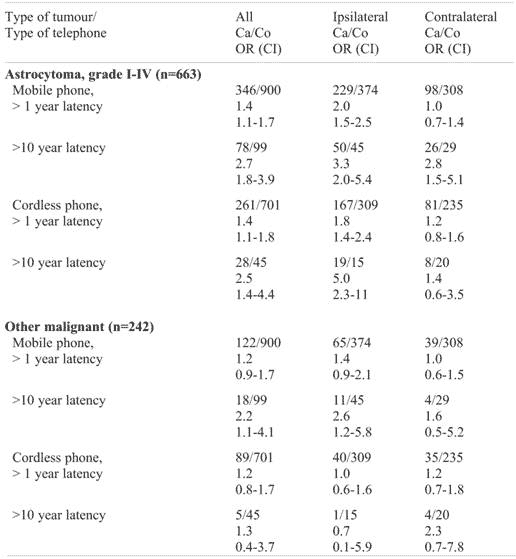
Ca/Co indicate number of exposed cases and controls respectively
For astrocytoma, mobile phone use for more than a year (>1 year latency) yields an odds ratio of 1.4 overall, i.e., users of mobile phones for more than a year are 1.4 times as likely to get malignant astrocytoma as unexposed controls. This relative risk increased to 2.0 for the ipsilateral case, the same side of the head the phone is used. For those who have used mobile phones for more than 10 years (>10 year latency), the risk increased further to 2.7 overall, and 3.3 in the ipsilateral case. For cordless phone users of more than 1 year, the overall OR is 1.4, and 1.8 for the ipsilateral case. For cordless phone users of more than 10 years, OR increases to 2.5 overall, and 5.0 for the ipsilateral case. Other malignant tumours followed the same trends in mobile phone users; but in cordless phone users the OR for ipsilateral case is smaller than the contralateral, a deviation probably resulting from the small number of cases.
Similar trends are found for benign tumours such as acoustic neuroma, meningioma and other brain tumours, for both mobile and cordless phone users.
The trends are more pronounced for young users of mobile and cordless phones as can be seen when the data are separated by age groups (see Table 2). The group that starts to use mobile and cordless phones before 20 has an OR of 5.2 and 4.4 respectively for malignant astrocytoma after one year (<20, 1 year latency) compared with 1.4 for both over all ages. This highlights the special susceptibility of the young to MW radiation from the wireless phones.
Table 2 Odds ratio (OR) and 955 confidence interval (CI) for astrocytoma and acoustic neuroma in different age groups
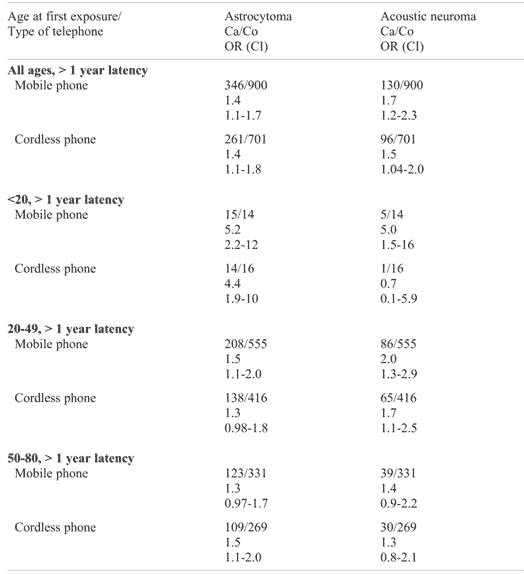
Ca/Co indicate number of exposed cases and controls respectively
Hardell’s group also analysed the data from the Interphone study [4], a research programme involving 13 countries set up in 2000 to investigate the association between mobile phone use and cancer risk, particularly brain, head or neck. The Interphone study used rather different methods; for example Interphone did not study cordless phone use, and instead of a standardized questionnaire, a computer guided personal interview was used for both cases and controls, in which the interviewer knew in advance whether it was a case or a control. Instead of drawing cases from the cancer registry, the Interphone study used hospital records, While the controls in Hardell’s studies were unexposed, i.e., consist of people who do not use mobile or cordless phones at all, or have used them for less than one year, the Interphone study unexposed group include those who have used cordless phones. Similarly, while the Hardell studies included as exposed cases people who have used mobile or cordless phones at any time, the Interphone study defined mobile phone use as ‘regular use´ on average once per week during at least 6 months; less than that was regarded as unexposed. The response rates for both cases and controls were substantially lower in the Interphone study. For these and other reasons, the Interphone study suffers from many weaknesses, as pointed out by Hardell [1], who suggested that the observations were biased and hence unreliable.
Indeed, an article published [5] by two participants (one of them the coordinator) of the Interphone study reviewed both the Hardell and Interphone results and concluded that overall, the findings suggest “the existence of possible association” between mobile phone use and head cancers, and recommended simple and low cost measures to reduce exposures as a precaution particularly among young people.
In a more recent publication, the Hardell group presented a further pooled analysis of case-control studies on malignant brain tumours and the use of mobile and cordless phones that included both living and deceased subjects, and the same results were found [6]. The risks of brain tumours go up with latency time (years of use) and cumulative use in hours, and are highest in subjects using mobile or cordless phones before the age of 20.
Article first published 22/06/11
Comments are now closed for this article