
Water and Fire
The case of salt water that can be ignited when exposed to a radio frequency beam and what it could tell us about the structure of water Dr. Mae-Wan Ho
Water-powered cars and welding torches that burn water have been ricocheting around the web for some years, but are impossible to pin down as they typically depend on a proprietary or otherwise ill-defined process that somehow causes water to release flammable gas(es).
A recent report caught my eye as the experimental details at least, are quite well described and documented.
Retired broadcast engineer and inventor John Kanzius was trying to find a cure for cancer when he stumbled upon a way of setting fire to water. He had made a radiofrequency generator intending to kill cancer cells loaded up with metal nanoparticles. When he aimed the radio waves on a test tube of salt water, it produced an unexpected spark. Kanzius put a lighted match to top of the water, and the water ignited and kept on burning for as long as it remained in the radio frequency field. The phenomenon was reproduced on YouTube [1] for the benefit of the local TV station. Independent witnesses verified that the flame was burning at 1 500 degrees C, and the heat was strong enough to run a small Stirling engine.
The YouTube video attracted the attention of Rustum Roy – Distinguished Prof of Materials at Arizona State University and Professor of the Solid State and of Geochemistry at Pennsylvania State University - who followed up the research, and held a public demonstration in September 2007, which was reported in the National Geographic News [2]. George Sverdrup, a technology manager at the US Department of Energy’s National Renewable Energy Laboratory in Golden Colorado was impressed: “It seems like, to me, an interesting set of processes that’s been uncovered,” he said.
So what exactly was uncovered? Further details were published in a preliminary report in the March 2008 issue of Materials Research Innovations, a journal edited by Rustum Roy [3].
The published paper [3] describes how having confirmed the observation on YouTube in John Kanzius’ lab in Erie, Philadelphia, the radiation source was brought to Roy’s microwave lab at Penn State University for a series of experiment [4].
The maximum power for most experiments was about 300 W and the frequency of the polarized radio frequency beam was in the range of 13.56 MHz.
The radio wave was aimed at pyrex test tubes containing solutions of 0.1 to 30 percent salt (NaCl), held upright by a Teflon stand and individually introduced into the RF (radio frequency) cavity. The gases at the top of the liquid surface were lit by means of a lighter. The solutions typically sustained a continuous flame till the water was exhausted. The temperature of the flame was about 1 800 C. At 3 percent NaCl (about sea water concentration), the results presented in the YouTube were confirmed.
Larger flame sizes of about 4-5 inches were obtained with higher salt concentrations. Immediately after the power is turned on, the flammable gas can be ignited, and it extinguishes instantly as the power is turned off. The smallest flame was sustained at 1 percent NaCl (see Figure 1).
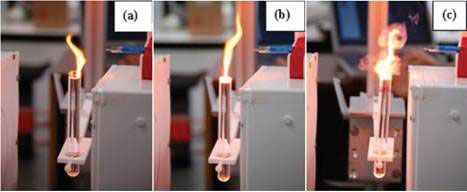
Figure 1. Burning water at different NaCl concentrations; a, 0.3 percent; b, 3.0 percent; c, 30 percent
The phenomenon is real, but the mechanism is entirely unknown. Roy and coworkers suggest specific resonant coupling of the RF radiation into the structure of water causing the split into “intimately mixed” hydrogen and oxygen. When ignited, the hydrogen burns regenerating water or steam. They also showed that the Raman spectrum of the saline solutions before and after exposure to Kanzius’ RF field differ dramatically in the 3000 to 3500 cm-1 region indicating that the structure of the water after exposure to the RF field has been very substantially changed, specifically with respect to the O-H bond. Raman spectroscopy is a technique used in condensed matter physics and chemistry to study the modes of vibrations of ions or atoms in solids and liquids
Electrolytic splitting of water is well-known. But, as first demonstrated by Faraday, it takes >1.23V to split water into hydrogen and oxygen. The 13.56 MHz RF beam delivers at most 10-8 of the energy required. The resonant coupling into the structure of water that is proposed for the spectacular Kanzius radiation effects may also be due to the specific polarization of the beam used. Roy and colleagues have previously demonstrated in a long series of papers that polarized, very weak electromagnetic fields have profound effects even on solid state materials.
Using specific polarized radiation, radically different phases were synthesized and direct decrystallization of many solids was induced, including the most important phases in the electronic industry: ferrites, barium titanates, and even elemental silicon. In those experiments, 2.45 GHz radiation in a single mode cavity generated the dramatic changes that were documented by X-ray diffraction, scanning and transmission electron microscopy, and Raman spectroscopy [5].
Thus, it is possible that weak electromagnetic fields, appropriately polarized could couple resonantly to certain critical structures in the liquid water that cause the splitting into hydrogen and oxygen.
Roy and colleagues point out [6] that in analogy to crystalline condensed matter such as SiO2 - which is very closely related to H2O in the glassy phase - n number of different phases can coexist in water. So liquid water is by no means homogeneous; and numerous different water structures on the nanometre scale are certain to co-exist. Under different influences, the distributions of these structures will change. That may explain why no two ice crystals are ever the same, which Masaru Emoto has exploited to great effect in deciphering ‘messages from water’ [7] (Crystal Clear – Messages from Water SiS 15).
Roy and colleagues also suggest that water can be ‘imprinted’ by different surfaces and solutes through a process analogous to a phenomenon well known in material science. Epitaxy – the transmission of structural information from the surface of one material (usually a crystalline solid) to another (usually a liquid) – occurs without any transfer of material [6]. The result is to induce the liquid to change its structure in the region close to the crystalline substrate, and possibly precipitate or crystallize in a pre-determined structure or morphology, the stuff of homeopathy and the putative memory of water.
We have featured a well-documented investigation using the physical technique of thermoluminescence in 2003 {8] (Water Remembers? Homeopathy Explained? SiS 19) that is compatible with epitaxy.
In [9] Living with Oxygen (SiS 43) and other articles in this series, we shall be exploring how water can burn in different ways, drawn from research emerging in the mainstream scientific literature; all in the interest of deciphering all the exciting things nature is trying to tell us.
Article first published 10/06/09
Comments are now closed for this article
There are 3 comments on this article.
Philip Ward Comment left 7th September 2009 01:01:21
The leap from these experiments to homeopathy is going too far. There is no evidence for the effectiveness of homeopathic treatment and the idea that water has a "memory" which is more potent with dilution is laughable. How come this "memory" is only operative for purposes that are beneficial to health?
The suggestion that 13.56MHz is insufficiently energetic (by a factor of 10^8) to break O-H bonds is misleading in this context: it leads to suggestion that somehow this experiment defies the Law of Conservation of Energy, when this is explicitly denied in the Materials Research Innovations paper. The Raman spectra of the solution before and after the experiment don't look radically different: they look similar, apart from a minor difference in peak intensities. The reference to microwave exposure on solids is also misleading. Certain solids (and liquids)heat up in microwave, as we all know: this is used to synthesise some compounds in the solid state.
I can't find any references to independent replication of this experiment.
Weasel Comment left 5th March 2011 23:11:51
Microwaves work because the frequency in use is 2.4GHz, which is the resonant frequency of water molecules. This is also why 2.4GHz WiFi signals have trouble passing through trees and leaves - because they contain water.
Mark Comment left 10th December 2014 18:06:50
Weasel:
Incorrect. Water's resonant frequency is at or above 1 terra hertz. Your quote of water resonating at 2.4 GHz is a common misconception based on the common household microwave operating frequency. There are industrial microwaves that operate on other frequencies, which disproves your claim. Microwaves operate by the molecular oscillations of water, oils & fats as they try to "flip" their polar directions to match the alternating microwave radiation, which generates molecular friction (heat).