
Evidence for cold fusion accumulates as enthusiasts transform it into a new discipline. Cheap, clean, and safe nuclear energy on the horizon.
Dr. Mae-Wan Ho
Nuclear fusion, as conventionally understood, is a process whereby the nuclei of light elements fuse together to form heavier ones. (See Box for a quick primer on atoms and nuclei.)
Atoms and nuclei
An atom is the smallest unit of a chemical element. It consists of a core nucleus containing protons and neutrons, surrounded by electrons on the outside. Protons carry a positive charge, which is balanced by the negative charge of the electrons, so that the atom is electrically neutral on the whole. Neutrons do not carry any electric charge.
The elements are identified by their atomic number Z - the number of protons, the same as the number of electrons - and atomic mass A - the total number of protons and neutrons - the mass of electrons are very much smaller and therefore neglected in the atomic mass. The simplest element is hydrogen; it consists of a single proton and a single electron, and is represented as 1H1. Helium is the next simplest element with 2 protons and 2 neutrons, and is represented as 4He2. Most elements exist as isotopes, different forms that have the same number of protons but different numbers of neutrons. Thus, hydrogen has two other isotopes, and unusually are given names of their own, deuterium and tritium, with one and two neutrons respectively, written as 2H1 and 3H1 (though they tend to be written often as D and T).
The protons and neutrons in the atomic nucleus are held together by strong forces, which overcome the electromagnetic repulsion between the positively charged protons. Strong forces act only at very close range; beyond that, weak forces due to electromagnetic interactions take over, so like charges repel and opposite charges attract.
As conventionally understood, nuclear fusions only take place in our sun and other stars, and produce all the chemical elements starting from the lightest, hydrogen. The fusion of light elements releases enormous amounts of energy, whereas the synthesis of the heaviest elements absorbs so much energy that it only take place in supernova explosions [1].
It takes a lot of energy to force even the lightest nuclei to fuse. This is because all nuclei have a positive charge due to their protons, and as like charges repel, nuclei strongly resist being too close together. However, should they get beyond this Coulomb barrier, a strong nuclear attractive force will take over and cause the nuclei to fuse. This can be achieved by accelerating the nuclei to very high speeds, i.e., heated to ‘thermonuclear’ temperatures in excess of 106 K. Only then would the nuclei can get close enough to fuse. Once the fusion reaction starts, it generates so much excess heat that it becomes a sustained chain reaction. The hydrogen bomb is an uncontrolled fusion chain reaction.
The deuterium-tritium fusion reaction is currently considered the most promising for producing clean nuclear energy. It produces helium and a neutron, together with 17.6 MeV (megaelectron volts) of energy.
2H1 + 3H1 → 4He1 (3.5MeV) + n (14.1MeV)
However, there has been no success as yet in producing a workable design for a hot fusion reactor that is safe and controllable.
In 1989, Martin Fleishmann at the University of Southampton in the UK and Stanley Pons at the University of Utah Salt Lake City in the United States published a preliminary note claiming that atomic nuclei could be made to fuse at ordinary temperatures, with the release of considerable ‘excess energy’, i.e., energy in excess of input and much more than could be accounted for by ordinary chemical reactions [2].
A barrage of disbelief and derision greeted their publication, as it was tantamount to claiming that nuclear reactions similar to those that created the hydrogen bomb could be made to happen on an ordinary lab bench, with nothing more sophisticated than passing current through metal electrodes immersed in some salt solutions.
“Cold fusion” has had such a bad press over the past 18 years that I heard of one woman referring to having sex with her estranged husband in those terms.
But a small international community of scientists became impressed, especially when Fleischmann and Pons published more substantial results in 1990 [3], documenting the accuracy of their measurements and answering many of the criticisms made against their preliminary findings published the year before.
These cold fusion enthusiasts managed to keep the research going with small sporadic funding from their governments or private investors. They held well over a dozen international conferences, and in 2004 renamed their subject more appropriately, “Condensed Matter Nuclear Science” [4] in recognition of the important feature that atomic nuclei trapped in condensed matter can react at far lower temperatures than the usual thermonuclear reactions taking place by random collisions of highly energetic nuclei.
At the beginning of 2007, The Royal Society of Chemistry put “cold fusion back on the menu” in a report with that title [5]. There was an invited symposium focusing on cold fusion - also referred to as low energy nuclear reactions - at the American Chemical Society (ACS) 2007 Conference in Chicago. This was the first such symposium that anyone could remember. The programme chair of the ACS’ division of environmental chemistry felt that with the world facing an energy crisis, it was worth exploring all possibilities.
More significantly, a lot of evidence has accumulated to vindicate Fleishmann and Pons’ cold fusion claim, the latest coming from the US Space and Naval Warfare Systems Centre (SPAWAR) in San Diego California.
Fleishmann and Pons packed deuterium into a palladium lattice by electrolysis of heavy water. The palladium electrode absorbed a lot of deuterium and the nuclei fused together, generating energy far in excess (about 1 000 fold) of any ordinary electrochemical reactions.
The SPAWAR researchers deposited palladium and deuterium together onto an electrode and speeded up the fusion process with an external electric field (parallel to the electrode surface). And using a plastic detector placed next to the electrode, the expected products of the nuclear reactions were identified [6].
The implications of cold fusion are enormous. It means that a cheap, much safer and controllable source of nuclear energy is on the horizon. Furthermore, it may be possible to use the same kinds of low energy nuclear reactions to transform existing hazardous radioactive nuclear wastes into more stable, non-radioactive elements.
The Fleishman-Pons reactor is a simple electrolytic cell enclosed in a Dewar flask (a sophisticated thermos flask, an insulated container having a double wall with a vacuum between the walls and silvered surfaces facing the vacuum), which enabled them to make accurate measurements of the rates of heat generation as light or heavy water is split by electrolysis [3]. Light water is ordinary H2O, while heavy water is deuterium oxide, D2O, deuterium being an isotope of hydrogen with the same atomic number and twice the atomic mass.
In the electrolytic cell, palladium (Pd) was the cathode and platinum the anode. The electrolyte solution contained lithium salts dissolved either in light or heavy water. When electric current is passed through the electrolyte, the water splits into hydrogen/deuterium at the cathode and oxygen at the anode. Pd is used because it absorbs hydrogen/deuterium avidly, thus bringing the atoms close together in its lattice (regularly spaced arrangement of atoms in the solid state).
Blank experiments gave a slightly negative rate of heat generation, on account of heat loss due to evaporation and so on. By contrast, the electrolysis of heavy water resulted in a positive excess rate of heat generation, this rate increasing markedly with current density I, at least as a function of I2, reaching 100 Watt cm-3 at about 1A cm-2.
Prolonged polarization of the palladium electrode in heavy water also resulted in bursts of high rates of heat generation, with the output energy exceeding the input by factors of 40 or more during these bursts.
The total specific energy output during the bursts as well as the total specific energy output of fully charged electrodes subjected to prolonged polarization was 5 – 50 MJ cm-3 (of electrode volume), and is 100 to 1 000 times the heat of ordinary chemical reactions.
But what exactly were the reactions?
One major factor contributing to the initial scepticism against nuclear reactions was that the excess energy released was not due to the established thermonuclear fusion reactions, which result in a tritium plus a hydrogen, or a helium plus a neutron. These reactions and the energies of the products are as follows:
2D1 + 2D1 → 3T1 (1.01 MeV) + 1H1 (3.02MeV)
2D1 + 2D1 → 3He2 (0.81 MeV) + n (2.45MeV)
Although low levels of tritium and, possibly, of neutrons were detected, the amounts could not account for most of the excess heat generated. (Nevertheless, some investigations have been more successful in finding tritium, which suggests that more than one reaction might have occurred.)
The researchers experimented with different dimensions of electrodes and currents and recorded their results. The highest excess power generation achieved was 105 W cm-3 with the 0.1cm (thinnest) x 1.25 (shortest) palladium rod electrode run at 1.024 A cm-2, and it happened at about 1 500h after the start of the experiment.
The excess heat generated tended to go up exponentially with the current. There was a steady rate that appeared to increase slowly with time, with bursts of very high rates superimposed on the slowly increasing steady state. The bursts occurred at unpredictable times and were of unpredictable duration. Following such bursts, the excess heat production returned to a baseline, which could be higher than that prior to the initiation of the burst.
The heat produced was so great that the electrolytic cells were frequently driven to boiling point, when the rate of heat production just became extremely large. It was not possible to make a quantitative estimate of the heat as the cells and instrumentation were unsuitable for making estimates under those conditions. Also, Fleishman and Pons adopted a policy of discontinuing the experiments (or at least reducing the current density) whenever the water started to boil. At such times, the palladium electrode also started to dissolve, which generated still more heat. They decided to avoid such conditions for fear of uncontrollable energy releases. These bursts of rapid increases of temperature were accompanied by marked increases in the rate of tritium production, suggesting that the nuclear reaction(s) occurring were different from those in the steady state.
Indeed, tritium production has been observed by many other labs since, and is considered by some to be one of the strongest pieces of evidence for condensed matter nuclear science, as it suggests an entirely new mechanism whereby nuclear reactions could occur at low temperatures (see How Cold Fusion Works, SiS 36).
Fleishman and Pons concluded in their 1990 paper co-authored with other cold fusion enthusiasts [3]: “It is our view that there can be little doubt that one must invoke nuclear processes to account for the magnitudes of the enthalpy [heat] releases.”
Fleishmann and Pons’ evidence for nuclear reactions was indirect, and depended on the excess heat generated that could not be explained by known ordinary physical or chemical process. No definitive nuclear products had been identified, and at the time, other investigators often had difficulty reproducing the results.
Since then, substantial progress has been made in the reproducibility of excess heat generation and in measuring nuclear products. The SPAWAR researchers are among the major groups that have carried out such experiments successfully.
The research team led by Stanislaw Spzak and Pamela Mosier-Boss at SPAWAR used a modified procedure in which palladium and deuterium were deposited together on a cathode consisting of a thin metal film [6]. In 1995, they first found indications of nuclear activity when the electrolytic cell emitted X-rays with a broad energy distribution, and occasionally with well identifiable peaks. Tritium was detected sporadically and often at low rates. Nevertheless, there were active periods that persisted for days, with tritium produced at approximately 6 x 10³ atoms/s.
Ten years later in 2005, they obtained further evidence of nuclear activity: heat generation, hot spots, mini-explosions (see Fig. 1), radiation, and tritium production; more importantly, they discovered that by placing the electrolytic cell in an external electrostatic field, the reaction(s) could be much speeded up, and new elements produced, among them Al, Si, and Mg (see Transmutation, the Alchemists’ Dream Come True? SiS 36).
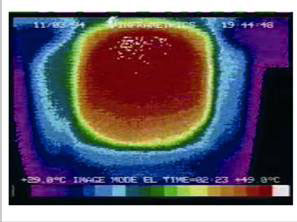
Figure 1. Infrared camera image of the cathode in an active electrolytic cell
The central red area with yellow and green borders is the hot cathode surrounded by cooler electrolyte solution; the white spots on the cathode are hot spots with temperatures off the top end of the scale (bottom of image); these hotspots are very dynamic flashing on and off from different parts of the electrode surface as can be seen in the video recording [7, 8].
In their latest report [6], Spzak and coworkers present direct evidence of low-energy nuclear reactions in the Pd lattice and the emission of charged particles in amounts far greater than the background level. The density of tracks registered by the CR-39 detector, a simple piece of plastic placed next to the cathode, was “of a magnitude that provided undisputable evidence of their nuclear origin.”
Under normal conditions when the cell operation is controlled by the cell current and temperature, the nuclear products consisted of X- and g-rays, tritium, and excess heat. However, when the operating cell was placed in an external electric field, the reaction products included the formation of “new elements” as well as the emission of charged particles such as p+ (protons) and a2+ (alpha particles consisting of two protons and two neutrons).
Tracks can be recorded after only 1 h of exposure. The researchers suggest that ‘coherent domains’ are formed in the cathode shortly after activation by the external electric field, and these coherent domains correspond to the hotspots of nuclear reactions (see Fig. 1).
Although the nature of the nuclear reaction(s) is still unclear, the emission of soft X-rays indicates that electron capture is occurring. The electron may be captured by a nucleus X, where X may be the deuteron (deuterium ion) D+, a doubly charged deuteron D2+, a lithium ion Li+ (from the electrolyte) etc, with a neutrino n escaping the reaction volume (see How Cold Fusion Works, SiS 36).
A(X)z + e- → A(X)z-1 + n
The SPAWAR experiments are by no means the only replication of the Fleishman-Pons effect in the sense of nuclear reactions occurring in an electrolytic cell. The most notable feature about the effect is the heterogeneity of reactions, and the variety of conditions under which they could happen.
One major product of cold fusion experiments involving deuterium appears to be helium, or helium-4, the usual abundant isotope. This was confirmed in three different sets of experiments conducted in another US Navy laboratory (NAWCWD) at China Lake, California between 1990 and 1994, funded by the Office of Naval Research [9]. There was a correlation between excess heat produced and the excess helium-4 measured in 18 out of 21 experiments. In experiments where no excess heat was generated, 12 out of 12 also produced no helium-4. This was a total of 30 out of 33 experiments that agreed with the hypothesis that the excess heat was correlated with producing helium-4. The measured rate of helium-4 production was always in the appropriate range of 1010 to 1012 atoms per second per Watt, in accordance with the reaction:
2D1 + 2D1 → 4He2 + 23.8 MeV
When H2O was substituted for D2O, neither excess heat nor helium-4 was generated. However, the excess heat generated in the China Lake experiments was modest, and did not exceed 30 percent of input.
Several other groups have confirmed the production of helium-4 correlated with excess heat. But the most spectacular results came from the experiments of Yoshiaki Arata and Yue-Chang Zhang at Osaka University, Japan [10].
Instead of a solid palladium cathode, Arata and Zhang used powdered palladium, or palladium black, which greatly increased the absorption surface area for deuterium. The palladium black was placed inside a container kept under a vacuum at constant temperature for 2-3 days before deuterium or hydrogen gas was injected at a constant low flow rate until the powdered palladium was fully saturated with the deuterium/hydrogen.
Using palladium black with extremely small particle size (15 to 40 nm), a high fusion rate was obtained, amounting to >1015 4He2 atoms in the closed inner space of the cathode. In contrast, no 4He2 (or excess heat) was ever generated when hydrogen was used instead of deuterium, or when bulk palladium was used.
Arata and Zhang also developed other materials that better absorbed H2/D2. In one experiment, Pd particles of 5 nm were embedded inside a matrix of ZrO2. ZrO2 on its own does not absorb H2 or D2, but ZrO2-Pd easily absorbed about 3 D atoms per host Pd atom. Arata and Zhang proposed that the D atoms absorbed are effectively solidified as an ultrahigh density deuterium lump inside each octahedral space within the unit cell of the Pd host lattice. These “pycnodeuterium” (heavy deuterium) are dispersed to form a metallic deuterium lattice with body-centred cuboctahedron structure (see Fig. 2) [11].
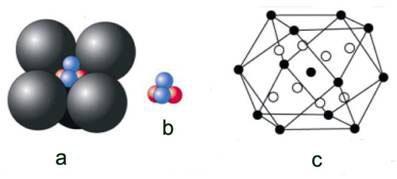
Figure 2. Proposed structure of pycnodeuterium in palladium lattice. (a) lump of deuterium atoms in an octahedral site between palladium atoms in host lattice, (b) lump of pycnodeuterium, (c) metallic deuterium lattice of pycnodeuterium (filled circles) forming a body-centred cuboctahedron structure
In a solid ‘nuclear fusion reactor’ using pycnodeuterium as fuel, the fuel sample was kept in an evacuated quartz glass cylinder chamber for two days at 130 C. After that, D2 gas was injected until pressure built up to 10 atm. Laser light was then applied as a repeated rectangular pulse (20 pulse per second for 10 seconds) with pulse width of 2ms (height of 7.5Kwatt, and pulse energy of 15J/pulse).
Electron microscope pictures showed that after the ‘laser welding’ the ZrO2 matrix and nano-Pd particles had melted, creating smooth spherical shapes as consistent with intense heat from nuclear reactions.
How well did the cold fusion reactor compare with hot fusion? It so happened that in 2002, laser stimulation had been used in hot fusion. With an extremely high power pulse of 1019 watt/50 picosecond (10-12s) applied to a plasma (hot ionised gas) at a temperature of 104 eV, a maximum of 1013 atoms of 4He2 were generated per pulse.
In contrast, the laser welding nuclear fusion reactor of Arata and Zhang used 300 watts, and generated 1019 to 1020 4He2 atoms per 10 seconds period of laser stimulation. The researchers own a patent on their reactor. At the latest International Conference on Cold Fusion which took place between 25 June and 1 July 2007, at Sochi, Russia, at least two different research groups reported replication of Arata and Zhang’s results using a variant of the procedure that involved loading D2 gas into nano-scale palladium black [12]. Watch this space.
Article first published 18/10/07
Comments are now closed for this article