
I-SIS Lecture
Invited Keynote Lecture, 2nd Mediterranean Conference on Organic Agriculture in Croatia, Organic Agriculture – Contribution to Sustainable Ecosystem, 2-6 April 2008, Dubrovnik University. Dubrovnik, Croatia
Thank you for inviting me to this beautiful city by the Adriatic Sea, which really concentrates the mind on why we must protect our natural ecosystems from the ravages of industrial agriculture and climate change. Congratulations too, to Dubrovnik County for being the first in Croatia to be GMO-free (17 out of the 20 counties in Croatia have declared themselves GMO-free so far), and to be taking organic agriculture so seriously that you have a yearly food fair devoted to it (4-6 April).
My talk is on how switching to organic agriculture and localised food and energy systems can save us from the ravages of industrial agricultural and climate change. It can feed the world; more than that, it is the only way we can feed the world, and also the most effective way to mitigate climate change. It can potentially compensate for all greenhouse gas emissions due to human activities and free us completely from fossil fuels. We have collected all the scientific evidence and evidence from farmers’ experiences around the world in a comprehensive report [1] (Food Futures Now *Organic *Sustainable *Fossil Fuel Free ) that has gone to press just before I came here.
Croatia is very wise not to be diverted by GM crops. To grow GM crops now is a recipe for global famine. They have the worst features of industrial agriculture as a major driver of climate change, and are far from safe for human health and the environment.
2008 has been designated the year of global food crisis by the United Nations [2-4]. The crisis has been building up over the past decades, but things have come to a head. Agricultural production has fallen below consumption for 7 out of the past 8 years, and world grain reserves are at the lowest since records began in the 1970s. To a large extent, this is a long-term trend reflecting the failure of industrial Green Revolution agriculture, and this very failure has been used to promote genetically modified (GM) crops as the new “doubly green” revolution [5] (Beware the New 'Doubly Green Revolution', SiS 37).
But within the past year, world food prices suddenly went up by an average of 40 percent. That leaves the World Food Programme to feed 73 million people in 78 countries – not even one-tenth of the world’s hungry – with a shortfall of US$500 million. In addition, 36 countries have declared a food crisis as of December 2007.
There have been food riots and protests in many countries around the world: Mexico, Yemen, Morocco, Mauritania, Senegal, Uzbekistan, Egypt, Burkina Faso, Cameroon, even Italy, and the UK, where pig farmers can’t make a living because feed prices have doubled [6]. India has been hit by an epidemic of farmers’ suicide at an average of 10 000 a year before escalating to 16 000 a year when GM crops were introduced (see Chapter 23 of our Report [1]). But in 2007, a record 25 000 farmers took their own lives [4].
What has precipitated this food crisis? Many commentators blame China and India, countries with rapidly growing economies. People there are becoming well off and eating too much meat, like Europeans and Americans. The record suicides in India speak volumes against the idea that Indians are becoming ‘well off’.
On recent visits to China, we found restaurants and local markets everywhere full of food of all kinds: fresh fruits and vegetables, fish, seafood, meats, sausages, wind-dried meats, honey, grains, pulses, dried mushrooms, lichens, dried jelly fish and other produce of the sea, and a variety of snacks, both cooked and raw, processed or preserved. People’s Daily, the official Chinese government newspaper issued a rebuttal, rejecting as “groundless” the accusation that China has been responsible for the food price hikes [7], saying that “China’s grain yields have steadily grown from 2004 to 2007, and grain reserves have increased accordingly”. During 2007, China exported 9.2 million tonnes of cereals and imported 1.44 tonnes; so export exceeded import by a factor of 4.9. The article conceded that food prices in China have gone up, and the Government has cancelled export rebate in order to discourage exports to stabilize food prices in the country.
A major contributing factor to the build up of the food crisis is ‘peak oil’ [8] (Oil Running Out, SiS 25). According to a recent analysis, production figures showed that oil has peaked in 2006 [9]. Petroleum prices reached a record $105 a barrel last year, which has certainly driven food and feed prices up because conventional agriculture is heavily dependent on synthetic fertilizers, pesticides, water and machinery, all of which require fossil fuels. But the immediate cause of the present food crisis is something else - an intensified production of biofuels in Europe and the United States - that is having widespread repercussions on the availability of food because biofuels use our food as feedstock.
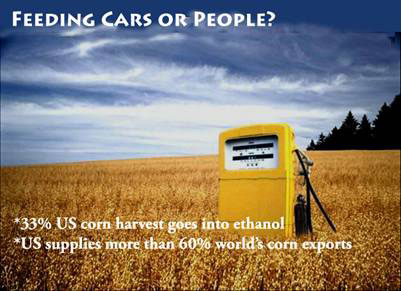
The United States divested a quarter of its corn harvests to producing ethanol in 2007, and in 2008, this will increase to a third. The US supplies more than 60 percent of the world’s corn exports and 40 percent of all cereal exports [2-4]. Other grains turned into biofuels are soybeans, wheat, and oilseed rape. And forests are being chopped down to grow soybeans and other feedstock such as oil palm, sugarcane, and jatropha, in South America, Asia, and Africa.
All our predictions that biofuels will bring biodevastation and hunger, and accelerate global warming (reviewed in Chapter 5 of our report [1]) have been confirmed. Thankfully, there has been a mind-change at the top. UK’s newly appointed chief scientist, Prof. John Beddington, attacked the biofuels industry in his first major speech [10], blaming it for having delivered a “major shock” to the to world food prices. Cutting down rainforest to produce biofuel crops is “profoundly stupid”, he said, and cannot imagine how we can produce enough crops for biofuels and feed people.
Unfortunately, the UK government is misadvised and misguided in its support for nuclear energy and GM crops. Biofuels and the food crisis have been a boon especially to Monsanto. More GM seeds have been sold for GM crops to be planted for biofuels in Brazil, Argentina and other South American countries, and Monsanto’s failing fortunes are dramatically turned around. It reported record profits over the past year [11]. BusinessWeek identified Monsanto as a “prime beneficiary” of the biofuels boom. Its stock correlated closely at 0.94 with oil price, better than that of ExxonMobile, which correlated at only 0.84, and hardly correlated with the price of corn, basically because people don’t eat GM corn. “For sure, what’s gotten the whole [agribusiness] industry raging is corn ethanol,” Charlie Rentschler, analyst at the stock research firm Wall Street Access told BusinessWeek.
The pro-GM lobby is using the food crisis to promote GM crops. UK government’s funding agency was even caught supporting a marketing exercise disguised as scientific survey [12] ('UK Farmers Upbeat about GM Crops' Debunked, SiS 38).
GM crops are one big failed experiment [13, 14] (Puncturing the GM Myths, SiS 22; No to GMOs, No to GM Science, SiS 35): no increase in yields, in many cases a decrease, including massive crop failures that escalated Indian farmers’ suicides. GM crops do not reduce use of pesticides; on the contrary there have been huge increases in recent years, according to the latest figures from the US Department of Agriculture [15]. GM crops have proven more harmful for biodiversity than conventional industrial agriculture in UK government-funded Farm Scale Evaluations, despite all attempts at manipulating the trials in favour of GM crops (Bogus Comparison in GM Maize Trial, SiS 22) [16]. Anecdotal evidence since 2005 from farmers around the world indicates that GM crops require more water [17]. GM crops have all the worst features of industrial Green Revolution varieties exaggerated, including susceptibility to diseases and climate extremes on account of genetic uniformity [5], plus there are outstanding safety concerns [18] ((GM Food Nightmare Unfolding in the Regulatory Sham , I-SIS scientific publication). Growing GM crops for biofuels does not make them safe, as they will contaminate our food crops all the same. GM crops are a dangerous diversion from the urgent task of addressing the world food crisis, and can end up exacerbating the crisis.
The outlook for food production is grim if we continue business as usual, especially because climate change is hitting us much quicker and harder than expected. Glaciers are melting faster than predicted, weather extremes are increasingly frequent, and these will have big impacts on food production. To top it all, our industrial agriculture and food system is a major driver of global warming.
Scientists of the British Antarctic Survey have just found that the West Antarctic glaciers are thinning alarmingly at 1.6 metre a year, which is more than 20 times faster than in the previous thousands and tens of thousands of years [19]. It is estimated that a rise in sea level of 1 metre would threaten the homes of 1 billion and put one-third of the world’s croplands at risk [20]. The loss of glaciers affects agriculture in another way. The biggest rivers in China and India, the Ganges, Yellow and Yangtze Rivers are fed by rain during the monsoon season, but during the dry season, they depend on meltwater from the glaciers in the Himalayas. The Gangotri Glacier in the Himalayas alone supplies 70 percent of the Ganges’ water in the dry season. The Intergovernmental Panel on Climate Change (IPCC) reported last year that the Himalayan glaciers could disappear by 2035. When that happens, the rivers will dry up completely [21].
A study published at the end of 2007 based on existing climate models show that apart from anything else, the rise in temperature and changes in rainfall patterns will reduce world agricultural productivity up to 16 percent by 2080 [22]. The most severe reductions will be in the tropics where the poorest live. Temperate regions may have cropping seasons extended because of temperature rise and the overall global reduction may also be mitigated by the ‘carbon fertilization effect’, the 15 percent increase in plant growth rate observed in a carbon dioxide rich atmosphere in green house experiments. That would reduce the deficit in global agricultural productivity to 3 percent. But the author of the report William Cline says don’t count on it, as actual in situ experiments failed to bear this out [23] (More CO2 Could Mean Less Biodiversity and Worse, SiS 20).
Weather extremes such as floods, hurricanes and droughts could reduce crop harvests by 30 percent or more, as US records show [24]. The recent drought in Australia reduced its wheat harvest by 60 percent in 2007 [4].
Finally, the industrial agriculture and globalised food system is responsible for at least 25 percent of global greenhouse gas (ghg) emissions when agriculture-related change in land use (deforestation and conversion of natural grasslands into cropslands), transport/processing/ packaging and storage costs are taken into account (see Chapter 19 of Report [1]). Industrial agriculture is water intensive as well. Aquifers have been pumped dry in the major breadbaskets of the world, and some see water shortage as even more serious than the depletion of fossil fuels.
Fortunately, we can do a lot to alleviate the food crisis and mitigate climate change, and it is really surprising that the IPCC has failed to mention the mitigating potentials of organic agriculture and localised food systems.
Our Report [1] is a unique combination of the latest scientific analyses, case studies on farmer-led research, and especially farmers’ own experiences and innovations that often confound academic scientists wedded to outmoded and obsolete theories. There is a refreshing mix of practical know-how and new theoretical concepts to put things in the broadest perspective, including the necessary transformation of the dominant knowledge system, which is blocking progress.
Here are some of the highlights in our Report. The largest single study of its kind in the world with data collected over 7 years in Ethiopia shows that composting together with simple water-conservation techniques gives 30 percent more crop yields than chemical fertilizers (Chapter 11). Coincidentally, scientists also find that organic out yields conventional agriculture by a factor of 1.3, and green manure alone could provide all nitrogen needs (Chapter 9). Local farmers in Sahel defied the dire predictions of scientists and policy-makers by greening the desert and creating a haven of trees (Chapter 25). Cuba has demonstrated it is possible to feed a nation without fossil fuels, and organic urban agriculture plays a large role (Chapter 12). Conservative estimates show that organic agriculture and localised food systems can mitigate nearly 30 percent of the world’s ghg emissions and save 1/6 of the world’s energy use (Chapter 19). Thirty percent of ghg emissions are just about what the current agriculture and food system costs, and 16.5 percent are also close to its energy costs. So practically, we could be eating for free, at the very least.
We can do better than that. If we add anaerobic digestion of food and farm wastes in a zero-emission integrated food and energy producing Dream Farm that could boost the total energy savings to nearly 50 percent and total ghg savings to more than 50 percent. That means agriculture will compensate for the energy and ghg costs of other sectors. In our Dream Farms, we also incorporate other renewable energies at small and microscale levels: solar, wind, hydroelectric. That means we can potentially produce a large excess of energy to feed into the grid for other users. There will be no need for fossil energies whatsoever.
In addition, our Report summarises the evidence accumulated indicating that organic agriculture does indeed gives us cleaner, safer environments, greater natural and agricultural biodiversity (Chapter 18), more nutritious, healthier and health-promoting foods (Chapter 20, 21), and a plethora of social benefits (Chapters 22-24): higher income and independence for farmers, more employment opportunities. Organic agriculture and localised food system regenerates local economies, revitalizes local knowledge, and creates enormous social wealth, that could counteract juvenile delinquency, gang violence and suicides in socially deprived areas.
Let me sketch out the main message in our Report.
A team of scientists led by Catherine Badgley at the University of Michigan, Ann Arbor, in the United States reviewed 293 studies comparing conventional with organic/sustainable or low input agriculture, and found that organic agriculture out yields conventional by a factor of 1.3. And, more than enough nitrogen can be provided by green manure alone, amounting to 171 percent of synthetic N fertilizer used currently. Organic agriculture, therefore, has the potential to support “a substantially larger population” than currently exists.
The increase in yield with organic agriculture confirms the direct comparisons in the Ethiopian study. The importance of this finding cannot be overemphasized. Using chemical fertilizers not only costs fossil fuels and its associated ghg emissions (plus nitrate pollution of drinking water), it increases nitrous oxide emissions directly, a ghg with global warming potential of about 300 compared with carbon dioxide. More seriously, it leads to a 23 percent reduction in our food supply.
Yet more evidence from scientists: a joint study by Iowa State University, Ohio, and USDA found that by using appropriate soil-building cover-crops and crop-rotation during conversion from conventional to organic, crop yields were equal by the third year, and by the fourth year, organic corn and soybean out yielded the conventional (Chapter 15).
Yields are not nearly as important as resilience to stress, especially under climate change. In the longest running experiment comparing organic and conventional agriculture in the Rodale Institute in Pennsylvania, scientists found that the yields were not significantly different during normal years; but organic far out yields conventional, by a third or more, during drought years (Chapter 13). That’s because the organic soil is so much better at holding water as well as other nutrients that make plants more resilient to all kinds of stresses.
This same study shows that while conventional soils failed to take carbon dioxide out of the atmosphere, organic soils are very good at it, and could take up to 4 tonnes of carbon dioxide per ha a year just in the top 30 cm of soil. This is a major contribution of organic agriculture to mitigating climate change.
These are just some of the examples where scientists are reproducing and rediscovering what farmers have found out for themselves long ago.
Here is something beautiful. Scientists and policy-makers have been making dire predictions that Sahel will turn into desert irreversibly as the result of the great droughts of the 1980s. But local farmers have proven them wrong (Chapter 25). By saving and planting trees, and cooperating in water conservation, they have pushed back the desert, as confirmed by observations on the ground and from the satellites since the 1990s. Satellite data consistently showed that the desert is greener than expected, and the greenest spots are correlated with human activities. The data also indicate that planting trees can create more rain, which is very good news for mitigating climate change, and show exactly how “profoundly stupid” [10] it is to cut down trees for bioenergy crop plantations (see earlier).
The greening of the Sahel is a prime example of how the dominant knowledge system had grossly misinformed policy-makers; and it was the knowledge and initiatives of local farmers that saved the situation.
There are more examples of farmers’ innovations, as well as trained agronomists unlearning what they have been taught in universities to pay heed to local knowledge (see Chapter 17). Local knowledge depends on working with and within the circular economy of nature.
Mr. Takeo Furano in Japan has perfected the Aigamo system (Chapter 26): putting ducklings to work in paddy fields, resulting in a bumper yearly harvest of 7 tonnes of rice, 300 ducks, 4 000 ducklings, countless fish, and enough vegetables for 100 from his 2 ha farm, Best of all, Furano and his family get plenty of free time from not having to do any weeding.
Furano has drawn a diagram (Fig. 1) to teach other farmers, which makes clear that the system works by reciprocity and mutual benefit, a circular economy in other words. And it is absolutely dependent on the natural biodiversity of species working to benefit one another, either directly or indirectly. For example, the ducks not only eat the weeds and seeds, they fertilize the water to feed the rice plants, the rice plants attract pests, which make more food for the ducks. The ducks also feed the plankton in the water, which feed the fish, and sometimes fish fries get eaten by the ducks, and so on.
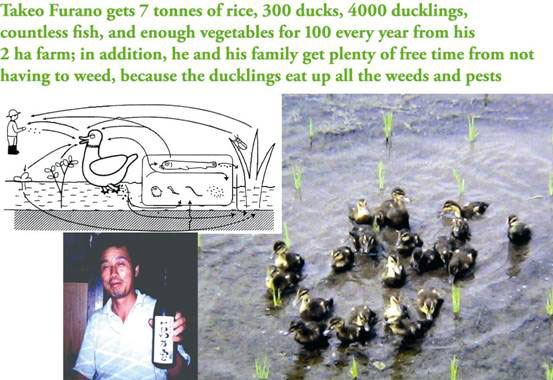
Figure 1. Takeo Furano and his Aigama System
Another example of the circular economy of nature put to work is the dyke-pond system perfected by the peasant farmers of the Pearl River Delta in China, in the course of thousands of years (Chapter 32).
There are many different dyke-pond systems, the one shown here is the simplest, and involves growing mulberry, elephant grass and vegetables and raising pigs and silkworms on the dykes (Fig. 2). Mulberry feeds silkworms, and after the cocoons are harvested, the faeces of the silkworms are dumped into the ponds to feed the plankton that feed the fish and water plants, which go to feed the pigs. The pig manure also fertilizes the pond. Typically 5 different species of carp are kept in the ponds to fill the different depths and ecological niche. Elephant grass feeds the grass carp.
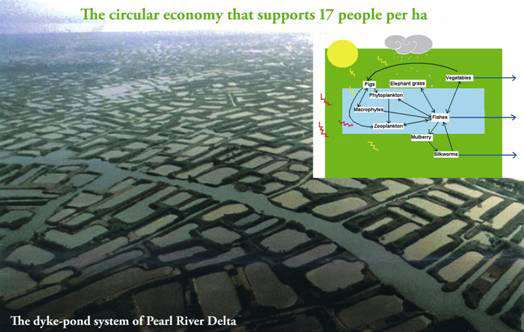
Figure 2. The circular economy of the dyke-pond system
There are eleven cycles in the diagram varying in length from 2 to 5 links. Such systems support on average 17 people per ha in this region, giving the lie to conventional ecological dogma that there is a fixed constant carrying capacity for a piece of land.
The dyke-pond system works perfectly on a small scale, but you can’t dump too much manure all at once directly into the pond, and here is where anaerobic digestion comes in.
Everyone in Britain should know about anaerobic digestion by now, as it has been constantly on The Archers – the longest running BBC drama about English country folks - for the best part of a year, and since we promoted its use in our Which Energy? report [25] published two years ago.
Professor George Chan was trained as an environment engineer in Imperial College, London, and had many government posts in the US and Mauritius before he was about to retire and spent 5 years with the Chinese peasants of the Pearl River Delta. He said he learnt as much from them as from Imperial College. From his experience in China, he perfected what he called an Integrated Food and Waste Management System of farming, which I called Dream Farm (Chapter 33), or Dream Farm 1.
You can see the circular economy at work, though George Chan didn’t call it that. The biogas digester is the heart of the system, and it reinforces the circular economy and makes it more efficient. Livestock manure and waste water, instead of being dumped directly into the fishpond go into the biogas digester where it is sterilised and converted into biogas, which is 60 percent or more of methane, and can provide all energy needs for cooking, heating, electricity and processing. The residue in the digester is a rich fertilizer for crops or for growing mushrooms. The wastewater from the digester is still not passed directly into the fishpond, but goes through further cleansing in shallow basins with algae growing, and producing oxygen through photosynthesis to oxidize the remaining chemical and biological pollutants. Only then is the water allowed into the fishponds. Water from the fishponds is used to ‘fertigate’ crops. The algae can be harvested to feed chicken, ducks and geese. Crops wastes go to raise earthworms or into the compost, or they could be fed into the biogas digester. What remains after the mushroom harvest can be fed to livestock, and the livestock manure goes back into the biogas digester to complete the grand cycle. As you can see, this farm is incredibly productive because it relies entirely on internal input, recycling all the wastes and turning wastes into food and energy resources. The nutrients too, remain within the cycle. Manure spread on land will lose nitrogen as ammonia and nitrous oxide, a strong greenhouse gas.
This system approaches the ideal of the sustainable system, which operates like an organism, as explained in my book, The Rainbow And The Worm [26].
The ideal circular economy doesn’t dissipate its energy and primary resources, doesn’t accumulate waste inside, and even the wastes exported to the outside is minimised. How is that achieved?
The organism manages because the big lifecycle consists of many different cycles of activities coupled together and working together, so that activities that yield energy are directly linked to those requiring energy, and all the cycles are feeding one another directly or indirectly.
The same principle of cooperation and reciprocity operates in a sustainable system, as opposed to the competition that rules the unsustainable mainstream model. In the traditional simple integrated farming, the farmer, livestock and crops form a symbiotic cycle that can perpetrate indefinitely. The farmer tends the crops and livestock. The crops feed the farmer and livestock and livestock returns manure to feed the crops.
Dream Farm is just a more complicated version of the same reciprocity and symbiosis. Notice that the more lifecycles are linked into the grand cycle, the more productive the land.
The skilful organic farmer knows that space-time has four dimensions, and can be put to good use for a diversity of crops that make the Chinese diet so rich
We can put everything together in an integrated food and energy Dream Farm 2 operating on the same organic circular economy (Chapter 34). It differs from Dream Farm 1 only in the explicit incorporation of renewable energies at small to micro-scale: wind, solar and hydroelectric (where appropriate). My ideal Dream Farm 2 (Fig. 3) works for demonstration, education, and research purposes, as incubator and showcase for new technologies, information exchange and resource centre for Dream Farms around the world, all based on maximum use of local resources and biodiversity and designed to the highest energy and carbon saving standards.
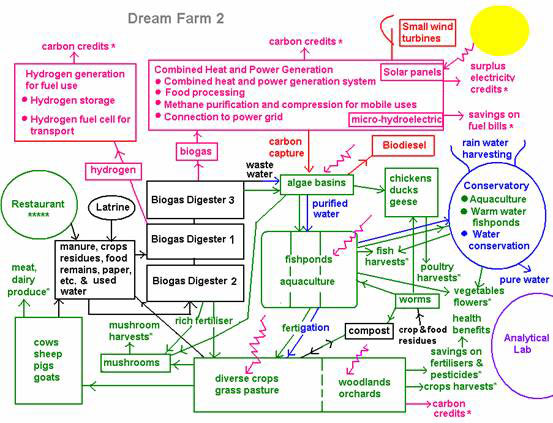
Figure 3. The complete Dream Farm 2
The diagram is colour-coded. Pink is for energy, green for agricultural produce, blue is for water conservation and flood control (increasingly important during climate extremes), black is waste in the ordinary sense of the word, which soon gets converted into food and energy resources. And there will be real carbon credits based on actual savings in operating the farm itself.
Let me show you a glimpse of the calculations done on the climate mitigating potentials of organic agriculture and localised food systems together with anaerobic digestion. You won’t believe how difficult it was to find exactly how much manure of each kind is produced in the UK, how many tonnes of other biological wastes, and so on.
Anaerobic digestion can provide 3.2 percent of total energy consumption in the UK, or, because methane can be used for mobile vehicles, it can provide 12.9 percent of transport fuel. It saves 7.5 percent of greenhouse gas emissions. And this is all from biological wastes which otherwise would pollute the environment.
The biogas yields from different feedstock are given in Figure 4 [27], so you can see that I have used very conservative estimates for biological wastes in general.
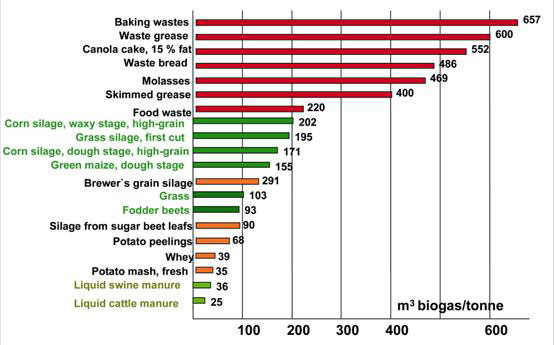
Figure 4. Potential biogas yields from different feedstock
Another thing you’d be interested to know is that anaerobic digestion also yields the most fuel per ha compared with ethanol and biodiesel [27]. But it is still unacceptable to use any food crop as feedstock for anaerobic digestion, as some women in The Archers are quite rightly opposing their local anaerobic digestion project on those grounds.
The mitigating potential of Dream Farms implemented globally saves greenhouse gas emissions by 54 percent (see Chapter 34 [1]). The biggest saving is from less fossil fuel burnt due to efficiency gains in consuming energy locally, which is 17 percent. The other big savers are carbon sequestration in organic soil (11 percent) and reduced transport due to localising the food systems (10 percent).
For energy, the efficiency gain in consuming energy locally is assumed to be half of that lost in heat and in electricity transport through the grid, estimated at 30 percent. The other big gain is in reduced transport from localising food systems, at 10 percent.
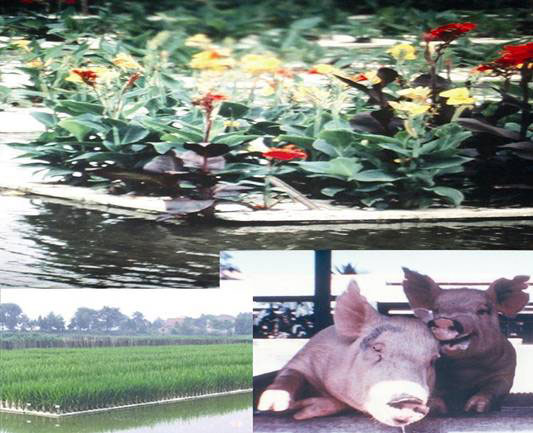
To end, here are some vignettes from George’s Dream Farms around the world, also a peek into our food futures.
Article first published 07/04/08
Comments are now closed for this article