
Kavitha Kurunganti reports from Tarnaka, India
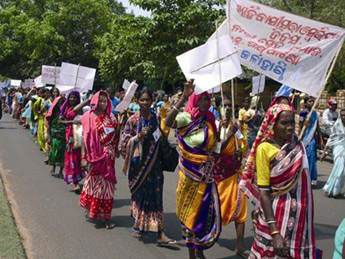
Nari Samaj rally in Bhubaneswar, Orissa
As India edges closer to what is probably the last year of field trials for Bt Brinjal (eggplant, aubergine) before commercial approval may be granted, large scale resistance has been building up all over the country.
Bt Brinjal, if allowed in India, would be the first food crop in the world with the Bt gene inserted into it that is to be directly consumed by human beings. Indians feel that they are about to be made guinea pigs by USAID, and by Monsanto and Cornell University that have developed this crop.
For the past six years, Indian farmers have experienced the stark realities of GM crop cultivation in the country in the form of Bt cotton. Reports continue to pour in from various districts of Andhra Pradesh including Adilabad, Warangal and Nalgonda on animal illnesses and deaths after grazing on Bt cotton fields. Farmers and shepherds have been reporting the toxic effects of Bt cotton on livestock since 2003 (see Mass Deaths in Sheep Grazing on Bt Cotton, SiS 30). But the regulators continue to rubbish the reports. Farmers and workers experience allergic reactions during harvest of Bt cotton, with scores of victims in different states (see More Illnesses Linked to Bt Crops, SiS 30). However, the governments have not even begun to acknowledge that.
To make matters worse, the ecology of cotton pests has altered drastically and Bt cotton farmers are dealing with newer pests and diseases. Last season’s infestation of mealy bug, a sucking pest, has resulted in pesticides sales shooting up steeply in several states including Punjab.
For farmers who wish to remain GM-free or organic, they find it almost impossible to get non-GM seed. Hundreds of organic farmers are placing special orders directly with seed companies for non-transgenic seed, as it is not readily available from retailers.
It is at this juncture that farmers’ unions, consumer organizations, environmental groups, development organizations and concerned scientists have stepped up their protests against Bt Brinjal, realizing that the experience with Bt cotton cannot be allowed to be repeated, especially with a vegetable crop that is directly consumed by people.
A large informal network called “Coalition for GM Free India” was formed in 2006, representing organizations and individuals from more than 15 states of India. The Coalition has been active since then in raising awareness among civil society groups, media and the general public, and in creating an informed debate on GMOs. The Coalition also sees resistance to GM crops in a larger framework of democratization of policy-making in science and technology for the country. Members believe that farmers’ science and knowledge, especially with regard to ecological farming, is the only sustainable way forward for farming in India.
On 8 April 2008, farmers’ organizations and other civil society groups in different states undertook concerted direct actions to highlight the dangers of GM crops in general and Bt Brinjal in particular. They targeted the state governments, which have a constitutional responsibility and authority with regard to agriculture-related issues. This is a prelude to a national level protest in Delhi on 6 May 2008 where hundreds of concerned citizens – farmers and consumers – will join the protest from around 15 states. The day of action included many events countrywide.
In Andhra Pradesh, more than 250 people took part in a protest meeting in Hyderabad organized by the Coalition for GM-Free Andhra Pradesh and around 15 mothers with their children put out a “NO GM IN OUR FOOD” message. Farmers and consumers from nine districts of Andhra Pradesh attended the meeting, including those who suffered losses with Bt cotton, those who have experienced allergies while working in Bt cotton fields and others who have lost their livestock that grazed on Bt cotton. Scores of farmers who practice ecological farming also joined in, urging the AP government to ban GM crop trials in the state.
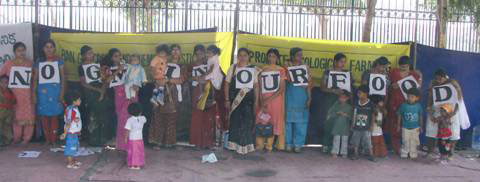
Hyderabad moms say No GM in Our Food
In Chittoor, the APVVU (an agricultural workers’ union) organized a rally in the district headquarters against GM crops. Speaking to a delegation that presented him with a memorandum in the evening, the Minister for Agriculture in Andhra Pradesh, Mr Raghuveera Reddy, assured the delegation that “if there is even 0.001 % problem with Bt Brinjal as per the University scientists, the government will proceed very cautiously on the matter.”
In Madhya Pradesh, around one thousand farmers took out a “death procession” of Bt Brinjal in Jhabua. In this symbolic protest, four pall-bearers joined by hundreds of farmers carried a large GM brinjal in a solemn Hindu cremation ritual; the protest was organized by Beej Swaraj Abhiyan (Seed Freedom Movement).
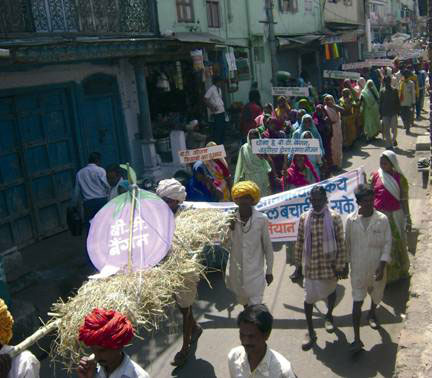
Death procession of Bt Brinjal in Jhabua, Madhya Pradesh
In Kerala, during a seminar organized by Thana (an environmental organization), the state Agriculture Minister reiterated his stand against allowing any GM crop trials in the state of Kerala, which is a mega-biodiversity hotspot. He also signed an anti-GM banner to be displayed in Delhi on 6 May. The seminar noted that foods containing soy, canola, corn and cottonseed ingredients, imported from the US, were being sold in many supermarkets, posing health threats. Speakers in the seminar called upon the people to boycott soybeans, corn (maize) products and other GM foods.
In Orissa, the Coalition for GM-Free Orissa submitted a petition signed by more than 30 000 farmers, intellectuals and activists in the state to the Minister for Agriculture. And rallies were held at Kendrapara, Bargarh, Bolangir, Rayagada, Sundargarh, Ganjam, Nayagarh and Sambalpur districts. Letters from 50 sarpanches (elected heads of local governance councils at the village level) were also submitted to the Minister asking him to ensure that Orissa remains free from genetically modified seeds.
The largest protest took place in Bhubaneswar, the state capital of Orissa, organized by Orissa Nari Samaj, a tribal women’s collective. More than 5 000 tribal women from 54 blocks, along with hundreds of farmers from Dhenkanal and over 300 students from Bhubaneswar joined a large protest rally against GM crops. They exhibited 500 indigenous paddy varieties that they have collected in front of State Assembly to send their message to the state government that it will put the rich diversity of rice species at risk if GMOs entered the region.
They submitted a memorandum to the Chief Minister, urging him to declare Orissa a GE-Free, organic state.
In Maharashtra, district level anti-GMO meetings were organized by the Sashwat Sheti Kriti Parishad to build farmer- and consumer awareness. The districts covered were Buldana, Amravati, Akola, Washim and Wardha.
In Tamil Nadu, CREATE and FEDCOT, consumer rights groups, organized a consumer awareness meeting in Tirunelveli on “GM Food & Consumer Health”. The meeting called for a ban on all GM foods in India.
On 14 April 2008, the day of Baisakhi (the new year’s day in certain states), protest and awareness meetings were again organized in Tamil Nadu and Punjab.
The various events on and around 8 April are an indication of the growing mass resistance against GM crops and foods in India, and it is high time that the central and state governments took note of the concerns of farmers and consumers with regard to this technology being thrust down their throats in an undemocratic fashion.
This comes at a crucial time when ecological farming is spreading rapidly all over India, supported by civil society groups including those in the Coalition for GM-Free India. It should convince the government that safer and much more sustainable alternatives do exist, and there is really no need for GM crops in the country.
Kavitha Kurunganti is with Consultant on Research and Campaigns working with Centre for Sustainable Agriculture, Tarnaka , Secunderabad, India
Article first published 30/04/08
Comments are now closed for this article