
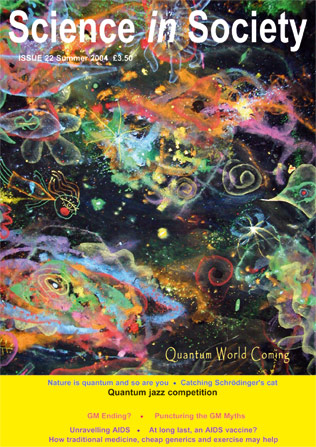
Jubilation swept through the green and pleasant land like a sunburst after the storm as Bayer CropScience abandoned growing GM maize in Britain, just weeks after the government gave it the go-ahead, aided and abetted by pro-GM scientists shamelessly bending science and scientific evidence. Bayer said the conditions imposed by environment secretary Margaret Beckett made growing GM maize "economically non- viable".
Bayer is not alone. Novartis has also told the government that no GM crops will be grown this year. In fact, all GM trials in the UK have been abandoned except for one, a herbicide-resistant pea tested for drought resistance at John Innes Centre, Norwich. This reflects a precipitous fall in applications for GM field trials from a peak of 159 in 2000-01, 140 in 2001-02 and 42 in 2002-03.
Developments elsewhere have been equally dramatic.
In just over a week at the end of March, 4 States in Australia ruled out large-scale planting of GM crops: Western Australia, the nations biggest crop producer, took the lead by announcing an outright ban. The next day Tasmania, too, voted for a ban. Victoria followed two days later by extending its moratorium on GM crops for four years. A few days later, New South Wales ruled out a 3 000 hectare trial of GM oilseed rape. And South Australia passed a bill that prevents GM crops from being grown for three years, except under strict conditions. This effectively puts Australias plans to grow GM crops "on hold indefinitely".
Simultaneously, a grassroots uprising has been gathering momentum in the United States, top grower and exporter of GM crops. In March, Mendocino County of California passed Measure H, which bans growing GM crops. A month later, the California Department of Food and Agriculture stalled the planting of a transgenic rice that produces dangerous pharmaceuticals. Then Vermont made history by becoming the first state in the country to require the labelling of GM seeds, and North Dakota drafted a ballot measure that could block Monsantos GM wheat.
On 21 April, President Chavez of Venezuela announced a ban on cultivation of GM soya in favour of the indigenous yucca. This followed on the heels of Angolas rejection of GM maize aid from the US. Angola has aligned itself with four southern African nations - Zambia, Zimbabwe, Mozambique and Malawi which have already banned imports of GM maize grain. Zambia made world headlines in rejecting US GM maize aid two years ago in the face of projected famine, opting instead for purchasing food surpluses from within the region (see SiS 16 and 17). Zambia has recovered so well that it is now exporting maize surpluses to Angola.
These are stunning victories for democracy and for science. ISIS and members of the Independent Science Panel (ISP) have been tireless in exposing the corrupt and corrupted science that has fed the GM bubble and brought financial and ecological ruin to family farmers in North America, Argentina and elsewhere.
The GM fight is by no means over. More GM crops are approved for growing in India, despite devastating counter-evidence. The Philippines, Indonesia, Kenya and other African countries are still under threat. The US lodged a complaint against the EU in the World Trade Organisation, and is demanding that the EU lifts its de facto moratorium on GM crop approvals and pay at least US$1.8 bn to the US in compensation for loss of exports over the past six years.
Further evidence of possible GM health hazards has surfaced: debilitating illnesses in villagers living near GM maize fields in the Philippines observed during the last growing season are repeated this year.
The French newspaper Le Monde has seen secret documents revealing health impacts of Monsantos GM maize Mon 863, which has just received a positive assessment from the European Food Safety Authority. They include kidney malformations and increases in white blood cells in male rats and increase in blood sugar and decrease in reticulocytes (immature red blood cells) in female rats.
It is clear that major struggles remain. The ISPs two-hour briefing to the UK Parliament filled the 100-seater Grand Committee Room to near capacity. Former environment minister Michael Meacher joined the ISP to call for a comprehensive enquiry into GM food safety, for transparency and independence in scientific research, and an end to the victimisation of scientists whose research findings are inconvenient for industry.
The GM-Free sustainable world is within our grasp. Dont let it slip out of reach.
AIDS (Acquired Immune Deficiency Syndrome) is perhaps the most researched yet most misunderstood disease in the world, about which the most misinformation is spread for political purposes.
Consequently, the multi-billion international projects for addressing the "AIDS pandemic" may well miss their targets of alleviating suffering and death, and could even make things worse.
Thats why we are offering an important series of articles, not only to go some way towards unravelling the complex debates surrounding the AIDS pandemic, but also to review effective treatments that are safe, effective and affordable for all.
This series is part of an in-depth report to be published later this year. There is still time to order a copy of the report, "Unravelling AIDS" at a special pre- publication price of £7.50 plus p&p. Please e-mail: sam@I-sis.org.uk
As a special treat, we offer a glimpse into the happening quantum revolution that may bring us the quantum computer, quantum cryptography and teleportation. But most of all, it may well change your life; or at any rate, change how you feel about yourself and the world you live in. It is spooky, but very, very nice, I think.
To celebrate the quantum world coming, we are running a competition for original artwork or music that most fits the title, "Quantum jazz" (see announcement on p.33). To know what this means, you will have to read the series, at least.
Article first published
Comments are now closed for this article