
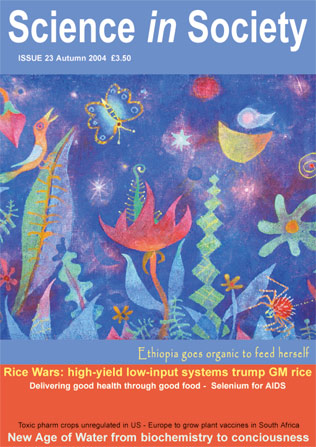
Famines and Ethiopia have become irrevocably linked in the public mind since Bob Geldof’s Live Aid Concert in the 1980s. But big changes are afoot. We carried the first exclusive report (Science in Society 16, 2002) on how Ethiopia is determined to feed herself. This success story is now told in full.
A project with small beginnings, based on reviving the traditional Indian farming practice of pit composting, has increased yields over and above chemical fertilizers and turned barren degraded land into productive greenery. The results are so impressive that the Ethiopian government is ready to adopt organic agriculture as one of its strategies for food security. Ethiopia is taking the lead in delivering not just food security to the nation: but good quality, nutritious food free from agrochemicals and a clean environment, which are crucial to delivering good health. This is what every country in the world should be doing, rich or poor.
The composting package was first introduced in 1996 to the northern state of Tigray by distinguished Ethiopian ecologist, Dr Tewolde Berhan Gebre Egziabher, recipient of the Right Livelihood award. Tewolde (what his friends calls him) is no stranger in international politics. As representative of the Ethiopian government and the African Union, he has been championing the rights of the poorest countries at the FAO Commission on Plant Genetic Resources, and played a key role in the successful negotiation of the Cartagena Biosafety Protocol for regulating genetically modified organisms.
We are privileged to have the inside story told by Sue Edwards, the Director of the Institute of Sustainable Development in Addis Ababa, who shared responsibility of the Tigray project with Tewolde.
Rice, the staple food crop for more than half the world’s population, among them the poorest, is the current target of genetic modification, an activity that has greatly intensified after the rice genome was announced two years ago (see "Rice is life" series, SiS 15, 2002). Since then, all major biotech giants are investing in rice research, with the clear intent of exercising monopolistic rights through gene patenting and genetic modification.
At the same time, a low-input cultivation system that really benefits small farmers worldwide has been spreading, but is dismissed by the scientific establishment as "unscientific". This is one among several recent innovations that increase yields and ward off disease without costly and harmful inputs, all enthusiastically and widely adopted by farmers in Asia and Africa.
A war is building up between the corporations and the peoples of the world for the possession of rice. The food security of billions is at stake, as is their right to grow the varieties of rice they have created and continue to create, and in the manner they choose.
We bring you a comprehensive exposé of how the scientific establishment is serving the corporate agenda against peoples’ interests.
Water has come of age. It is cool on everyone’s lips. Decades of research on water is yielding remarkable insights into its dynamic collective structures, and changing our big picture of life and living process.
Organisms are seventy to eighty percent water. Is this water necessary to life? What vital functions does it serve?
Entire biochemistry and cell biology textbooks are still being written without ever mentioning the role of water. It is simply treated as the inert medium in which all the specific biochemical reactions are being played out.
Instead, recent findings are raising the possibility that it is water that’s stage-managing the biochemical drama of life. Water is life, it is the key to every living activity. Some people will even say it is the seat of consciousness.
Nowhere else will you find such a feast for the discerning mind. And there will be more in the coming issues.
As one after another biotech giant retreated from GM crops for food and feed in Europe amid massive losses and lack of investment, the desperate industry is redoubling its efforts to use GM crops to produce transgenic pharmaceuticals in North America and elsewhere.
These pharm crops pose a range of health hazards; as documented in numerous reviews in past and present issues of SiS: allergies, immune-suppression, immune sensitization followed by anaphylaxis, oral tolerance leading to loss of immunity to pathogens. An AIDS vaccine produced in the maize crop has been compared to the release of a "slow bioweapon". What have our governments been doing to protect the public?
Prof. Joe Cummins uncovered a major scandal: these pharm crops have been produced and marketed in the United States for at least two years behind our backs, via a gaping loophole in the regulatory process. This has galvanised public interest organisations to call for a moratorium on the release of transgenic pharm rice in California.
Meanwhile, the European Union announced the award of 12 million euros to a "Pharma-Planta" consortium, a network of laboratories in 11 European countries plus South Africa to develop pharm crops for vaccines and treatments for AIDS, rabies, diabetes and TB. South Africa's role is to be the testing ground for the first pharm crops.
The exploitation of Third World countries to produce transgenic pharmaceuticals unacceptable in Europe and the United States harks back to the days of colonialism, and raises the spectre of unmonitored and unregulated human exposures to the dangerous products without the informed consent of those directly affected. This will become worse as opposition grows in North America and Europe. We are calling for a global forum to alert people to the dangers as well as the "benefits" (see p.29). Meanwhile, it is imperative to impose a global ban on field test releases and biopharmaceutical production, especially in Third World countries.
Article first published 24/08/04
Comments are now closed for this article