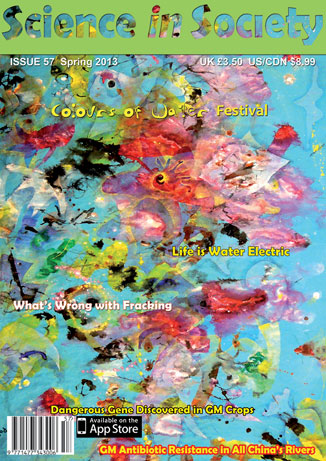
From the Editors - Hazardous Virus Gene Discovered in GM Crops after 20 Years
How to bury a bombshell
A
European Food Safety Authority (EFSA) scientist has just discovered that major
GM crops and products the regulatory agency has been approving for commercial
release over the past 20 years
contain a potentially dangerous virus gene. The gene – Gene VI - overlaps with
the cauliflower mosaic virus (CaMV) 35S promoter. The CaMV 35S promoter is the
commonest, most widely used regulatory sequence for driving gene expression in
GM crops. This momentous discovery was published in a little known journal
during the holiday season at the end of 2012, and would have passed unnoticed
had it not caught the attention of Jonathan Latham and Alison Wilson of Independent
Science News. They described the finding and carried out a proper
retrospective risk assessment on the Gene VI fragment in a report posted on
their website. This attracted so much public attention that EFSA and its counterpart Food
Standards Australia New Zealand (FSANZ) are said to have jointly “shredded” the
scientific paper on which Latham and Wilson’s report is based.
EFSA
and FSANZ say the allegations that the viral Gene VI hidden in the CaMV 35S
promoter might not be safe for human consumption and could disturb the normal
functioning of crops are completely false. A spokesperson from FSANZ states:
“Human exposure to DNA from the cauliflower mosaic virus and all its protein
products through consumption of conventional foods is common and there is no
evidence of any adverse health effects.”
Ironically,
the first author of the scientific paper Nancy
Podevin is from EFSA, while the second author Patrick Du Jardin is at University of Liège in
Belgium; and EFSA GMO
Panel is acknowledged for “advice given”. The main thrust of the paper is in
fact a screening of Gene Vi amino acid sequence against existing databases for
known allergens and finding none; thereby offering false reassurance while
the real hazards are swept under the carpet.
This
is not the first time that the safety of CaMV 35S promoter is being questioned.
Serious concerns had been raised over the safety of
CaMV 35S promoter
ISIS
first raised concerns over the CaMV 35S and similar promoters in a paper
published in the journal Microbial Ecology in Health and Disease in 1999
(Cauliflower Mosaic Viral
Promoter - A Recipe for Disaster?) when it was discovered to have a
recombination (fragmentation) hotspot that would enhance unintended horizontal gene
transfer and recombination, and in the process create new viruses or activate
old ones, and trigger cancer in animal cells by well-known processes of
‘insertion carcinogenesis’. The CaMV 35S promoter was known to be highly
promiscuous in being able to function in most if not all species across the
living world (including human cells, as it turned out). To make matters worse,
many synthetic versions of the promoter have been constructed with additional gene
expression enhancers and sequences from other sources, all of which increase
its instability (tendency to fragment) as well as its ability to drive
inappropriate gene expression. (We
also reported the overlap of the 35S promoter with Gene VI, so this knowledge
must have been widely known, although its safety implications were not obvious,
at least to us.)
As a precautionary measure, we
strongly recommended that all transgenic crops containing CaMV 35S or similar
promoters should be immediately withdrawn from commercial production or open
field trials.
Our
first paper brought a swift reaction. Within
two days of its being published online, someone managed to solicit at least
nine critiques, including one from Monsanto, which were posted on a website
funded by the biotech industry and widely circulated on the internet. The
critiques varied in tone from moderately polite to outright abusive. We wrote a
detailed rebuttal, which was likewise circulated and posted to the same
website, and have not received any replies from our critics since. But in January
2000, Nature Biotechnology published a distorted, one-sided and
offensive account of our paper, concentrating on the criticisms and ignoring
our rebuttal completely, which we published in the same journal that carried
the first paper (Hazards of
Transgenic Plants Containing the Cauliflower Mosaic Viral Promoter).
Regulators’ objections irrelevant and false
It
is of interest that the objections for ‘shredding’ the scientific paper of
Podevin and du Jardin and Latham and Wilson’s report are exactly the ones used
against us. The first objection is that humans have been eating the CaMV for
millennia without ill effects; the second is that the CaMV 35S promoter is only
active in plants and certainly not in animal or human cells.
Our
rebuttal to the first objection is that the
intact CaMV, consisting of the CaMV genome
wrapped in its protein coat, is not infectious for human beings or for other
non-susceptible animals and plants, as is well-known; for it is the coat
that determines host susceptibility in the first instance. So eating the intact
virus is of little consequence. However, the
naked or free viral genomes (and parts thereof) are known to be more infectious
and have a wider host-range than the intact virus. Furthermore, the synthetic CaMV 35S promoters
are very different from the natural promoters, and are both much more aggressive as promoters driving inappropriate gene
expression as well as more prone to fragment and recombine.
The second
objection - that CaMV 35S is not active
in animals and human cells - is simply false as we discovered in the scientific
literature dating back to 1989, and pointed this out in a third paper (CaMV 35S promoter fragmentation
hotspot confirmed, and it is active in animals ). The
CaMV 35S promoter was found to support high levels of reporter gene expression
in mature Xenopus oocytes, and to give very efficient transcription in
extracts of nuclei from HeLa cells (a human cell line).
What
of our original concern over the CaMV 35S promoter activating viruses in host
genomes? There is new evidence suggesting that
the CaMV 35S promoter may indeed enhance the multiplication of
disease-associated viruses including HIV and cytomegalovirus through the
induction of proteins required for transcription of the viruses (New Evidence Links
CaMV 35S Promoter to HIV Transcription).
It
is in this context that Latham and Wilson’s report for ISIS (Potentially
Dangerous Virus Gene Hidden in Commercial GM Crops, SiS 57) should be read, which fully
justifies our original recommendation for a total recall of the affected GM
crops. The same call is now repeated by Latham and Wilson.
Fully referenced versions of this editorial and all
articles are available on ISIS members website: http://www.i-sis.org.uk/sismembers.php
Subscribe Now
|