
Comprehensive study gives the lie to claims that organic agriculture cannot feed the world because it gives low yields and there is insufficient organic fertilizer. Dr. Mae-Wan Ho
Two usual objections are levelled against the proposal that organic agriculture can feed the world. Organic agriculture, opponents claim, gives low yields, and there isn’t enough organic fertilizer to boost yields substantially.
A team of scientists led by Catherine Badgley at the University of Michgan Ann Arbor in the United States has now refuted those common misconceptions about organic agriculture. Organic agriculture gives yields roughly comparable to conventional agriculture in developed countries and much higher yields in developing countries; and more than enough nitrogen can be fixed in the soil by using green manure alone [1].
The research team compared yields of organic and conventional agriculture (including low-intensive food production) in 293 examples, and estimated the average yield ratio (organic versus non-organic) of different food categories for the developed and the developing world. With the average yield ratios, they modelled the global food supply that could be grown organically in the current agricultural land base. The results indicate that organic methods could produce enough food to sustain the current human population, and potentially an even larger population, without increasing the agricultural land base.
They also estimated the amount of nitrogen potentially available from nitrogen fixation by legumes as cover crops. Data from temperate and tropical agroecosystmes suggest that they could fix enough nitrogen to replace all of the synthetic fertilizer currently in use.
The report concluded: “These results indicate that organic agriculture has the potential to contribute quite substantially to the global food supply, while reducing the detrimental environmental impacts of conventional agriculture.”
The researchers are quick to point out that the Green Revolution has been a stunning technological achievement; for even with the doubling of the human population in the past 50 years, more than enough food has been produced to meet the caloric requirements for all; if food were distributed more equitably.
However, there is great uncertainty about the future, given the projection of 9 to 10 billion in the human population by 2050 and the global trends of increasing meat consumption (requiring much more grain) while grain harvests are decreasing. They have not mentioned the additional pressure on agricultural production from the growing demand for biofuels [2] (Biofuels: Biodevastation, Hunger & False Carbon Credits, SiS 33), which has already created “a looming food crisis” worldwide, as John Vidal reports in detail in The Guardian [3]. The climate extremes - droughts and floods – brought on by climate change are almost certainly making matters a great deal worse.
Much of the current reduction in grain harvests is due to environmental degradation from decades of unsustainable practices of the Green Revolution: massive soil erosion, loss of soil fertility, loss of agricultural land through salination, depletion of water tables and increased pest resistance. Other environmental costs of the Green Revolution include surface and groundwater contamination, release of greenhouse gases (especially through deforestation and conversion into agricultural land), and loss of biodiversity.
Many have argued that more sustainable methods of food production are essential. Notably, the Independent Science Panel consisting of dozens of scientists from around the world have issued a report in 2003, calling for a comprehensive shift to sustainable, organic agriculture [4] (The Case for A GM-Free Sustainable World). It is no coincidence that those most opposed to organic agriculture are also the strongest supporters of genetically modified crops, and they see the recent rise in demand for biofuels as yet another opportunity to promote a technology that has failed miserably to deliver its promises in 30 years, while evidence of serious health risks continue to emerge [5] (No to GMOs, No to GM Science, SiS 35).
The organic agriculture examples reviewed by the Michigan University team cover a wide spectrum of farms that are agroecological, sustainable or ecological, but not necessarily certified organic. They rely on natural nutrient-cycling processes, exclude or rarely use synthetic pesticides, and sustain or regenerate soil quality. Farming practices include cover crops, manure application, composting, crop rotation, intercropping, and biological pest control.
The 293 studies reviewed consist of 160 that compared organic with conventional methods and 133 cases comparing organic with low-intensive methods. Most studies are from the peer-reviewed published literature, a minority from conference proceedings, technical reports or website of an agricultural research station. They range from a single growing season to over 20 years. Some examples are based on yields before and after conversion to organic in the same farm.
To estimate global food supply from organic agriculture, the average ratios of the yields of organic versus non-organic are applied to current food production values minus post harvest losses from the UN Food and Agriculture Organization (FAO) database for 2001.
The yield ratios summarised in Table 1 are grouped into 10 categories covering the major plant and animal components of human diets.
Table 1. Yield ratios of organic versus conventional agriculture
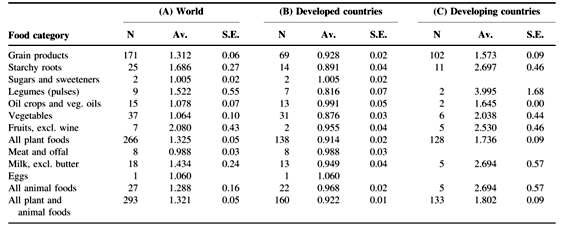
As can be seen, the average yields of organic and non-organic produce are about the same in the developed world, but it is in the developing world - where most food is needed and where farmers can least afford to pay for expensive synthetic fertilizers and pesticides - that the major gains in organic agriculture are most evident. Yield ratios of organic versus conventional range from about 1.6 to 4.0. The ratio averaged over all foodstuffs for the world is 1.3.
The team has worked out two models of global food production. Model 1 is conservative, and applies the yield ratios derived from studies in the developed countries to the entire global agricultural land base; Model 2, more realistically, applies the yield ratios determined for the developed and the developing countries back to the respective regions. The calories per capita resulting from the models are estimated by multiplying the average yields by FAO estimates of calorific content in the food category.
The amount of food available in Model 1 is about the same as currently available. The main gain is in reducing energy and fossil fuel intensive inputs, and avoiding all the collateral damages from conventional agriculture. Model 2 results in real gains of 1.3 to 2.9-fold of various foods available in addition.
Both models show that organic agriculture could sustain the current human population. In terms of daily caloric intake, the current world food supply after losses provides 2786 kcal/per/day. The average requirement for a healthy adult is between 2200 and 2500. Model 1 yields 2641 kcal/day, above the recommended level (94.8 percent of current level). Model 2 yields 4381 kcal/day, 157.3 percent of what is current available. Thus, organic production has the potential to support a substantially larger human population than currently exists.
The main limiting macronutrient for agricultural production is nitrogen in most areas. Nitrogen amendments in organic farming derive from crop residues, animal manure, compost and biologically fixed N from legumes (green manure). In the tropics, legumes grown between plantings of other crops can fix substantial amounts of nitrogen in just 40 to 60 days.
The estimate of N available globally is determined from the rates of N availability or N-fertilizer equivalence reported in 77 studies, 33 for temperate regions and 44 for the tropics, including three from arid regions and 18 of paddy rice.
The availability of N in kg/ha are obtained from studies as either ‘fertilizer-replacement value’ (i.e., the amount of N fertilizer needed to achieve equivalent yields to those obtained using N from cover crops), or calculated as 66 percent of N fixed by a cover crop becoming available for uptake by plants during the growing seasons following the cover crop.
In 2001, the global use of synthetic N fertilizers was 82 Mt. The estimated N fixed by additional legume crops as fertilizer is 140 Mt, based on an average N availability of 102.8 kg N/ha (the average N availability of temperate and tropical regions are 95.1 kg N /ha and 108.6kg/ha respectively). This is 171 percent of current synthetic N used globally, or 58 Mt more. Even in the US where conventional agriculture predominates, the estimate shows a surplus of available N through the additional use of leguminous cover crops between normal cropping periods.
In temperate regions, winter cover crops grow well in the autumn after harvest and in early spring before the planting of main food crops. Research at the Rodale Institute (Pennsylvania) showed that red clover and hairy vetch as winter covers in an oat/wheat-corn-soybean rotation with no additional fertilizer achieved yields comparable to those in conventional controls [6]. The Farm System Trial at the Rodale Institute uses legume cover crops grown between main crops every third year as the only source of N fertility. Non-legume winter cover crops are used in other years to maintain soil quality and fertility and to suppress weeds.
In arid and semi-arid tropical regions, where water is limiting between periods of crop production, drought-resistant green manures, such as pigeon peas or groundnuts, can be used to fix N. Using cover crops in arid regions has been shown to increase soil moisture retention.
These estimates of N available do not include other practices for increasing biologically fixed N, such as intercropping, alley cropping with leguminous tress, rotation of livestock with annual crops, and inoculation of soil with free-living N-fixers. In addition, rotation of food-crop legumes, such as pulses, soy, or groundnuts, can contribute as much as 75 kgN/ha to the grains that follow the legumes.
The implications of the University of Michigan study are far reaching. The results imply that even with rather conservative estimates, no additional land area is required to grow enough food to feed the world if we were to switch to organic, and enough biologically available N can be obtained to entirely replace the current use of synthetic N fertilizers.
There are numerous other benefits of switching to organic agriculture not mentioned in the paper that are documented in the Independent Science Panel Report [4] and elsewhere. (See also [7] FAO Promotes Organic Agriculture, SiS 36).
The largest gains from organic agriculture arise from the savings on the damages to public health and the environment, estimated at more than US $59.6 billion a year in the United States [6, 8] (Organic Agriculture Enters Mainstream, Organic Yields on Par with Conventional & Ahead during Drought Years, SiS 28).
Another is the key issue of food security. Findings from the Rodale Institute also confirm that organic management retains more nutrients, organic carbon and moisture in the soil, all of which make organic crops more able to withstand climatic stress. So it is not surprising that while organic yields are comparable to conventional during normal years, they are well ahead in drought years [6, 8].
There are substantial savings on carbon emissions and fossil fuels to mitigate climate change simply from phasing out pesticides and synthetic fertilizers, not to mention the extra carbon sequestered in organic soils.
The study has not even considered all the existing options for renewable energies [9] (Which Energy?, ISIS Report) or systems of farming that turns wastes into food and energy resources, thereby potentially phasing out fossil fuels altogether [10] (How to Beat Climate Change & Be Food and Energy Rich - Dream Farm 2, ISIS Report). Nor does it mention the many social, economic, and health benefits from organic agriculture [4, 7].
The case for a global shift to organic agriculture has never appeared more compelling and more urgent.
The Michigan University team see numerous challenges for implementing a comprehensive shift to organic agriculture, however promising it seems. The practice of organic agriculture on a large scale requires support from research institutions dedicated to agroecological methods of soil fertility and pest management, a strong extension system and a committed public.
Also needed are strong government commitment and support, and policy changes that favour and encourage a globall shift to organic, sustainable agriculture [11].
Most of all, it is time to put to rest the debate about whether or not organic agriculture can make a substantial contribution to the food supply. We should be debating instead the allocation of resources for research on agroecological food production, the creation of incentives for farmers and consumers; and the policies needed at the national and international levels to promote and facilitate the global transition.
Article first published 06/09/07
Comments are now closed for this article