
Announcing special series
Until fairly recently, the conventional view held by most physicists is that nature is somewhat sharply divided into the classical domain of every day objects in which Newton's laws of mechanics hold, and the weird and wonderful world of quantum systems at the scale of elementary particles, atoms and simple molecules, in which ‘things’ are both wave and particle, and can be in two places or multiple, contradictory states at the same time.
Quantum systems are destroyed by the act of measurement, which brings them abruptly into the ordinary classical world.
Austrian physicist Erwin Schrödinger, who, like Albert Einstein, never really believed in quantum theory, invented the story of a cat, now named after him, to illustrate how absurd the situation is. Schrödinger's cat is locked in a box containing a capsule of deadly cyanide gas that would be released the moment that a radioactive nuclide undergoes radioactive decay. The way to find out if the cat is dead or alive is to open the lid of the box, which is equivalent to performing a ‘measurement’ and bringing the ‘quantum system’ of the cat in the box abruptly into the classical world.
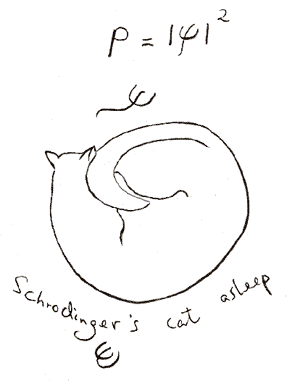
Schrödinger's cat asleep by Mae-Wan Ho
But before someone - a conscious being - opens the lid, the cat in the box is neither dead nor alive, but both. It is said to be in a superposition of two alternative states: being dead and being alive, or more accurately, all possible combinations of being both dead and alive at the same time. Someone opening the lid instantaneously ‘collapses’ the quantum superposition (or the wave-function describing this state) and only a classical result can be observed. But can’t the cat surely collapse its own wave function by experiencing itself either dead or alive?
Over the past 20 years, the scale at which quantum effects can be observed has become increasingly large, so the problem of Schrödinger's cat is all the more relevant to our picture of physical reality. Could there be some conceptual error involved in the idea of measurement and the collapse of the wave function itself? Many surprising discoveries are raising questions over the standard interpretation of quantum theory, and that is perhaps the most exciting development in contemporary western science in the 21st century.
The mere promise of quantum computing is enough to send people into a frenzy of speculation on the coming quantum information revolution that will make current information technology look Stone Age. Quantum computing not only provides an exponential increase in computing power, but can also solve problems that the classical computer can’t handle. However, there appears to be insurmountable engineering hurdles in actually building a quantum computer. There may well be deeper problems involved with the whole idea of a quantum computer that we can actually control and use.
A bit closer to realisation is quantum communication based on entirely new interactions between light and matter in quantum optics, and quantum cryptography to keep military and commercial secrets snoop-proof; potentially a boon for dictators, corporations and terrorists alike, but what's in it for ordinary people?
The way I see it, the quantum age entails a shift to a truly organic way of living and perceiving the world that will reconnect western science to the deeply ecological and holistic knowledge systems of all indigenous cultures, most of which are facing extinction. It will make us realise how urgently we need to protect and revitalize them as the real "common heritage" of the human species.
A quantum world is a radically interconnected, interdependent world where every entity evolves like an organism, entangled with all that there is.
I-SIS will be circulating a unique series of articles that will change your life. So look out!
Matter, even big clumps of it, is simultaneously wave and particle. Dr. Mae-Wan Ho explains
One of the first experiments to show up the strangeness of the quantum world consisted of shining a light through two narrow slits onto a photographic plate placed some distance behind the slits (Fig. 1).
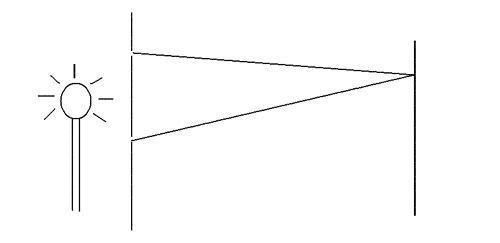
Figure 1. The two-slit experiment
When only one slit is opened, an image of the slit is recorded on the photographic plate, which, when viewed under the microscope, would reveal tiny discrete spots. And this is consistent with the interpretation that individual particle-like photons, on passing through the slit, have landed on the photographic plate, where each photon causes a single silver grain to be deposited.
When both slits are opened, an interference pattern of alternating bright and dark zones forms on the photographic plate, which is consistent with a wave-like behaviour of the light: the two wave trains, on passing through the slits, arrive at different parts of the photographic plate either in phase, where they reinforce each other to give a bright zone, or out of phase, where they cancel out to give a dark zone. On examining the plate under the microscope, however, the same graininess appears, as though the light waves become individual particles as soon as they strike the plate.
Numerous other more sophisticated experimental configurations have been devised to investigate this phenomenon, and always the conundrum remains. Photons are split into superposed reflected and transmitted states, or into opposite polarized states, that are capable of interfering when brought together again; but as soon as information is gained as to which path the photon has taken, or which polarised state it has adopted, then it behaves as an ordinary particle.
More remarkably, the two-slit experiment has been repeated with increasingly massive particles and essentially the same results have been obtained: electrons, neutrons 1800 times as massive as the electron, and more recently ‘ buckyballs’, a newly identified form of carbon molecule consisting of 60 atoms of carbon arranged in the shape of a football, and possibly, even a small protein.
Professor Anton Zeilinger, who leads a group in the University of Vienna engaged in these experiments, said when giving the 16th Schrödinger Lecture in London last November that they are planning to try a small virus next, and is quite confident that it too, will behave as both wave and particle.
There is quite a gap between virus and a mouse, or a human being, but who is to say we are not both a wave spread out in space and a seemingly solid body that can bump into furniture?
Schrödinger would have been astonished by all these findings if he were alive today. After all, he invented the parable of the cat named after him to show what absurd things quantum theory would have us think about: that an entity could be simultaneously in mutually contradictory states until the instant it is ‘measured’.
But what constitutes a measurement? Quantum physicists John Bell, who died a few years ago, had apparently called for the word ‘measurement’ to be banished from quantum theory.
At a workshop in 1990 concerned with how quantum effects can manifest on a macroscopic scale, the concept of measurement became very ambiguous. Philip Ball, reporting in Nature, said, "the most profound message from that meeting was that interpretations of quantum theory are no longer a matter of philosophical taste." Why? It was because of the development of electronic systems of remarkable sensitivity, and many ‘thought experiments’ could be directly tested.
It had become possible by then to create individual macroscopic quantum objects, perhaps a few centimetres in size. Among the first most promising candidates for displaying macroscopic quantum behaviour were various kinds of electronic circuits, particularly semiconductor structures, in which electrons behave like a two-dimensional gas, and super-conducting rings (which conduct electricity with zero resistance) containing weak links in the SQUID (Super Quantum Interference Device) magnetometer. SQUID magnetometers are increasingly used to measure the ultraweak magnetic fields coming from the body as electric currents flow through it.
At the 1990 workshop, Terry Clark of University of Sussex in Britain discussed the then state of the art in SQUID ring experiments. The weak link in these rings - typically made from a low-temperature superconductor such as niobium - is a point contact, and transport of correlated electron pairs (called Cooper pairs) across the contact relies on quantum tunnelling through the energy barrier created by the weak link. This is a probabilistic process resulting in a build-up of charge on either side of the junction, so the device develops a capacitance (charge storage).
At the microscopic level, charge Q and magnetic flux f are related, like position and momentum by the uncertainty principle that's fundamental in quantum physics, DfDQ > h/2. That means if you measure one quantity precisely, the other is totally uncertain: if you know the exact position of a particle, its momentum (mass x velocity) could be anything from zero to infinity, and conversely, if you pinpoint the momentum, then the particle could be anywhere in the universe.
The weak-link ring can adopt two quantum modes - a flux mode, in which charge flows and could be anywhere in the system, but the magnetic flux lines through the ring tend to be localized inside the ring; and a charge (capacitive) mode, in which charge tends to be localized, but not the magnetic flux. Different quantized (discrete) energy states (eigenstates) of the charge and flux modes are coupled by some characteristic tunnelling frequency so that in principle, the ring may lie in a quantum superposition of the two states. Is it possible to catch the ring in such a superposition?
This is where measurement comes in. According to the standard ‘Copenhagen’ interpretation, the act of measurement ‘collapses’ the quantum superposition. But the hope is that if the coupling (connection) to a measurement device is very weak, this collapse would not happen. Terry Clark's team managed to set up just such a weak measurement system and obtained results suggesting that the SQUID ring could exist in a quantum superposition of both the flux mode and the charge mode (see Box).
So, where does the quantum world stop and the classical start? One might say I am a quantum being between the acts of living and dying, like Schrödinger's cat. Read on.
In the SQUID ring experiment, weak coupling between the quantum system and the measuring device is achieved by using an electronic circuit - the ‘tank circuit’ - containing an induction coil (with inductance L) and a capacitor (with capacitance C). When driven by an alternating current source, the circuit has a resonant frequency of 1/√(LC). But if the inductor is inductively coupled (via electromagnetic fields generated by current flows) to the weak-link ring, changes in the flux state of the ring causes changes in L, and thus in the resonance condition.
The response of the tank circuit is in turn monitored by a radio receiver, which probes its resonance condition. In this way, the quantum state if the weak-link ring could be probed without looking at it directly. The response of the tank circuit to externally applied flux through the ring was periodic. The minima correspond to eigenstates encircling an integral number of flux quanta fo. Because of the weak link, the ring supports a screening super-current in response to the applied flux that falls periodically as f increases, letting an additional magnetic flux quantum thread the ring (Fig. 2). The ring passes from one flux state, nfo = nh/2e to the next, (n+1)fo, via a quantum superposition of states, between successive minima.
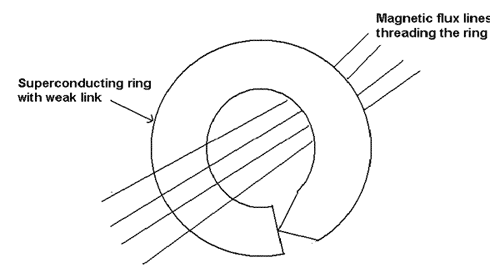
Figure 2. The superconducting ring threaded by magnetic flux lines increasing one at a time as the applied flux through the ring increases.
Remarkably, these results were obtained without alternating current driving the tank circuit. They show the response due solely to self-excitation by thermal voltage fluctuations at a temperature of about 4 K. This ensures that coupling to the quantum object is maintained at an absolutely minimal level.
Article first published 16/03/04
Comments are now closed for this article