
The biogas economy is taking off, but will it mean vast swathes of energy crops feeding enormous biogas plants instead of people? Dr. Mae-Wan Ho
Only a few years ago, the ‘hydrogen economy’ [1, 2] was on everyone’s lips as the natural successor to our fossil fuel dominated carbon economy. Not anymore. A ‘biogas economy’ has emerged to take its place, at least for the foreseeable future.
In 2007 the German Greens commissioned a report on the potential of biogas in Europe from the Öko-Instituts and the Institut für Energetik in Leipzig. The report, released to the media at the beginning of 2008, claim that Germany alone can produce more biogas by 2020 than all of EU’s current natural gas imports from Russia [3].
The biogas sector is booming in Germany and has become Europe’s fastest growing renewable energy sector. The market leader Shmack Biogas has received €130 million investment to expand its activities, and is involved in several large scale projects. One of these is to build Europe’s biggest biogas plant with E.ON Ruhrgas and E.ON Bayern; it will be a 4 MW facility costing around €15.8 million [4]. After cleaning and upgrading, the high quality methane will be fed into the natural gas grid.
Biogas production in Germany relies to a large extent on dedicated energy crops such as maize, and has been a boon to the agricultural sector of the region around Schwandorf. For the first time, farmers there are growing “energy maize” crops guaranteed to be taken up by the biogas plant. Schmack Biogas’s announcement in July 2007 made the unsubstantiated claim that energy maize “reduced the land needed to grow feedstock by up to a third” and can “restore degraded land and increase its fertility”. It did not foresee the huge increases in food prices a year later due to the diversion of grains into producing energy [5] (Food Without Fossil Fuels Now, SiS 38), as a World Bank report has recently confirmed [6].
Biogas is produced in anaerobic digestion of organic wastes by communities of bacteria that are naturally found in livestock manure, and consists of 60 to 70 percent methane, which can be used as fuel like natural gas (see Biogas China [7], SiS 32).. While it is true that biogas is produced much more efficiently from crops - a hectare of maize yields twice as much biogas energy than ethanol – its chief advantage is that it can be produced from a wide variety of organic wastes such as livestock manure, crop residues, food and food processing wastes, even paper and human manure, and in a distributed, decentralized way to increase energy efficiency in combined heat and power generation.
We have been promoting anaerobic digestion in I-SIS since 2005, for mitigating greenhouse gas (GHG) emissions and providing food and fuel security in the worsening ‘peak oil’ crisis [8, 9] (see Which Energy? and Food Futures Now *Organic *Sustainable *Fossil Fuel Free , I-SIS publications). So we are naturally pleased that the biogas economy is arriving.
The danger, however, is that the biogas economy will be hijacked by big companies for centralised power-generation from bio-energy crops, which may well jeopardise our food security and prevent its full energy and carbon mitigating potentials and other benefits from being realised.
A sure sign that the biogas economy will take off is that the United States is talking about it too. A new study backs up the advantages of biogas from livestock manure.
The US livestock industry produces more than one billion tons of manure each year, most of it kept in lagoons or stored outdoors to decompose, polluting the land, water and air, and emitting an estimated 51 to 118 million metric tonnes of carbon dioxide equivalent (CO2e) in methane and nitrous oxide, strong GHGs with global warming potentials of 21 and 310 respectively. (One metric tonne, or 1 000 kg, is equal to 1.102 US ton).
Chemical engineers Amanda Cuéllar and Michael Webber at the University of Texas, Austin, have taken a ‘top down approach’ and compared two scenarios for their combined energy and GHG emissions [10]. Scenario A is business as usual (Fig. 1, top panel), manure is left in a lagoon or in the open and coal is burnt to produce electricity. GHGs are emitted both from the manure and coal fire. Scenario B treats all the livestock manure in anaerobic digesters, which converts the wastes into biogas (Fig. 1, bottom panel). The resulting biogas is burned to generate electricity to offset coal-fired power, so the carbon dioxide from burning biogas is the only GHG emitted.
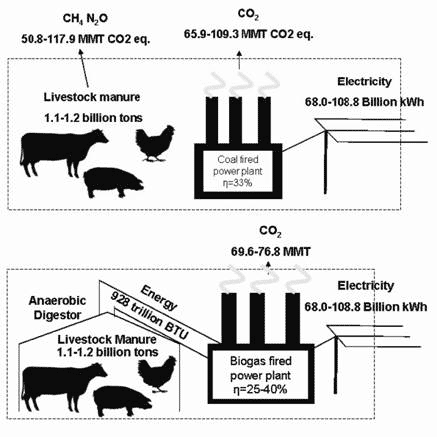
Figure 1. How anaerobic digestion of livestock manure saves energy and carbon emissions (see text)
Summing up all the manure contributions from the different kinds of livestock, Cuéllar and Webber found a total of 928 trillion British Thermal Unit (BTU) of energy available, which is about 1 percent of the country’s energy use. And assuming biogas-fired power plants range in efficiency from 25 to 40 percent, between 68 and 108.8 billion kWh of electricity could be generated each year, about 1.8 to 2.9 percent of the country’s electricity.
They then worked out the equivalent amount of coal that has to be burnt to generate the same amount of electricity at a typical efficiency of 33 percent for coal-fired plants, and compared the carbon dioxide emissions. Biogas from livestock manure represents a saving of between 47.2 and 150.4 Mt of CO2, i.e., about 1.9 to 6 percent of the country’s carbon dioxide emissions.
The US researchers have understated the case for biogas in many ways. Notably, co-digestion of other organic wastes will at least double, if not triple, the volume of biogas available, and because biogas methane can be purified as a renewable fuel for mobile uses for cars as well as farm machinery [7-9], it can displace larger amounts of fossil fuels, thereby contributing even more to mitigating GHGs and saving energy.
Sweden has led the world in biogas use for buses and other vehicles since 1996 [11]. Biogas methane has to be cleaned and upgraded for vehicles to avoid corrosion and mechanical wear, and to meet quality requirements. Cleaning involves removing particles, traces of water and hydrogen sulphide. Upgrading involves removing carbon dioxide that makes up 30 to 40 percent of biogas. Cleaning and upgrading are done to a standard set in Sweden in 1999.
The most common method of upgrading is scrubbing with water under high pressure, the second most common method is Pressure Swing Adsorption: CO2 is adsorbed on activated carbon at high pressure and released when the pressure is reduced down to vacuum Other methods are adsorption with organic solvents such as polyethylene glycol or a proprietary amine.
During 2006, 54 percent of the gas delivered to vehicles was biogas. By June 2007, there were 12 000 vehicles driving on upgraded biogas/natural gas and the forecast predicts 500 filling stations and 70 000 vehicles by 2010 [12].
The sale of biogas for vehicles is increasing every year; it went up by 48 percent between 2005 and 2006, and by the end of 2006, there were 95 filling stations for biogas/natural gas.
The use of biogas as vehicle fuel in Sweden started in the 1990s by municipalities or companies owned by municipalities. They saw the biogas generated at sewage treatment plants as a resource and a locally produced renewable fuel. Municipalities still play an important role as the majority of gas in Sweden comes from sewage treatment plants or municipal waste handling companies. Private companies have now stepped in to sell vehicle fuel and building filling stations. Energy companies like E.On Gas and Gothenburg Energy have invested in upgrading plants and actively working for more renewable gas.
Strong government support is important, it includes 30 percent investment support, zero tax, reduced income tax for company car users, and no congestion fees in the capital city of Stockholm.
If biogas can be injected into the gas grid (originally built to transport natural gas) then all of the gas from the biogas plants can be used. This would especially benefit small to medium scale biogas digesters sited on farms. Rather like the electricity grid for distributed generation from solar panels [13] (Solar Power to the Masses, SiS 39), the gas grid also works as a backup and biogas can reach new customers. In Sweden, there is only natural gas in the western part of the country and so far, four biogas plants inject biogas into the grid.
In fact, many countries in Europe that have not yet gone into anaerobic digestion to produce biogas are predisposed to take advantage of biogas. In Italy, for example, cars running on natural gas or on both natural gas and petrol are widespread. While on a study/lecture tour in Italy in July 2008, I was driven in a 17 year old 2 000 cc Audi that has been modified to run on either petrol or methane. By simply pushing a button next to the steering wheel, you can switch from one to the other smoothly while on the road. The modification cost €700 and involved a tank for compressed methane in the boot, with a capacity of 11 m3, plus a ‘lung’, presumably a fuel-injection system for gas. Filling stations for methane are every 25 km on ordinary roads, though not on the motorway. The old Audi gave about 30 km per m3 of methane containing about 40 MJ of energy, some 20 percent more than a litre of petrol. But methane appears to run the engine a bit more efficiently. Methane was selling at about €0.95 per m3, and petrol at €1.50 or more a litre. For the same distance, it cost only 35 percent as much on methane as on petrol. No wonder people were all filling up on methane rather than diesel or petrol. Needless to say, as the price of petrol and diesel goes up, so does the price of natural gas; which is another reason to use biogas methane as fuel.
Germany and Austria also have cars already running on natural gas, and have both gone into biogas enthusiastically, though mostly using bio-energy crops as feedstock. They recently set up national targets of 20 percent biogas in the gas sold to vehicles.
At the end of 2006, Germany had about 3 500 biogas plants with total electric capacity of 1.1 GW in operation [12]. Most of the new biogas plants have an electrical capacity between 400 – 800 kW. The first industrial biogas energy park, Klarsee, with 40 biogas plants (total capacity 20 MW, has come into operation. Energy crops are the main substrate, and manure constitutes less than 50 percent. Industrial companies mainly built plants for fermentation of energy crops. Germany is already growing energy crops on more than 1.3 million ha, or 11.4 percent of its arable land [14].
Currently, there are quite a few large biogas digesters at wastewater treatment plants, landfill gas installations, and industrial bio-waste processing facilities, and more are under construction (see above). But it has been predicted [12] that by 2020, the largest volume of produced biogas will come from farms and large co-digestion biogas plants, integrated into the farming and food-processing structures.
How much biogas energy can we realistically expect for Europe as a whole, counting both energy crops and livestock manure?
One estimate from the University of Southern Denmark [15] assumed that energy crops convert to biogas at an efficiency of 80 percent, as not all the compounds from biomass can be digested, for example lignin, and only around 25 percent of the energy crop will be dedicated for biogas production, the rest to be applied to other renewable energy production such as solid and liquid biofuels. The EU27 has a total land area of 433.2 Mha, of which 196.6 Mha is agricultural and 113.5 Mha arable. If 20 percent of arable land is dedicated to energy crops such as switch grass – so 5 percent goes to biogas - 45.5 Mtoe (megatonne of oil equivalent) of methane can be produced at a projected yield of 20 tonnes of solids/ha, about twice as high as currently achievable.
In addition, the EU27 produces 1 578 Mt of cow and pig manure a year. The animal production sector is responsible for 18 percent of the GHG emissions, which includes 37 percent of the anthropogenic methane and 65 percent of anthropogenic nitrous oxide. The total potential for methane from the livestock manure is 18.5 Mtoe.
Hence, a total of 64 Mtoe, or 71 200 million m3 of methane can be produced by 2020 from energy crops grown on 5 percent of Europe’s arable land, plus its mountains of livestock manure [15]. This does not quite make up for the 74 400 million m3 of natural gas methane that EU currently imports from Russia [16].
Obviously, if all the energy crops on 20 percent of EU-27’s arable land were to be converted into biogas methane – which makes sense as it is far more efficient than conversion into ethanol or biodiesel - the estimates improve by quite a lot, as it would yield 182 Mtoe, giving a total of 200.5 Mtoe, about 10 percent of the current EU energy consumption of about 2 Gtoe [17].
Natural gas consumption has increased in the last 30 years and now accounts for almost one quarter of the world’s energy consumption. It is projected to account for 43 percent by 2030. The theoretical potential of biogas methane in EU27 would produce enough to supply 15.5 percent of the natural gas consumption in Europe [15] (or considerably more if all energy crops were dedicated to biogas methane production). At the same time, the emissions of several toxic compounds like nitrogen oxides and reactive hydrocarbon can be reduced by up to 80 percent compared to petrol and diesel.
A big question mark is whether dedicating 20 percent of Europe’s arable land to producing energy crops is sustainable in terms of food production and conservation of natural biodiversity. Practically all of the set-aside land would have to be pressed into crop production.
None of the estimates based on energy crops have taken into account the advantages of smaller scale local generation and consumption [8, 9], which make energy crops unnecessary.
Biogas methane produced and used locally gives substantial energy savings due to increased energy efficiency. The increase in efficiency could be as much as 70 percent. That is because the ‘waste’ heat produced in generating electricity can be retrieved for heating purposes, and local use of electricity avoids the losses due to long distance transport through power lines. When this is factored in, the energy and carbon mitigating potentials of biogas methane simply from organic wastes, without any energy crops, can be much greater, perhaps up to 50 percent or more in combination with organic agriculture and localised food systems [9]. Add other small to micro-scale renewable energies such as solar and wind, and we have no need for fossil fuels altogether, let alone carbon capture and storage for big coal-fired facilities [18] (Carbon Capture and Storage A False Solution, SiS 39) or nuclear power [19] (Deconstructing the Nuclear Power Myths, SiS 27).
A biogas circular economy operating at local levels also gives us cleaner air and water, which is good for natural biodiversity and the rural economy, and at the same time, provides rich organic fertilizers for more abundant, nutritious, and healthier foods [9].
Article first published 27/08/08
Comments are now closed for this article