
Dr. Mae-Wan Ho Biophysics Group, King's College, London, UK.
Plenary lecture at Food Security in An Energy-Scarce World international conference, 23-25 June 2005, University College, Dublin, Ireland.
Decades of an "environmental bubble economy" built on the over-exploitation of natural resources has accelerated global warming, environmental degradation, depletion of water and oil, and brought falling crop yields, precipitating a crisis in world food security with no prospects for improvement under the business as usual scenario.
There is, nevertheless, a wealth of knowledge for making our food system sustainable that not only can provide food security and health for all, but can also go a long way towards mitigating global warming by preventing greenhouse gas emissions and creating new carbon stocks and sinks.
One of the most important obstacles to implementing the existing knowledge is the dominant economic model of unrestrained, unbalanced growth that has already failed the reality test. I describe a highly productive integrated farming system based on maximising internal input to illustrate a theory of sustainable organic growth as alternative to the dominant model.
World grain yield fell for four successive years from 2000 to 2003 as temperatures soar, bringing reserves to the lowest in thirty years [1]. The situation did not improve despite a ‘bumper’ harvest in 2004, which was just enough to satisfy world consumption. Experts are predicting [2] that global warming is set to do far worse damage to food production than "even the gloomiest of previous forecasts." An international team of crop scientists from China, India, the Philippines and the United States had already reported that crop yields fall by 10 percent for each deg. C rise in night-time temperature during the growing season [3].
The Intergovernment Panel on Climate Change (IPCC) predicted in 2001 that the earth’s average temperature would rise by 1.4 to 5.8 deg. C within this century [4]. In 2003, a Royal Society conference in London told us that the IPCC model fails to capture the abrupt nature of climate change, that it could be happening over a matter of decades or years [5]. In January 2005, a group based in Oxford University in the UK predicts a greater temperature rise of 1.9 to 11.5 deg. C when carbon dioxide level in the atmosphere, currently standing at 379 parts per million, doubles its pre-industrial level of 280 parts per million sometime within the present century [6].
The "environmental bubble economy" built on the unsustainable exploitation of our natural resources is due for collapse [7] said Lester Brown of Earth Policy Institute. The task of turning our food production system sustainable must be addressed at "war-time" speed.
He summarised the fallout of the environmental bubble economy succinctly [8]: "..collapsing fisheries, shrinking forests, expanding deserts, rising CO2 levels, eroding soils, rising temperatures, falling water tables, melting glaciers, deteriorating grasslands, rising seas, rivers that are running dry, and disappearing species."
In too many of the major food-production regions of the world, such as the bread baskets of China, India and the United States, conventional farming practices including heavy irrigation have severely depleted the underground water [7, 8]. At the same time, world oil production may have passed its peak [9]; oil price hit a record high of US$58 a barrel on 4 April 2005, and is expected to top US$100 within two years [10]. This spells looming disaster for conventional industrial agriculture, which is heavily dependent on both oil and water.
Our current food production system is a legacy of the high input agriculture of the green revolution, exacerbated and promoted by agricultural policies that benefit trans-national agribusiness corporations at the expense of farmers [11, 12]. Its true costs are becoming all too clear (see Box 1).
Box 1
True costs of industrial food production system
Getting our food production sustainable is the most urgent task for humanity; it is also the key to delivering health, mitigating global warming and saving the planet from destructive exploitation. As Gustav Best, Senior Energy Coordinator of FAO pointed out [22], agriculture is impacted by climate change, it contributes a great deal of greenhouse gases directly, but properly done, it goes a long way towards mitigating climate change.
The benefits of sustainable food systems are becoming evident [24] (see Box 2). There are major opportunities to reduce energy use, to make our food system much more energy efficient, and even to extract energy through converting agricultural wastes into rich fertilizers to increase productivity, that at the same time, reduces greenhouse gas emissions while increasing carbon stocks and sinks.
Box 2
Some benefits of sustainable food production systems
There is a wealth of existing knowledge that could provide food security and health for all and significantly mitigate global warming. Unfortunately, our elected representatives are overwhelmingly committed to the neo-liberal economic model that created the bubble-economy in the first place. They lack the wisdom and the political will to make the structural and policy change required for implementing the knowledge. That is why the Institute of Science in Society (ISIS) and the Independent Science Panel (ISP) have launched a Sustainable World Global Initiative to create an opportunity for scientists across the disciplines to join forces with all sectors of civil society in a bid to make our food system sustainable [44]. We aim to produce a comprehensive report at the end of the year that will lay out the existing knowledge base as well as the socioeconomic and political policy and structural changes needed to implement sustainable food systems for all. The launch conference takes place in UK Parliament 14 July 2005 (https://www.i-sis.org.uk/isp/SustainableWorld2ndAnnouncement.php).
The dominant economic model glorifies competitiveness and unlimited growth involving the most dissipative and destructive exploitation of the earth’s natural resources that have laid waste to agricultural land and impoverished billions.
A study for the International Food Policy Research Institute reveals that each year, 10 million hectares of cropland worldwide are abandoned due to soil erosion, and another 10 million hectares are critically damaged by salination as a result of irrigation and/or improper drainage methods. This amounts to more than 1.3 percent of total cropland lost annually; and replacing lost cropland accounts for 60% of the massive deforestation now taking place worldwide [45]. Clearing forests releases their massive carbon stocks to the atmosphere, turning important carbon stocks and sinks into sources. Some estimates have placed the total carbon stock of secondary tropical forests as high as 418 tonnes of C per hectare including soil organic carbon, and carbon is sequestered at 5 tonnes C per hectare per year [46]. Change in land use such as this accounts for 14% of the global total greenhouse gas emission [4].
The World Health Organisation estimates that more than 3 billion people are malnourished (lacking in calories, protein, iron, iodine and/or vitamins A, B, C, and D), of which 850 million actually suffer from hunger (protein-energy malnutrition) [47]. The principal cause of hunger is poverty. Some 1.08 billion poor people in developing countries live on $1 or less a day; of these, 798 million are chronically hungry.
Continued commitment to the dominant economic model – that has so glaringly failed the reality test - is perhaps the greatest obstacle to implementing sustainable food systems. There are already many success stories from the grassroots, and I shall describe one of them [30] briefly. It illustrates most concretely an alternative model of sustainable, balanced growth that I have been elaborating over the past 8 years [48-51], and presented in its most definitive form recently in collaboration with ecologist Robert Ulanowicz [52].
It may sound like a dream, but it is possible to produce a super-abundance of food with no fertilizers or pesticides and with little or no greenhouse gas emission. The key is to treat farm wastes properly to mine the rich nutrients that can be returned to the farm, to support the production of fish, crops, livestock and more; get biogas energy as by-product, and perhaps most importantly, conserve and release pure potable water back to the aquifers.
Professor George Chan has spent years perfecting the system; and refers to it as the Integrated Food and Waste Management System (IFWMS) [53]. I just call it "dream farm" [30].
Chan was born in Mauritius and educated at Imperial College, London University in the UK, specializing in environmental engineering. He was director of two important US federal programmes funded by the Environmental Protection Agency and the Department of Energy in the US Commonwealth of the Northern Mariana Islands of the North Pacific. On retiring, Chan spent 5 years in China among the Chinese peasants, and confessed he learned just as much there as he did in University.
He learned from the Chinese peasants a system of farming and living that inspired him and many others including Gunter Pauli, the founder and director of the Zero Emissions Research Initiative (ZERI) (www.zeri.org). Chan has worked with ZERI since, which has taken him to nearly 80 countries and territories, and contributed to evolving IFWMS into a compelling alternative to conventional farming.
The integrated farm typically consists of crops, livestock and fishponds. But the nutrients from farm wastes often spill over into supporting extra production of algae, chickens, earthworms, silkworms, mushrooms, and other valuables that bring additional income and benefits for the farmers and the local communities.
The secret is in treating wastes to minimize the loss of valuable nutrients that are used as feed. At the same time, greenhouse gases emitted from farm wastes are harvested for use as fuel.
Livestock wastes are first digested anaerobically (in the absence of air) to harvest biogas (mainly methane, CH4). The partially digested wastes are then treated aerobically (in the presence of air) in shallow basins that support the growth of green algae. By means of photosynthesis, the algae produce all the oxygen needed to oxidise the wastes to make them safe for fish. This increases the fertilizer and feed value in the fishponds without robbing the fish of dissolved oxygen. All the extra nutrients go to increase productivity, which is standing carbon stock, preventing carbon dioxide (CO2) going to the atmosphere. Biogas is used, in turn, as a clean energy source for cooking. This alone, has been a great boon to women and children [54], above all, saving them from respiratory diseases caused by inhaling smoke from burning firewood and cattle dung. It also spares the women the arduous task of fetching 60 to 70 lb of firewood each week, creating spare time for studying in the evening or earning more income. Biogas energy also enables farmers to process their produce for preservation and added value, reducing spoilage and increasing the overall benefits.
The system has revolutionized farming of livestock, aquaculture, horticulture, agro-industry and allied activities in some countries especially in non-arid tropical and subtropical regions. It has solved most of the existing economic and ecological problems and provided the means of production in the form of fuel, fertilizer and feed, increasing productivity many-fold.
"It can turn all those existing disastrous farming systems, especially in the poorest countries into economically viable and ecologically balanced systems that not only alleviate but eradicate poverty." Chan says [55].
The ancient practice of combining livestock and crop had helped farmers almost all over the world. Livestock manure is used as fertilizer, and crop residues are fed back to the livestock.
Chan points out, however, that most of the manure, when exposed to the atmosphere, lost up to half its nitrogen as ammonia and nitrogen oxides before they can be turned into stable nitrate that plants use as fertilizer. The more recent integration of fish with livestock and crop has helped to reduce this loss [56].
Adding a second production cycle of fish and generating further nutrients from fish wastes has enhanced the integration process, and improved the livelihoods of many small farmers considerably. But too much untreated wastes dumped directly into the fishpond can rob the fish of oxygen, and end up killing the fish.
In IFWMS, the anaerobically digested wastes from livestock are treated aerobically before the nutrients are delivered into the fishponds to fertilize the natural plankton that feed the fish without depleting oxygen, thereby increasing fish yield 3- to 4-fold, especially with the polyculture of many kinds of compatible fish feeding at different trophic levels as practiced in China, Thailand, Vietnam, India and Bangladesh. The fish produce their own wastes that are converted naturally into nutrients for crops growing both on the water surface and on dykes surrounding the ponds.
The most significant innovation of IFWMS is thus the two-stage method of treating wastes. Livestock waste contains very unstable organic matter that decomposes fast, consuming a lot of oxygen. So for any fish pond, the quantity of livestock wastes that can be added is limited, as any excess will deplete the oxygen and affect the fish population adversely, even killing them.
Chan is critical of "erratic proposals" of experts, both local and foreign, to spread livestock wastes on land to let them rot away and hope that the small amount of residual nutrients left after tremendous losses that damage the environment have taken place.
According to the US Environment Protection Agency, up to 70% of nitrous oxide, N2O, a powerful greenhouse gas with a global warming potential of 280 (i.e., 280 times that of carbon dioxide) comes from conventional agriculture [57]. Nitrous oxide is formed as an intermediate both in nitrification – oxidising ammonia (NH3) into nitrate (NO3-) – and denitrification, reducing nitrate ultimately back to nitrogen gas. Both processes are carried out by different species of soil bacteria. Animal manure could be responsible for nearly half of the N2O emission in agriculture in Europe, according to some estimates; the remainder coming from inorganic nitrate fertilizer [58]. Thus, anaerobic digestion not only prevents the loss of nutrients, it could also substantially reduce greenhouse gas emissions from agriculture in the form of both methane (harvested as biogas) and nitrous oxide (saved as nutrient).
Chan further dismisses the practice of composting nutrient-rich livestock wastes [59], for this ends up with a low-quality fertilizer that has lost ammonia, nitrite (NO) and nitrous oxide. Instead of mixing livestock wastes with household garbage in the compost, Chan recommends producing high-protein feeds such as earthworms from the garbage, and using worm castings and garbage residues as better soil conditioners.
To close the circle, which is very important for sustainable growth, livestock should be fed crops and processing residues, not wastes from restaurants and slaughterhouses. Earthworms, silkworms, fungi, insects and other organisms are also encouraged, as some of them are associated with producing high value goods such as silk and mushrooms.
The aerobic treatment in the shallow basins depends on oxygen produced by the green alga Chlorella. Chlorella is very prolific and can be harvested as a high-protein feed for chickens, ducks and geese.
When the effluent from the Chlorella basins reaches the fishpond, little or no organic matter from the livestock waste will remain, and any residual organic matter will be instantly oxidized by some of the dissolved oxygen. The nutrients are now readily available for enhancing the prolific growth of different kinds of natural plankton that feed the polyculture of 5 to 6 species of compatible fish. No artificial feed is necessary, except locally grown grass for any herbivorous fish.
The fish waste, naturally treated in the big pond, gives nutrients that are effectively used by crops growing in the pond water and on the dykes [60].
Fermented rice or other grain, used for producing alcoholic beverages, or silkworms and their wastes, can also be added to the ponds as further nutrients, resulting in higher fish and crop productivity, provided the water quality is not affected.
Trials are taking place with special diffusion pipes carrying compressed air from biogas-operated pumps to aerate the bottom part of the pond; to increase plankton and fish yields.
Apart from growing vine-type crops on the edges of the pond and letting them climb on trellises over the dykes and over the water, some countries grow aquatic vegetables floating on the water surfaces in lakes and rivers. Others grow grains, fruits and flowers on bamboo or long-lasting polyurethane floats over nearly half the surface of the fishpond water without interfering with the polyculture in the pond itself. Such aquaponic cultures have increased the crop yields by using half of the millions of hectares of fishponds and lakes in China. All this is possible because of the excess nutrients created from the integrated farming systems.
Planting patterns have also improved. For example, rice is now transplanted into modules of 12 identical floats, one every week, and just left to grow in the pond without having to irrigate or fertilize separately, or to do any weeding, while it takes 12 weeks to mature. On the 13th week, the rice is harvested and the seedlings transplanted again to start a new cycle. It is possible to have 4 rice crops yearly in the warmer parts of the country, with almost total elimination of the back breaking work previously required.
Another example is hydroponic cultures of fruits and vegetables in a series of pipes. The final effluent from the hydroponic cultures is polished in earthen drains where plants such as Lemna, Azolla, Pistia and water hyacinth remove all traces of nutrients such as nitrate, phosphate and potassium before the purified water is released back into the aquifer.
The sludge from the anaerobic digester, the algae, crop and processing residues are put into plastic bags, sterilized in steam produced by biogas energy, and then injected with spores for culturing high-priced mushrooms.
The mushroom enzymes break down the ligno-cellulose to release the nutrients and enrich the residues, making them more digestible and more palatable for livestock. The remaining fibrous residues also can still be used for culturing earthworms, which provide special protein feed for chickens. The final residues, including the worm casting, are composted and used for conditioning and aerating the soil.
There has been a widespread misconception that the only alternative to the dominant model of infinite, unsustainable growth is to have no growth at all. I have heard some critics refer to sustainable development as a contradiction in terms. IFWMS, however, is a marvellous demonstration that sustainable development is possible. It also shows that the carrying capacity of a piece of land is far from constant; instead it depends on the mode of production, on how the use of the land is organised. Productivity can vary three- to four-fold or more simply by maximising internal input, and in the process, creating more jobs, supporting more people.
The argument for population control has been somewhat over-stated by Lester Brown [7, 8] and in several contributions to the present conference predicting massive starvation and population crash as oil runs out. I like the idea of "human capital" to counter that argument, if only to restore a sense of balance that it isn’t population number as such, but the glaring inequality of consumption and dissipation by the few rich in the richest countries that’s responsible for the current crises. The way Cuba coped with the sudden absence of fossil fuel, fertilizer and pesticides by implementing organic agriculture across the nation is a case in point [61]. There was no population crash; although there was indeed hardship for a while. It also released creative energies, which brought solutions and many accompanying ecological and social benefits.
For the past 50 years, the world has opted overwhelmingly for an industrial food system that aspired to substitute machines and fossil fuel for human labour, towards agriculture without farmers. This has swept people off the land and into poverty and suicide. One of the most urgent tasks ahead is to re-integrate people into the ecosystem. Human labour is intelligent energy, applied precisely and with ingenuity, which is worth much more than appears from the bald accounting in Joules or any other energy unit. This is an important area for future research.
Let me clarify my main message with a few diagrams. The dominant model of infinite unsustainable growth is represented in Figure 1. The system grows relentlessly, swallowing up the earth’s resources without end, laying waste to everything in its path, like a hurricane. There is no closed cycle to hold resources within, to build up stable organised structures.
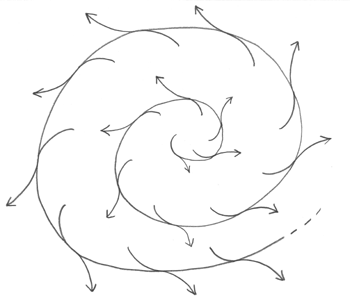
Figure 1. The dominant economic model of infinite unsustainable growth that swallows up the earth’s resources and exports massive amounts of wastes and entropy
In contrast, a sustainable system is like an organism [48-52], it closes the cycle to store as much as possible of the resources inside the system, and minimise waste (see Figure 2). Closing the cycle creates at the same time a stable, autonomous structure that is self-maintaining, self-renewing and self-sufficient.
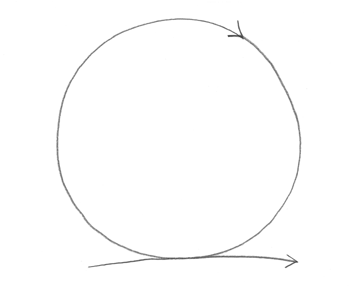
Figure 2. The sustainable system closes the energy and resource use cycle, maximising storage and internal input and minimising waste, rather like the life cycle of an organism that is autonomous and self-sufficient
In many indigenous integrated farming systems, livestock is incorporated to close the circle (Figure 3), thereby minimizing external input, while maximising productivity and minimizing wastes exported to the environment.
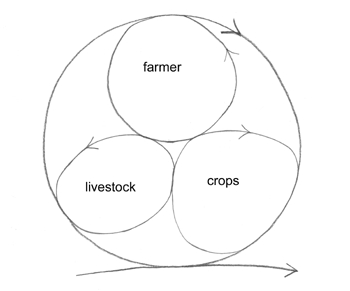
Figure 3. Integrated farming system that closes the cycle thereby minimizing input and waste
The elementary integrated farm supports three lifecycles within it, linked to one another; each lifecycle being autonomous and self-renewing. It has the potential to grow by incorporating yet more lifecycles (Figure 4). The more lifecycles incorporated within the system, the greater the productivity. That is why productivity and biodiversity always go together [62]. Industrial monoculture, by contrast, is the least energy efficient in terms of output per unit of input [51], and less productive in absolute terms despite high external inputs, as documented in recent academic research [63].
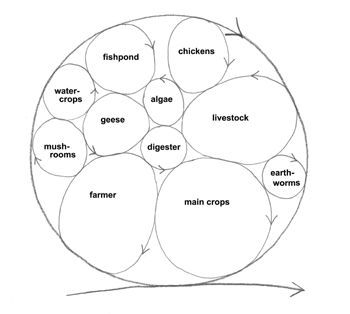
Figure 4. Increasing productivity by incorporating more lifecycles into the system
Actually the lifecycles are not so neatly separated, they are linked by many inputs and outputs, so a more accurate representation would look something like Figure 5 [49, 50, 52].
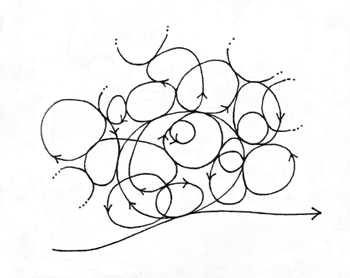
Figure 5. The many-fold coupled lifecycles in a highly productive sustainable system
The key to sustainable development is a balanced growth that’s achieved by closing the overall production cycle, then using the surplus nutrients and energy to support increasingly more cycles of activities while maintaining internal balance and nested levels of autonomy, just like a developing organism [49, 50, 52]. The ‘waste’ from one production activity is resource for another, so productivity is maximised with the minimum of input, and little waste is exported into the environment. It is possible to have sustainable development after all; the alternative to the dominant model of unlimited, unsustainable growth is balanced growth.
The same principles apply to ecosystems [52] and economic systems [50, 51] that are of necessity embedded in the ecosystem (Figure 6).
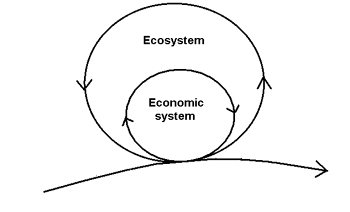
Figure 6. Economic system coupled to and embedded in ecosystem
Economics immediately brings to mind money. The circulation of money in real world economics is often equated with energy in living systems. I have argued however, that all money is not equal [50, 51]. The flow of money can be associated with exchanges of real value or it can be associated with sheer wastage and dissipation; in the former case, money is more like energy, in the latter case, it is pure entropy. Because the economic system depends ultimately on the flow of resources from the ecosystem, entropic costs can either be incurred in the economic system itself, or in the ecosystem, but the net result is the same.
Thus, when the cost of valuable (non-renewable) ecosystem resources consumed or destroyed are not properly taken into account, the entropic burden falls on the ecosystem. But as the economic system is coupled to and dependent on input from the ecosystem, the entropic burden exported to the ecosystem will feedback on the economic system as diminished input, so the economic system becomes poorer in real terms.
On the other hand, transaction in the financial or money market creates money that could be completely decoupled from real value, and is pure entropy produced within the economic system. This artificially increases purchasing power, leading to over-consumption of ecosystem resources. The unequal terms of trade, which continues to be imposed by the rich countries of the North on the poor countries of the South through the World Trade Organisation, is another important source of entropy. That too, artificially inflates the purchasing power of the North, resulting in yet more destructive exploitation of the earth’s ecosystem resources in the South.
It is of interest that recent research in the New Economics Foundation shows how money spent with a local supplier is worth four times as much as money spent with non-local supplier [43], which bears out my analysis. It lends support to the idea of local currencies and the suggestion for linking energy with money directly [64]. It also explains why growth in monetary terms not only fails to bring real benefits to the nation, but end up impoverishing it in real terms [65, 66].
Lester Brown argues [7] that the economy must be "restructured" at "wartime speed" by creating an "honest market" that "tells the ecological truth". I have provided a sustainable growth model that shows why the dominant model fails, and why telling the ecological truth is so important.
I am indebted to FESTA for inviting me to present a lecture at the conference, Food Security in An Energy-Scarce World, which resulted in the present paper. It benefited a great deal from the formal presentations as well as discussions with Richard Douthwaite, Folke Gunther, Colin Hines, Julian Darley, David Fleming, James Bruges, Bruce Darrell and numerous others.
Article first published 29/06/05
Comments are now closed for this article