
The UK Government issued a White Paper “Our energy future – creating a low carbon economy” [1] in 2003, saying that it was not proposing to build any new nuclear power stations, and that before such a decision was taken there would be another consultation.
Now, less than three years later, it is conducting a review of its energy policy, and nuclear energy is very much back on the table [2].
Peter Bunyard has explained in a previous issue (SiS 27) [3, 4] why nuclear power is not a solution to our energy crisis. Apart from important safety considerations that cannot be ignored, there is little if any saving in greenhouse gas emissions if we include all the processes involved, from mining the uranium to disposing of the waste. Nuclear energy is also very expensive. What is more, it is at best a temporary solution, as uranium, like oil, is a finite resource. Even at today’s rate of consumption, known reserves that can be mined and refined economically would be exhausted by the end of this century. If we were to substantially increase our dependence on nuclear energy, they would run out much sooner than that, probably within 50 years.
However, the Blair Government still believes that we need a substantial contribution from nuclear energy, and we have been told that it is looking to a new technology, the Pebble Bed Modular Reactor (PBMR) for the next generation of nuclear power stations. It is supposed to be both safer and cheaper than the reactors in use today, chiefly the pressurised water reactor (PWR) (see Box).
The South African state-owned electric utility Eskom is currently designing a PBRM in a consortium that includes the Industrial Development Corporation of South Africa, and British Nuclear Fuels. The US electric utility Exelon was a member but dropped out; its involvement at an earlier stage is helpful, because it meant that many Americans, including members of the US Nuclear Regulatory Commission, have studied the proposals carefully and raised important issues. A detailed and well-documented analysis [5] has been done by Jim Harding, the Director of Power Planning and Forecasting for Seattle City Light.
The Eskom design is based on two German reactors. The first, the small 15 MW AVR, began operating in 1967 and lasted 21 years. On the whole, it performed well. The other, the 300 MW THTR-300, took 14 years to build, cost DM 4 billion against an original estimate of only DM 650 million, and was shut down after four years. During its operation, there was an incident in which radioactivity was released into the environment. There was also a nuclear plant at Fort St. Vrain (Colorado, USA) that used high temperature helium as a coolant, as the PBMRs will, but this experienced many technical problems. After about ten years, the reactor was decommissioned and the plant now runs on natural gas [6].
On the whole, the PBMR design does appear to be inherently safer than the PWR. Above all, it is probably proof against meltdown. On the other hand, there are still some important safety issues, and it is hard to know how serious these are.
Much the same applies to cost. The proponents claim that the PBMR will produce electricity economically, but this is on the basis of a new and largely untested technology. Furthermore, much of the expected savings arise because the designers are so confident of the safety of the reactor that they plan to build them without containment buildings and close to populated areas where the power is required, and to operate them with much lower staffing levels than other types of reactor. Should the licensing authorities judge that PBMRs require the same sort of precautions as other reactors, much of the cost advantage will disappear.
And even if the PBMR does live up to the claims of its proponents, it still produces waste that has to be disposed of, it still increases the chance of proliferation of nuclear weapons, and it is still at best a temporary solution to the energy problem.
The Pressurised Water Reactor vs the Pebble Bed Modular Reactor
Nuclear reactors generate energy from nuclear fission. When an atom of uranium splits into two, it releases energy plus two neutrons; and if either of the neutrons hits another uranium atom it can cause that atom to split, which releases more energy and another pair of neutrons, and so on. This is the so-called chain reaction. If every neutron released stimulated a uranium atom to split, the number reacting would double at each step, and the reaction would rapidly get out of control, as it does in an atomic bomb. Nuclear reactors are designed to prevent that happening, for example by using variable amounts of neutron-absorbing materials such as boric acid or carbon.
In a Pressurised Water Reactor (PWR), the fuel - enriched uranium dioxide - is formed into ceramic pellets and packed into tubes called fuel rods. Water circulates around the fuel rods and is heated to a temperature of about 320 C; this is possible because it is under pressure. This water provides the heat for a boiler that generates steam that drives turbines and so produces electricity.
The coolant water serves another function besides transferring energy from the fuel rods to the steam boiler. The neutrons released during fission are too hot to be absorbed by other uranium atoms, which is necessary for the reaction to continue. They have to lose energy, and in a PWR this happens mostly by collisions with molecules of the water. The water acts as the moderator.
An advantage of using the coolant water as the moderator is that if the coolant is lost, the chain reaction stops. There is consequently no danger of the reactor turning into an atomic bomb. Ordinary radioactive decay would continue, however, and if nothing were done, the temperature would rise to dangerous levels, possibly leading to meltdown. PWRs have additional safety systems to counter this danger. They are also surrounded by strong containment buildings so that however badly damaged the reactor may be, no radioactive material should be released into the environment, at least in principle.
A Pebble Bed Modular Reactor (PBMR) is quite different. Instead of fuel rods, it has 452 000 pebbles. Three quarters of these are fuel pebbles, made of microspheres just under a millimetre in diameter. Each microsphere has a core of enriched uranium, about half a millimetre across, surrounded by three layers of coating: first pyrolytic carbon (a form of graphite), then silicon carbide, and finally another layer of the pyrolytic carbon. About 15 000 of these TRISO (three isotropic layers) microspheres are mixed with graphite and then pressed and sintered (fixed under heat and pressure) into a fuel pebble about 6 cm in diameter. The remaining non-fuel pebbles are pure graphite.
During operation, pebbles are continuously added to the top of the reactor and taken from the bottom. The fuel pebbles removed are inspected and if they are exhausted or damaged they are rejected from the system; otherwise they are returned to the reactor.
Pressurised helium, rather than water, is used as the coolant. It flows directly through a turbine; there is no secondary circuit as in a PWR. The helium enters the core at 482 C and leaves at 900 C, and the high temperature of the helium, the direct coupling, and the use of a gas turbine should make a PBMR much more efficient than a PWR. [5, 7]
PBMRs are relatively small. A single reactor occupies an area smaller than a football field and produces only about 110 MW. (A typical PWR or other light water reactor produces about ten times as much.) If more power is required at a site, up to 10 PBMRs can be located together and run from a common control suite, which is why they are called modular.
A PBMR has a number of features that should make it safer than a PWR. Crucially, the use of pebbles means it has a considerably lower power density in the core, and as pebbles have a much greater surface area than fuel rods (for a given volume of fuel) it is also better at dissipating heat. A loss of coolant should therefore not result in a meltdown.
The moderator in a PBMR is graphite, rather than water. That might seem to make the PBMR less safe than a PWR because if the coolant (in this case, helium) is lost, the moderator is still present. In fact, this is not the case. As a reactor heats, more neutrons are captured by U-238 atoms, which do not split, leaving fewer for the fissile U-235. This effect is much greater with graphite as a moderator than with water (because more collisions are needed to slow the neutrons) and the chain reaction would therefore stop before there is any danger of an explosion.
A PWR has to be shut down, refuelled and started up again about every eighteen months. It is expected that a PBMR would only be shut down for maintenance about every six years. Continuous refuelling also means that the fuel has much the same properties throughout, so excess reactivity can be kept to a minimum. There are, however, a number of outstanding questions about the safety of a PBMR.
Fuel The core of just one PBMR contains 5 billion microspheres. These have to be made to high quality because it is the coatings that prevent the release of fission products from the fuel during normal operation. When the US Nuclear Regulatory Commission (NRC) considered an application to build a PBMR in the USA [8], they noted that if the fuel kernel is not perfectly centred in the microsphere it will migrate out of the particle, so the fabrication must be accurate enough to prevent that happening.
Another question is the packing of the pebbles in the core. It is hard either to predict or to control how they will arrange themselves as they move down, and this can lead to significant local variations from the mean operating temperature. While the German AVR reactor had a predicted maximum fuel temperature of 1 150 C, it turned out to have many hot spots exceeding 1 280 C. That is important because the coatings on the fuel pellets begin to degrade at 1 250 C [9]. The current design provides for neither in-core instrumentation nor emergency cooling systems [5].
Fire The PBMR core contains a large amount of graphite, and this is an obvious hazard because graphite can oxidise at 400 C and the reaction becomes self-sustaining at 550 C, both well below the operating temperature. There could also be dangerous reactions if water vapour were allowed to enter. Using helium at high pressure clearly reduces the chance that either air or water can reach the graphite, but it remains to be seen by how much. For example, it has been shown that if a pipe were to break and the helium system lose pressure, air inflow could occur [9]. A fire in a PBMR would be especially serious, because there is to be no containment building and the reactors are meant to be built near the towns they serve [4].
Reliability of key components The PBMR has a number of components that are the first of their kind, and how well they perform in practice has obvious implications for both safety and cost.
External threats However well they are designed and built, nuclear reactors are subject to threats such as earthquakes, plane crashes, floods and terrorism. Articles on PWRs often point out that their strong containment structures offer resistance to such threats [10, 11]. Similar articles on PBMRs, which do not have the same protection, do not mention external threats [7, 11]. Instead they are so blandly reassuring that they become misleading (see Fig. 1).
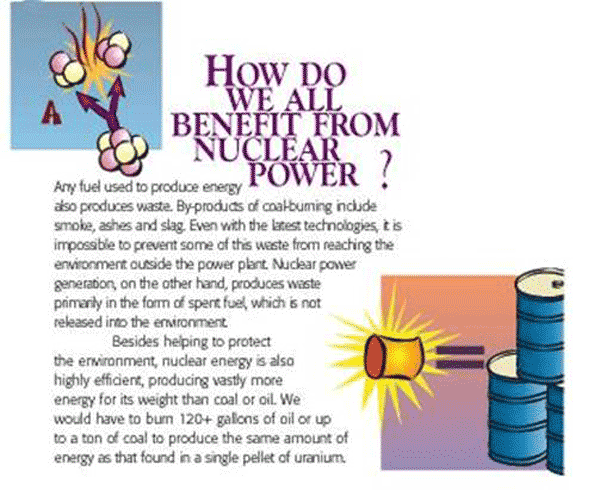
Fig. 1 How Exelon explains away the problem of nuclear waste to the public
Whether we use PWRs, PBMRs or any other form of reactor, we still have to dispose of highly dangerous radioactive waste. There seems broad agreement in principle that it should be possible to store the waste safely in geologic repositories, but identifying actual sites is turning out to be very difficult. The USA has been concentrating on one particular location, Yucca Mountain in Nevada, but this has still not been commissioned after 15 years. Moreover, it is estimated [12] that if there were a thousand 1 GW light water reactors in the world, a new repository equivalent to Yucca Mountain would be required every three or four years.
Supporters of PBMRs claim that the waste should be easier to deal with because the coating will ensure that the spent radionuclides are contained for extremely long periods of time. Even if the pebbles can be relied upon to retain integrity for thousands of years without additional processing, the total volume of waste is still very much greater than with a PWR [8]. Eskom has argued that the repository requirements would be much the same for both types because spent PWR fuel requires overpacking and spent pebbles do not, but this remains to be seen.
An important selling point for the PBMR is that individual modules are small and (so it is claimed) relatively easy to build and operate. They could therefore be sold to countries that could not afford to buy and run conventional reactors. Harding [5] points out that this would mean such countries would receive shipments of fuel which had been enriched to 9.6 per cent U-235. That’s about twice the enrichment required for light water reactors; and about 90 per cent of the separative work required for weapons grade uranium, the rest could be done using a small gas centrifuge plant.
The Interdisciplinary MIT Study [12] recommends that the International Atomic Energy Agency should do more to prevent proliferation and that nuclear power should not expand unless the risk of proliferation from operation of the commercial nuclear fuel cycle is made acceptably small. The widespread use of PBMRs would increase this risk rather than decreasing it.
The Eskom Board estimated in 2004 that a demonstration plant could be built for about 10 billion Rand. Subsequent units, they claimed, would cost about one fifteenth of that, and would make the total costs (recovery of capital and operating) about 1.7 US cents per kWh, well below the costs of new coal, gas or wind plants, and far below the cost of other nuclear power.
Harding [5] rightly argues that the estimates both for the demonstration plant, and even more so, for the follow-on plants are based on “a large number of extremely optimistic safety, reliability and efficiency assumptions.” Above all, a lot of the claimed savings come from weakening the usual safety standards.
In theory, the PBMR has a number of advantages over most current reactors. If all goes well, it could turn out to be both safer and more economical. But that’s a very big “if”, and past experience with nuclear reactors and indeed new technologies in general tells us that things are unlikely to go as anticipated.
Even if the problems that are bound to arise during development and the operation of the first prototypes can be solved without substantially increasing the costs, there remains the problem of safety. The design may make incidents such as fires and accidental release of radiation less likely than with, say, a PWR, but are they so unlikely that PBMRs should be built near towns and without containment structures? If licensing authorities decide they are not, a considerable part of the economy disappears.
The intractable problems of waste, proliferation, and the finiteness of the uranium supply remain. For those committed to nuclear energy, the PBMR may well turn out to be an improvement on existing reactors, though it will be at least five years before we can know. But it makes no difference whatsoever to the wider debate. The arguments against nuclear energy remain overwhelming.
Article first published 17/02/06
Comments are now closed for this article