From the Editors
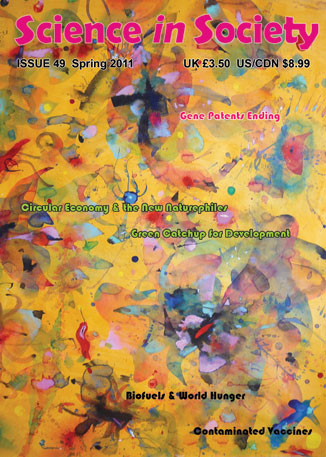
Death of Gene Patents?
Subscribe Now
It took more than a decade to expose
this legal monstrosity; all patents on DNA sequences natural or synthetic
should be banned on the ground that they usurp the ‘laws of nature’ embodied in
the DNA coding mechanisms that have evolved through billions of years of
evolution
US Government rejects gene patents
The US federal government dropped a
bombshell on 29 October 2010 when it reversed a longstanding policy. It said
that patents should not be granted for genomic DNA as it is a product of nature
even when isolated from the organism. However, recombinant DNA, or new
combinations of DNA for making genetically modified organisms, or gene therapy,
or ‘synthetic life’ (see Synthetic
Life? Not By a Long Shot, SiS 47) remain patentable.
The opinion was
expressed in the amicus (friend of the court) brief from the Justice Department
in response to the ongoing legal battle over US patents for the breast and
ovarian cancer-predisposing genes BRCA1 and BRCA2.
“The chemical
structure of native human genes is a product of nature, and it is no less a
product of nature when that structure is ‘isolated’ from its natural
environment than are cotton fibers that have been separated from cotton seeds
or coal that has been extracted from the earth,…
“We acknowledge that
this conclusion is contrary to the longstanding practice of the Patent and
Trademark Office, as well as the practice of the National Institutes of Health
and other government agencies that have in the past sought and obtained patents
for isolated genomic DNA,” the brief said.
Is this a major
reversal of policy?
“It’s major when the
United States, in a filing, reverses decades of policies on an issue that
everyone has been focused on for so long,” said Edward Reines, a patent
attorney who represents biotechnology companies.
Dr. James P. Evans, a
professor of genetics and medicine at the University of North Carolina and head
of a government advisory task force on gene patents, referred to the
government’s brief “a bit of a landmark, kind of a line in the sand.” He pointed
out that although gene patents had been issued for decades, the patentability
of genes had never been examined in court.
As of 2010
approximately 40 000 US patents exist that relate to an estimated 2 000 human
genes, or about 20 percent of the human genome. Patents have been issued for
isolated genes, methods of using the isolated genes, and methods to diagnose a
disease based on an association between a gene and a disease.
Legal battle over breast cancer genes
This major reversal in US policy came in the midst of a legal battle over patents on the breast cancer genes. In
March 2010, a US District court ruled that claims in seven patents supporting a
widely used genetic test for breast and ovarian cancer susceptibility are
invalid. This was in stark contrast to a 2008 decision by the appeals board of
the European Patent Office, which supported the patents. The US ruling was delivered as the result of a lawsuit brought in May 2009 against Myriad Genetics, Salt Lake City, Utah, and the University of Utah Research Foundation, which hold the
patents on the BRCA1 and BRCA2 genes.
The company
charges more than US$3 000 for a test. In 2009, Myriad’s revenues from
molecular diagnostics grew by 47 percent to $326.5 million, with BRCAnalysis
accounting for the lion’s share of the revenues.
The
plaintiffs in the case included individual physicians and patients as well as
the Association for Molecular Pathology and the American College of Medical
Genetics; they were represented by the American Civil Liberties Union (ACLU)
and the New York–based Public Patent Foundation.
The
plaintiffs called the patents illegal on the basis that they restrict both
scientific research and patients’ access to medical care, and claim that
patents on human genes violate patent law because genes are products of nature.
In his written opinion, Judge Robert Sweet of the US District Court for the
Southern District of New York ruled that both Myriads' composition and method
claims are invalid under the law, disagreeing, for instance, with Myriad’s
argument that the purification of a natural product like a gene necessarily
renders it patentable,
“The
summary judgment is a first step but a very important one," says
Mary-Claire King, a geneticist at the University of Washington in Seattle, who discovered BRCA1 in 1990. “Opening genetic testing for BRCA1 and
BRCA2 to the competitive marketplace of new genomic technologies would
be good for breast and ovarian cancer patients, their families, and their
physicians.”
Apart from the
steep price of the test, the plaintiffs raised of the points raised in the
Myriad case, was that Myriad made efforts to prevent clinical trials on their
test and the patents denied patients from receiving second opinions on their
test results.
Specific claims, though
not all claims, in seven of Myriad’s 23 patents on BRCA1 and BRCA2 were
challenged in the complaint, covering the isolated genes as well as diagnostic
methods.
In his decision
handed down 29 March 2010, the judge rejected the legal equivalency between
chemical compositions such as purified adrenaline and DNA.
Judge Sweet said: “The
information encoded in DNA is not information about its own molecular structure
incidental to its biological function, as is the case with adrenaline or other
chemicals found in the body...this informational quality (of DNA) is unique
among the chemical compounds found in our bodies, and it would be erroneous to
view DNA as ‘no different’ than other chemicals previously the subject of
patents....DNA, in particular the ordering of its nucleotides, therefore serves
as the physical embodiment of laws of nature - those that define the
construction of the human body…the preservation of this defining characteristic
of DNA in its native and isolated forms mandates the conclusion that the
challenged composition claims are to unpatentable products
of nature.”
Myriad announced that it would appeal the decision, and did so 16 June
2010.
In September 2010,
Melissa Parke, a Member of Parliament in Australia, announced that she intends
to call for amendments to the Patents Act so gene patents would no longer be
recognized for reasons similar to those in the Myriad case.
Division within the US government
On 1November 2010, David Kappos,
Undersecretary of Commerce for Intellectual Property and Director of the United
States Patent and Trademark Office told the press: “The USPTO at the present
time is maintaining the status quo. We’re continuing with current
procedures as they are.”
This presages a
public policy battle between the United States Department of Commerce and the
United States Department of Justice.
ISIS has called for a ban on gene patents since 1999 (see Open Letter
from World Scientists to all Governments Concerning Genetically Modified
organisms (GMOs), http://www.i-sis.org.uk/list.php);
and argued time and again Why Biotech Patents Are Patently
Absurd (ISIS-TWN Report). We are obviously gratified by these new
developments, and look forward to a ban on all patents on DNA sequences,
synthetic or natural on ground that humans are usurping the laws of nature
embodied in the DNA coding mechanisms (as Judge Robert Sweet had pointed out in
his ruling against Myriad), which have evolved through billions of years of
evolution.
Fully referenced versions of all
articles including this editorial are available on ISIS members’ website
Fully referenced versions of this editorial and all
articles are available on ISIS members website: http://www.i-sis.org.uk/sismembers.php
Subscribe Now
|