
A potted history of Dream Farm 2, its conceptual underpinnings and update with a potential site in mind. Dr. Mae-Wan Ho
Many people have asked what exactly is Dream Farm 2. There are several answers. First of all, Dream Farm 2 is a model of an integrated, ‘zero-emission’, ‘zero-waste’ highly productive farm that maximises the use of renewable energies and turns ‘wastes’ into food and energy resources, thereby completely obviating the need for fossil fuels. It is our answer to the energy crisis and climate change, and more. It is a microcosm of a different way of being and becoming in the world, and in that respect, nothing short of a social revolution.
In a way, I have dedicated the past 20 years to developing the idea, and trying to live up to it.
The technical details are in my book [1], The Rainbow and the Worm - The Physics of Organisms 2nd Edition , published in 1998, and reprinted several times since. The book presented a theory of the organism that captures the essence of Dream Farm 2 and the kind of social and spiritual revolution it entails.
I also proposed that we could look at sustainable systems as organisms. Strangely enough,
I had actually discovered Gunther Pauli’s ‘zero-emission’ work, if only peripherally, and had cited it in a paragraph at the end of the final chapter of another book, first published also in 1998, Genetic Engineering Dream or Nightmare [2] where I argued that we need a deep and sustained change of direction in all spheres of life before the dream of solving all the world’s problems by genetic engineering turns into a nightmare. But the full significance of Pauli’s work had not dawned on me until much later.
Sometime during the Christmas break of 2004, a letter from theoretical ecologist Robert Ulanowicz at the University or Maryland turned up on my desk; only it was sent six months earlier. I had put it aside as ‘very important’ and forgotten about it. I e-mailed him at once, expressing abject apology, and lucky me! We ended up writing a paper together, which took the idea of Sustainable Systems as Organisms into ecology [3]. Our paper was published in May 2005. So when I discovered George Chan’s Integrated Food and Waste Management System, its connection with my own work struck home; and soon afterwards, I saw how to extend my theory of sustainable systems as organisms to include growth and development explicitly, which until then, it did not.
By July 2005, I had met waste-treatment engineer and town planner Kenneth Spelman who came to the Sustainable World First International Conference [4] (Sustainable World Coming, SiS 27) organised by ISIS. Kenneth has an extraordinarily long string of titles following his name, revealed when he handed me his card at the conference dinner.
In August 2005, I made contact with George Chan, to tell him we need something like his IFWMS in Britain, and could he help? He said to me, “Get me a good engineer.” So I picked up the phone and got Kenneth, who said, “What a good idea!” And that was the start of what later became Dream Farm 2.
But let me backtrack just a little to explain the idea of looking at sustainable systems as organisms.
Essentially, the ‘zero-waste’ or ‘zero-entropy’ model of the organism and sustainable systems predicts balanced development and growth at every stage, as opposed to the dominant model of infinite, unsustainable growth. This immediately disposes of the myth that the alternative to the dominant model is to have no development or growth at all, and that is how most critics of the dominant model see it, including the New Economics Foundation, for example, which sees itself as very radical [5].
The dominant model of infinite competitive growth can be represented as the bigger fish swallowing the smaller ad infinitum (Fig. 1), and it describes equally how a person should behave and how a company should develop in order to be successful.

Figure 1. Big fish swallows small fish swallows little fish
A person grows at the expense of other people; a company grows by taking over other companies, laying waste to the earth’s resources in the meantime. There is no closed cycle to hold resources within, to build up stable organised social or ecological structures. Not surprisingly, this is totally unsustainable, which is why we are faced with global warming and the energy crisis.
In contrast, the archetype of a sustainable system is a closed lifecycle, like that of an organism, it is ready to grow and develop, to build up structures in a balanced way and perpetuate them, and that’s what sustainability is all about. Closing the cycle creates a stable, autonomous structure that is self-maintaining, self-renewing and self-sufficient.
In order to do that, you need to satisfy as much as possible the zero-entropy or zero-waste ideal (Fig. 2). We tend towards that ideal, which is why we don’t fall apart, and grow old only very slowly. If we were perfect, you realise, we’d never grow old. The secret is described in my book, the Rainbow Worm, so you better read it.
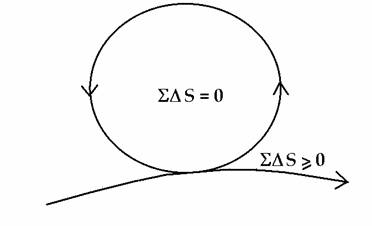
Figure 2. The zero-entropy ideal of a sustainable system
This diagram says no waste or disorganisation (entropy) accumulates in the system. Even the waste (entropy) exported to the outside is minimised towards zero in a healthy balanced system. The more we approach that ideal, the better the system can develop and grow, and remain young and vibrant.
The system’s cycle contains more cycles within that are interlocked to help one another thrive and prosper. The minimum integrated farm has the farmer, livestock and crops. They work by reciprocity and devolved autonomy.
The farmer prepares the ground to sow the seeds for the crops to grow that feed the livestock and the farmer; the livestock returns manure to feed the crops. Very little is wasted or exported to the environment. In fact, a high proportion of the resources are recycled and kept inside the system. The system stores energy as well as material resources such as carbon. The extra carbon is sequestered in the soil as the soil improves, and in the standing biomass of crops and livestock.
The farm can perpetuate itself like that quite successfully and sustainably, or it can grow. Organic growth is always done in a balanced way by engaging more cycles, units of devolved autonomy that help one another do better.
In the old paradigm, organisms are predominantly seen to compete for resources and for space. But we’ve got three space dimensions and the time dimension too. We’ve got space-time that we can fill up more thickly with life cycles of different sizes that occupy different space-times. That is exactly what organisms in a naturally biodiverse ecosystem do to maximise the reciprocal, symbiotic relationships that benefit all the species. So you can add fish, algae, poultry, worms, mushrooms, etc., turning the ‘waste’ from one cycle to resource for another.
The more lifecycles incorporated, the more energy and standing biomass are stored within the system, and the more productive the farm. It will also support more farmers or farm workers.
Productivity and biodiversity always go together in a sustainable system, as generations of farmers have known, and recent academic researchers have rediscovered. It is also the most energy efficient. Why? Because the different life cycles are essentially holding the energy for the whole system by way of reciprocity, keeping as much as possible and recycling it within the system.
Industrial monoculture, in contrast, is the least energy efficient in terms of output per unit of input, and often less productive in absolute terms despite high external inputs, because it does not close the cycle, it does not have biodiversity to hold the energy within, and it ends generating a lot of waste and entropy and depleting the soil.
Actually the lifecycles are not so neatly separated, they are linked by many inputs and outputs.
As one cycle winds down another winds up, and vice versa later on. This kind of reciprocity is operating all the time in our body as in a sustainable system, which is why energy and materials stay stored for much longer.
It is my belief that organisation and societies that encourage devolved autonomy, reciprocity and synergy would be much more effective and creative than those that emphasize competitiveness and control. They’ll be far happier too. But that’s the ideal people including myself have to try live up to constantly, and it is well worth it.
I have dubbed George Chan’s IFWMS, Dream Farms [6] in an article published in last autumn’s issue of our magazine Science in Society. So lets call it Dream Farm 1.
For those who don’t already know, the biogas digester is the key technology for developing the minimum IFWMS. The biogas digester provides an anaerobic environment for bacteria present in livestock waste to ferment the biological material, first into acids and alcohols, which are then turned into methane by methane producing bacteria. Anaerobic digestion prevents methane as well as volatile nitrogen from escaping; thereby saving strong greenhouse gas emissions and nutrients that otherwise would have been lost to the farm only to pollute the environment. The waste water from the biogas digester with dissolved nutrients and remaining pollutants then goes through aerobic digestion, where the algae produce all the oxygen needed to detoxify the pollutants so the purified water with nutrients can go into the fishponds without killing the fish. The nutrients encourage plankton to grow to feed the fish, and the water in the fishponds containing fish-waste nutrients can be used to fertigate crops growing on the dykes or in the fields. You can also grow crops in floats on the fishponds. Worms, poultry, mushrooms can all be integrated into the core system. The biogas harvested is 60 percent or more of methane (the rest carbon dioxide), and can be used directly as cooking fuel, or for generating heat and electricity.
The advantages of anaerobic digestion of organic wastes to recover methane [7] (see Box ) (How to be Fuel and Food Rich under Climate Change, this issue) are far greater than other “energy from waste” technologies, the worst of which is probably incineration.
Box 1
Advantages of anaerobic digestion to recover methaneAs is already clear from George’s excellent presentation at Kindersley Centre [8] described in my presentation of Dream Farm 2 (Dream Farm II, How to beat climate change and post fossil-fuel economy, SiS 29), there are many possible implementations of his system based on locally available resources.
Kenneth Spelman, distinguished Chartered Engineer and Environmentalist, Fellow of Royal Town Planning Institute and numerous other learned institutions, loved the idea of Dream Farm 2 right away when I explained that to him breathlessly over the phone. And we soon agreed to put forward a joint application to the UK government funding body, The Carbon Trust. We misnamed our proposal “Integrated Reduced Emissions Food and Energy Farm” because we thought we had to have a boring title. But the more you look at it, the more you realise Dream Farm 2 is not only ‘reduced emission’ but closer to ‘zero emission’. By incorporating other readily available renewable energies into the core, the farm can be both energy and food rich without fossil fuels.
Our Carbon Trust application failed as people said it would, because they did not think Carbon Trust would support such proposals. After that, I improved the proposal and made it public. I-SIS invited George Chan over from Mauritius for our first Dream Farm workshop, where I also launched Dream Farm 2. I wanted everyone to know about it, and to set up similar farms all over the world that would be supported by Dream Farm 2 proper.
George has been supporting our project, and sharing his knowledge and wisdom with a large network of fans and answering technical questions ever since. He volunteered to return for the launch of I-SIS Which Energy? Report [9] at UK parliament [10] (Which Energy? Gets High Praise At Launch) and speak to the second Dream Farm workshop in May 2006. Thank you George, from all of us at ISIS, for your support, which has built up the current enthusiasm for our Dream Farm 2, and is crucial for its eventual success; your support is also attracting key people to the now worldwide movement to set up similar farms.
Appreciation and thanks are also due to Peter Rae for volunteering to organise the second and third Dream Farm 2 workshop (27 May and 15-16 July 2006), to Chris Maltin of Organic Power for generously hosting both the workshops, and to David Saunders for publicising the Dream Farm 2 project. Many useful suggestions, ideas and contacts arose out of the workshops.
‘Dream Farm 2’ proper is a particular implementation and extension of George Chan’s IFWMS concept, in that it consciously integrates food and energy production, emphasising consumption of both at the point of production. While it operates as a farm, it will also serve as a demonstration, education and research centre and incubator for new ideas, designs and technologies. Its aim is to promote and support similar farms springing up all over Britain and the rest of the world not only through publicity of Dream Farm 2 itself, but also by collating and analysing data from all similar farms, by acting as resource centre and centre for information exchange (see Box 2).
Box 2
Benefits of Dream Farm 2
I have updated the diagram of the complete model of Dream Farm 2 in Figure 3, which will be implemented at a potential site now under consideration. The diagram is colour coded to emphasize the major components: Pink is energy, green is food, blue is water purification and conservation, black is waste in the common sense of the word, though in Dream Farm 2, it rapidly becomes transformed into resources for producing energy or food. Purple is the analytical laboratory on site, which links to many other labs. We want to be able to do water, gas and soil analyses on site, to monitor how the system is working. Modelling and forecasting will be done on site as well.
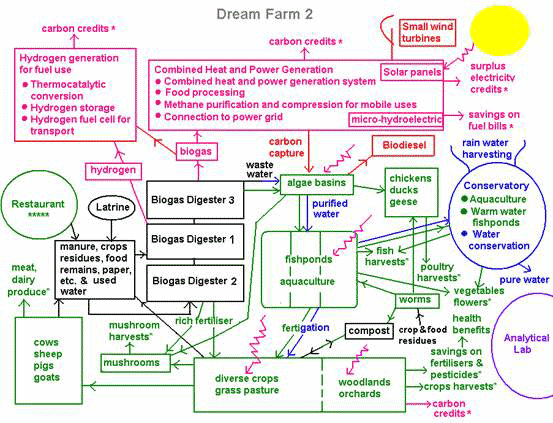
Figure 3 Dream Farm 2 version 2
Because this is an organic system in the sense I have described, we don’t have to have all the elements all at once. We can have a very simple system consisting of biogas digester, livestock, crops, algae basins without fishponds, as that essentially does the water purification already and closes the cycle. The algae can be used to feed livestock, as an alternative to grain or worse, soybeans.
Fishponds can be added and aquaculture and planting done on the dykes. Willow trees will be fine. The Chinese sauté willow shoots with almonds and sesame oil, mouth-watering, isn’t it? Solar power and wind turbines suitably scaled down are relatively easy and cheap to install, micro-hydroelectricity also. Combined heat and power generation is well developed. Methane purification and compression for mobile uses are already up and running, as Chris Maltin has demonstrated [11] (Organic Waste-Powered Cars, SiS 30). All these renewable energy harvesting would provide enough fuel for cars and farm machinery retrofitted to run on natural gas, as well as heat for the conservatory with more aquaculture and warm fishponds, where we can install water harvesting and water purification, again, based on well-tried technologies. Similarly, we can expand the production of the farm to poultry and mushrooms, lots of fresh fruits and vegetables aimed at recovering indigenous biodiversity in both plants and animals. And of course, we have the gourmet restaurant on site to make good use of the fresh organic produce.
The more experimental and innovative technologies, for example, hydrogen production either directly from wastes [12] (Bug Power, SiS 27) or from methane, fuel cells for combined heat and power generation, conversion of methane to hydrogen, and using Green Algae for Carbon Capture [13] etc., can all be added on and perfected while the farm is running and producing, which is very important
Notice that three biogas digesters are present, connected both in parallel and in series. This is advisable, because it provides spares in case one is not working properly. It also provides for the production of both hydrogen and methane in a two-stage digestion process. I am also suggesting that we include human manure in the biogas digestion, as well as restaurant wastes. If we set this farm up as a research institute, and we never export any waste to the outside at all, could we escape the regulatory hurdle, and better yet, cause DEFRA (Department of the Environment, Food and Rural Affairs) to change the regulations for such farms?
That’s why we need the analytical lab facilities, to produce the data to show how pure our water is, what wonderful detoxification and removal of harmful pathogens is achieved after anaerobic and aerobic digestion.
There’s an article on the web [14] featuring a project in the northwest of Yunnan Province in Southern China covering 69 000 square kilometres (the size of Ireland) of high mountains, deep gorges, and indigenous forest containing some of the world’s most diverse and threatened plants and animals. The area also contains the upper reaches of important rivers like the Yantze, Mekong, Salween and Irrawaddy on which the livelihoods of many millions of people further downstream depend.
About 3.2 million live in the region, from 15 distinct ethnic groups. The main threats to the ecology of the region comes from tree cutting mostly for fuel wood, insensitive tourist activities, unmanaged collection and use of plants and animals, and over-grazing of animals on grasslands.
The Chinese branch of the international conservation organisation, The Nature Conservancy, helped set up the China Rural Energy Enterprise Development programme, working with local entrepreneurs to develop businesses making, selling and installing fuel-efficient cooking stoves, fuel briquettes made from crop wastes, and ‘four in one’ biogas digesters, solar water heaters, solar cookers and micro-hydropower plants.
This ‘four in one’ biogas production incorporates an underground biogas digester, a greenhouse for growing vegetables, a pigpen and a latrine. The open cover for the digester is close to the pigpen and latrine. The greenhouse also covers this area, so it gets heated and this accelerates the fermentation process in the digester. Human excreta falls directly into the digester from the latrine and a shovel is used to put the pig waste into the digester.
The biogas digester is built of concrete, and has a capacity of six to eight cubic metres. This is sufficient to meet most of the cooking and lighting needs of households, except when it is too cold. The cost of the four in one system varies from US$250 to 800, depending on the size of the greenhouse.
The challenge now is to make Dream Farm 2 a reality, to put flesh on the bare bones of the diagram, so we can start building the best when the site is agreed. Watch this space.
This article is based on her presentation at Dream Farm 2 workshop 15-16 July 2006, Gould’s Farm, Wincanton, UK.
Article first published 24/07/06
1. Ho MW. The Rainbow and The Worm, The Physics of Organisms, 2nd ed., World Scientific, Singapore, 1998, reprinted 2000, 2001, 2003, 2006.
2. Ho MW. Genetic Engineering Dream or Nightmare? The Brave New World of Bad Science and Big Business, Third World Network, Penang, Malaysia, Gateway Books, Bath, UK 1998; 2nd ed., Gill & Macmillan, Dublin, Ireland, Continuum Books, New York, USA, 1999, translated into many languages. Reprinted with long introduction, Third World Network, Penang, 2006.
3. Ho MW and Ulanowicz R. Sustainable systems as organisms? BioSystems 2005,
4. Gala R. Sustainable world coming. Science in Society 2005, 27, 36-40, https://www.i-sis.org.uk/isisnews.php
5. Woodward D and Simms A. Growth isn’t working: the uneven distribution of benefits from economic growth, new economics foundation, London, 2006.
6. Ho MW. Dream Farm. Science in Society 2005, 27, 26-28, https://www.i-sis.org.uk/isisnews.php
7. Ho MW. How to be fuel and food rich under climate change, Science in Society 2006, 31, https://www.i-sis.org.uk/which_energy.php
8. Ho MW. Dream Farm II. How to beat climate change and the post fossil fuel economy, Science in Society 2006, 29, 10-14+, https://www.i-sis.org.uk/isisnews.php
9. Ho MW, Bunyard P, Saunders PT and Gala R. Which Energy? 2006 I-SIS Energy Report, ISIS, 2006, https://www.i-sis.org.uk/which_energy.php
10. Burcher S and Ho MW. Which Energy? gets high praise at launch. Science in Society 2006, 31, https://www.i-sis.org.uk/isisnews.php
11. Ho MW. Organic waste-powered cars. Science in Society 2006, 30, 38-39, https://www.i-sis.org.uk/isisnews.php
12. Ho MW. Bug power. Science in Society 2005, 27, 24-25, https://www.i-sis.org.uk/isisnews.php
13. Ho MW. Green algae for carbon capture and biodiesel. Science in Society 2006, 30, 40-41, https://www.i-sis.org.uk/isisnews.php
14. Biobusters – China, HandsOn – The Earth Report from TVE.org, (http://www.handsontv.info/series5/energetic_reports/03_BioBusters%20-%20China.html)
Comments are now closed for this article