
Proposal for an integrated food and energy rich farm to beat climate change and the energy crisis, and a path to social revolution Dr. Mae-Wan Ho Institute of Science in Society
Floods are devastating Britain, the likes of which have not been seen in one and a half centuries [1, 2]. Five have been killed, thousands left without power, and hundreds of families without homes. Farming has been badly hit [2, 3]: an estimated 25 percent of Britain’s pea crop destroyed, along with potatoes, cereals and other produce, and hundreds of livestock dead. Flood damages are set to exceed £1.5 billion from insurance claims, and £3 billion when losses from uninsured households and damage to roads and other public sector works are included [4].
Meanwhile, the major breadbaskets of the world are suffering prolonged drought. United States has been thirsting for seven consecutive years [5], Australia is hit by its worst drought in 1 000 years [6, 7] and China, its worst in 50 years [8, 9].
Extreme weather patterns are disrupting food production on all the continents, when world grain yields have been falling for six of the past seven years as the result of unsustainable agricultural practices as much as from climate change; and the reserves are now at the lowest in more than thirty years [10].
There is general scientific consensus that the increasing frequency of floods and droughts are down to global warming [11], which is caused by the increasing release of CO2 and other greenhouse gases into the atmosphere since the industrial revolution [12] (Global Warming Is Happening, SiS 31). The two main sources of CO2 emissions - burning fossil fuels and industrial processes, and change in land use, mainly land clearing for agriculture and industrial development - accounted for 7.9 Gt C and 1.5 Gt C in 2005; the former growing rapidly in recent years while the latter remaining nearly steady.
Consequently, the rate of increase in CO2 emissions has jumped from 1.1 percent a year for 1990-1999 to >3 percent a year for 2000-2004 [13], as consistent with scientists predicting a few years ago that climate change is abrupt [14] (Abrupt Climate Change Happening, SiS 20), and many more recent signs that it is indeed accelerating [15]. The oceans are losing the capacity to soak up rising CO2 emissions, and increasing the rate of global warming by 30 percent. There is also evidence that the oceans may be turning from a carbon sink that soaks up CO2 to a source that emits it to the atmosphere [16] (Save Our Oceans, Save Our Planet series, SiS 31).
As if all that is not enough, fossil fuels are rapidly depleting, both oil [17] (Oil Running Out, SiS 25), and natural gas [18]; and the global scramble for biofuels to make up for the deficit is set to make matters much worse. Biofuels such as ethanol and biodiesel compete directly with food for feedstock like maize, soybean, oilseed rape, sugarcane etc., sending food prices sky-high. They also compete for land to grow the crops, causing large swathes of tropical rainforests to be razed to the ground, to be replaced by oil palm and jatropha plantations; and in the process, releasing extra megatonnes of CO2 into the atmosphere, further accelerating global warming [19] (Biofuels: Biodevastation, Hunger & False Carbon Credits, SiS 33).
It is clear that we must have a strategy for food and energy security if we are to survive global warming. The good news is that we have all the means to do so, which can be assembled together in one food and energy system we call Dream Farm 2 [20] (Dream Farm 2 - Story So Far, SiS 31).
What exactly is Dream Farm 2? There are several answers. First of all, Dream Farm 2 is a model of an integrated, ‘zero-emission’, ‘zero-waste’ highly productive farm that maximises the use of renewable energies and turns ‘wastes’ into food and energy resources, thereby completely obviating the need for fossil fuels. It is indeed a solution to the energy and food crisis that is capable of mitigating climate change, and more. It is a microcosm of a different way of being and becoming in the world, and in that respect, nothing short of a social revolution.
Dream Farm 2 goes back to a theory of the organism that I have developed ten years ago in The Rainbow and the Worm - The Physics of Organisms 2nd Edition [21], and a proposal that we can understand sustainable systems as organisms [22], that was further elaborated in a joint paper with theoretical ecologist Robert Ulanowicz [23] Sustainable Systems as Organisms, ISIS scientific publication) published in 2005.
The idea of sustainable systems as organisms was independently corroborated and practically implemented in Günther Pauli’s zero-emission production systems [24] and George Chan’s Integrated Food and Waste Management Systems (IFWMS), which I have described as [25] Dream Farms (SiS 27).
Dream Farm 2 incorporates renewable energies explicitly into George Chan’s IFWMS, with emphasis on coupled cycles of operation.
Figure 1 is a very schematic diagram of George Chan’s system, which I shall call Dream Farm 1. The farms are very diverse, depending on local resources, ingenuity and imagination.
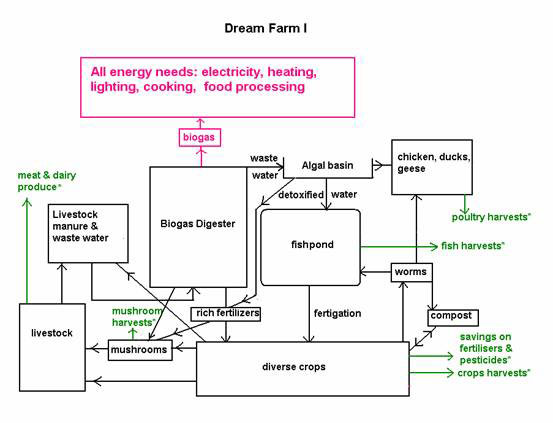
Figure 1. Dream Farm 1
The anaerobic digester takes in livestock manure plus wastewater, and generates biogas, which provides all the energy needs for heating, cooking and electricity. The partially cleansed wastewater goes into the algal basin where the algae produce by photosynthesis all the oxygen needed to detoxify the water, making it safe for the fish. The algae are harvested to feed chickens, ducks, geese and other livestock. The fishpond supports a compatible mixture of 5-6 fish species. Water from the fishpond is used to ‘fertigate’ crops growing in the fields or on the raised dykes. Aquaculture of rice, fruits and vegetables can be done in floats on the surface of the fishpond. Water from the fishpond can also be pumped into greenhouses to support aquaculture of fruits and vegetables. The anaerobic digester yields a residue rich in nutrients that is an excellent fertiliser for crops. It could also be mixed with algae and crop residues for culturing mushrooms after steam sterilisation. The residue from mushroom culture can be fed to livestock or composted. Crop residues are fed back to livestock. Crop and food residues are used to grow earthworms to feed fish and fowl. Compost and worm castings go to condition the soil. Livestock manure goes back into the anaerobic digester, thus closing the grand cycle. The result is a highly productive farm that’s more than self-sufficient in food and energy.
George’s farms are strong on animal welfare [26] (Dream Farm Power Point Presentations, https://www.i-sis.org.uk/onlinestore/av.php). They are organically fed, and the pigs are especially easy to toilet-train to deposit their manure directly into the digester, so the animals and their living quarter are spotlessly clean, which makes for healthy and contented animals.
Anaerobic digestion, the core waste-treatment and energy technology in Dream Farm 1, has numerous advantages over other waste-treatment and energy technologies, including other biofuels [27] (see Box 2 from How to be Fuel and Food Rich under Climate Change, SiS 31). The Chinese government is promoting the widespread use of biogas digesters to support a burgeoning eco-economy [28] (Biogas China, SiS 32).
Box 2
Advantages of anaerobic digestion to recover methane
George Chan’s Dream Farm 1 gave me a lot of food for thought on how my theory of the organism and sustainable systems contrasts with the dominant model.
The dominant model of infinite competitive growth consists essentially in the bigger fish swallowing the smaller ad infinitum, and it describes equally how a person should behave and how a company should develop in order to be successful.
A person grows at the expense of other people; a company grows by taking over other companies.
A system engaged in infinite competitive growth must inevitably swallow up the earth’s resources, laying waste to everything in its path, like a hurricane. There is no closed cycle to hold resources within, to build up stable organised social or ecological structures. Not surprisingly, this is totally unsustainable, which is why we are faced with global warming and the food and energy crises.
In contrast, the archetype of a sustainable system is a closed lifecycle, like that of an organism, it is ready to grow and develop, to build up structures in a balanced way and perpetuate them, and that’s what sustainability is all about. Closing the cycle creates a stable, autonomous structure that is self-maintaining, self-renewing and self-sufficient.
In order to do that, you need to satisfy as much as possible the zero-entropy or zero-waste ideal (Fig. 2). We tend towards that ideal, which is why we don’t fall apart, and grow old only very slowly. If we were perfect, we’d never grow old or die. In the same way, a sustainable system can remain vital and stable indefinitely, and the closer it approximates to the zero entropy ideal, the better.
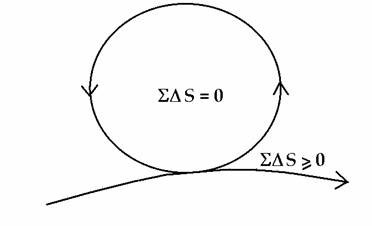
Figure 2. The zero-entropy ideal of a sustainable system
More importantly, the ‘zero-waste’ or ‘zero-entropy’ model of the organism and sustainable systems does allow for growth and development, but in a balanced way, as opposed to the unbalanced, infinite growth of the dominant model. This immediately disposes of the myth that the alternative to the dominant model is to have no development or growth at all.
Balanced development and growth arises naturally in the organism, because the organism’s life cycle is maintained by cycles within that are coupled together to help one another thrive and prosper.
Similarly, the minimum integrated farm is an example of a sustainable system. It consists of the farmer, livestock and crops. The farmer prepares the ground to sow the seeds for the crops to grow that feed the livestock and the farmer; the livestock returns manure to feed the crops. Very little is wasted or exported to the environment. In fact, a high proportion of the resources are recycled and kept inside the system. The system stores energy as well as material resources such as carbon. More extra carbon is sequestered in the soil as the soil improves, and in the standing biomass of crops and livestock, which also increase as the soil-carbon increases.
The farm can perpetuate itself like that quite successfully and sustainably, or it can grow by engaging more cycles. These other cycles, such as the fish, fowl, algae, earthworms, mushrooms, etc., are units of devolved autonomy that help one another do better.
In the old paradigm, organisms are predominantly seen to compete for resources and for space. But we’ve got three space dimensions and the time dimension too. We’ve got space-time that we can fill up more thickly with life cycles of different sizes that occupy different space-times. That is exactly what organisms in a naturally biodiverse ecosystem do to maximise the reciprocal, symbiotic relationships that benefit all the species. So adding the fish, algae, poultry, worms, mushrooms, etc., essentially turns the ‘waste’ from one cycle into resource for another.
The more lifecycles incorporated, the more energy and standing biomass are stored within the system, and the more productive the farm. It will also support more farmers or farm workers.
Productivity and biodiversity always go together in a sustainable system, as generations of farmers have known, and recent academic researchers have rediscovered. It is also the most energy efficient. Why? Because the different life cycles are essentially holding the energy for the whole system by way of reciprocity, keeping as much as possible and recycling it within the system.
Industrial monoculture, in contrast, is the least energy efficient in terms of output per unit of input, and often less productive in absolute terms despite high external inputs, because it does not close the cycle, it does not have biodiversity to hold the energy within, and it ends up generating a lot of waste and entropy and depleting the soil, thereby reducing soil fertility and food quality.
In a visit to China in 2006 as part of the Dream Farm 2 project, I was delighted to discover that something very similar to the model of sustainable systems as organisms is in the official Chinese mainstream discourse; they call it the “circular economy”. Chinese farmers have perfected it over the past two thousand years [29] (Circular Economy of the Dyke-Pond System, SiS 32) especially in the Pearl River Delta of southeast China. This integrated agriculture and fish farming system is a key component of George Chan’s IFWMS, and as he will tell you, that’s where he got the idea. This really disposes of yet another myth: that there is a constant carrying capacity for a given piece of land in terms of the number of people it can support. There is a world of difference between industrial monoculture and circular integrated farming. The Pearl River Delta sustained an average of 17 people per hectare in the 1980s, a carrying capacity at least ten times the average of industrial farming, and two to three times the world average.
‘Dream Farm 2’ is a particular implementation and extension of George Chan’s IFWMS concept, in that it consciously integrates food and energy production, emphasising consumption of both at the point of production.
The ideal Dream Farm 2 operates as a farm, and also serves as a demonstration, education and research centre, and incubator for new ideas, designs and technologies. The aim is to promote and support similar farms springing up all over Britain and the rest of the world not only through publicity of Dream Farm 2 itself, but also by collating and analysing data from all similar farms, by acting as resource centre and centre for information exchange (see Box 3) [20, 27, 30] (How to Beat Climate Change & Post Fossil Fuel Economy, SiS 29).
Most significant of all, it runs entirely without fossil fuels. As Robert Ulanowicz says, “I’ll bet people will be surprised at how quickly the carbon dioxide levels in the atmosphere can come down if we stop burning fossil fuels.” I think he may well be right.
Benefits of Dream Farm 2
The ideal model of Dream Farm 2 is presented in Figure 3. The diagram is colour coded to emphasize the major components: Pink is energy, green is food, blue is water purification, conservation and flood control, black is waste in the common sense of the word, though in Dream Farm 2, it rapidly becomes transformed into resources for producing energy or food. Purple is the analytical laboratory on site, which links to many other labs. It will be able to do water, gas and soil analyses on site, to monitor how the system is working. Modelling and forecasting could be done on site as well.
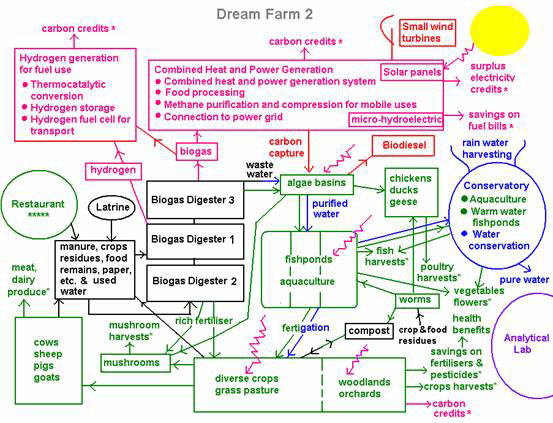
Figure 3. Dream Farm 2
Because this is an organic system in the sense I have described, we don’t have to have all the elements, or all at once. We can have a very simple system consisting of biogas digesters, livestock, crops, algae basins without fishponds, as that essentially does the water purification already and closes the cycle. The algae can be used to feed livestock, as an alternative to grain or soybeans.
The more experimental and innovative technologies, for example, hydrogen production either directly from wastes [32] (Bug Power, SiS 27) or from methane, fuel cells for combined heat and power generation, conversion of methane to hydrogen, and using Green Algae for Carbon Capture [33] etc., can all be added on and perfected while the farm is running and producing, which is very important
Another possibility with woody wastes that don’t break down easily in the biogas digester is to turn them into charcoal by pyrolysis (smouldering) and burying them to encourage crops to grow. Scientists now agree that the exceptionally fertile black earth, found in prehistoric settlements in the Amazon is where indigenous tribes have buried the ashes and charcoal intentionally to help crops grow. The particles of char produced in this way are able to retain nutrients and water that might otherwise be washed down and away from the roots, and they harbour micro-organisms that turn the soil into a spongy, fragrant, dark material [34]. Eprida, a “for-profit social-purpose enterprise” in Athens Georgia in the United States is marketing an improved process to farmers. Its selling point is to increase crop productivity to quite remarkable extents, and sequester a lot of carbon in the soil at the same time. This prehistoric process is still not completely understood scientifically, and there are research opportunities as well as business opportunities. The process is now commercially exploited to produce bio-oil (for fuel use) as well as bio-charl [35].
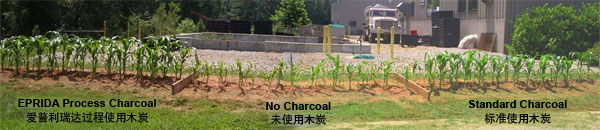
Figure 4. The Eprida process and productivity of crops
One abiding philosophy of Dream Farm 2 is to combine the best of indigenous and western science to serve people in all local communities. We can learn a lot from a project [36] in the northwest of Yunnan Province in Southern China covering 69 000 square kilometres (the size of Ireland) of high mountains, deep gorges, and indigenous forest containing some of the world’s most diverse and threatened plants and animals. The area also contains the upper reaches of important rivers like the Yangtze, Mekong, Salween and Irrawaddy on which the livelihoods of many millions of people further downstream depend.
About 3.2 million live in the region, from 15 distinct ethnic groups. The main threats to the ecology of the region comes from tree cutting mostly for fuel wood, insensitive tourist activities, unmanaged collection and use of plants and animals, and over-grazing of animals on grasslands.
The Chinese branch of the international conservation organisation, The Nature Conservancy, helped set up the China Rural Energy Enterprise Development programme, working with local entrepreneurs to develop businesses making, selling and installing fuel-efficient cooking stoves, fuel briquettes made from crop wastes, and ‘four in one’ biogas digesters, solar water heaters, solar cookers and micro-hydropower plants. They are already doing what we plan to do in Dream Farm 2, but on a household scale.
The ‘four in one’ biogas production incorporates an underground biogas digester, a greenhouse for growing vegetables, a pigpen and a latrine. The open cover for the digester is close to the pigpen and latrine. The greenhouse also covers this area, so it gets heated and this accelerates the fermentation process in the digester. Human excreta falls directly into the digester from the latrine and a shovel is used to put the pig waste into the digester.
The biogas digester is built of concrete, and has a capacity of six to eight cubic metres. This is sufficient to meet most of the cooking and lighting needs of households, except when it is too cold. The cost of the four in one system varies from US$250 to 800, depending on the size of the greenhouse.
ISIS is currently developing an implementation/planning model with the Third World Network and other organisations that can be adapted to a dream farm 2 of any size, anywhere in the world. It will provide projected costs and benefits, not only in financial terms, but especially also in terms of savings in energy and carbon emissions (including carbon sequestered in the soil and in standing biomass). We believe this is the best way forward to a greener, cleaner, healthier and more fulfilling life without fossil fuels [37] (Which Energy?, ISIS 2006 Energy Report).
Article first published 10/07/07
Comments are now closed for this article