
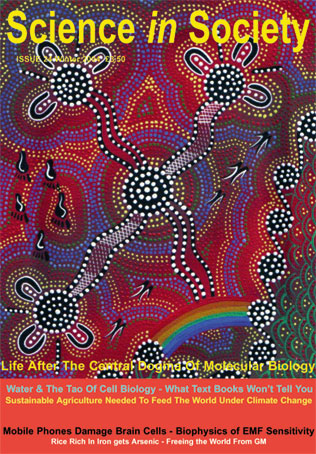
The biotech industry was launched on Francis Crick’s infamous ‘Central Dogma of molecular biology’, the scientific myth that organisms are hardwired in their genes, and hence, by moving genes across species separated by billions of years of evolution, new ‘genetically modified’ organisms could be created to serve our every need.
The Central Dogma has been thoroughly exploded by scientific findings accumulating since the mid-1970s, and especially so after the human and other genomes have been sequenced (see Living with the Fluid Genome, by Mae-Wan Ho).
We bring you the latest surprises that tell you why our health and environmental policies based on genetic engineering and genomics are misguided; and more importantly, why the new genetics demands a thoroughly ecological approach to life.
The Independent Science Panel (ISP) (see SiS 18) took its campaign for a GM-free sustainable world to the European Parliament on 20 October 2004. One hundred and twenty registered for the special briefing including 27 who crossed the channel with the scientists from the UK. The event made a big impression and the participants could not stop congratulating us afterwards. We thank all our sponsors and supporters for making it such a success. Cordis News, the official EU news service for science and technology reported the event the very next day with the title "Politicians, professors and protestors target sustainable non-GM agriculture". Further media coverage was still coming in five days later.
The ISP message is crucial as GM battles are raging across the world. The high point of the briefing was the talk by Sue Edwards, Director of the Institute for Sustainable Development, who helped convinced the Ethiopian government to adopt an organic composting, water and soil conservation package as its main strategy for combating land degradation and poverty throughout the country (see SiS 23). It brought home the proven successes of low-input, health enhancing agricultural practices that should be adopted all over the world.
Sustainable agriculture is particularly important under climate change when oil and water – on which industrial agriculture, and even more so, GM agriculture are heavily dependent - are both running out. Industrial agriculture uses up to seven times the energy per tonne of food than organic agriculture; it also turns organic soil, which is a carbon sink, into a carbon source, and generates other green house gases that exacerbate global warming. In order to feed the world, we must invest in sustainable, non-GM agriculture across the globe right now, which will also ameliorate the worse consequences of climate change.
At the same time, important changes have to be made in international agencies and institutions, which have hitherto supported the dominant model of industrial agriculture as well as policies that work against poor countries, where farmers are also desperately in need of secure land tenure.
More and more biological effects of electromagnetic fields are documented at weaker and weaker field intensities, suggesting that the current exposure standards – which are aimed at preventing outright heating of tissues – may be up to 10 million fold too high, if we are to really protect the public. Researchers are finding long-lasting brain damage in rats exposed to mobile phones, as well as a range of health problems among people living near the mobile phone masts.
Still, the regulators profess themselves powerless to lower the exposure limits because of the lack of plausible mechanisms – within conventional mainstream science - that could explain how fields with such minute energies could have any biological effects. Leukaemia, DNA damage in brain cells and other electromagnetic field effects cannot be explained unless scientists communicate and collaborate across the disciplines, which they are currently unable to do, partly due to the lack of interdisciplinary education, partly due to existing funding structure in research and the general culture of mainstream science that overwhelmingly discriminates against innovative people and ideas (see also SiS 17). Will our government take the radical steps needed in scientific research funding and in science education to improve both the quality of our science and its ability to protect the public?
Entire biochemistry and cell biology textbooks will have to be rewritten to put water at the centre of living activities. It is indeed water inside cells and in the extracellular matrix that’s stage-managing the continuing drama of life. Enjoy and marvel!
Article first published 22/11/04
Comments are now closed for this article